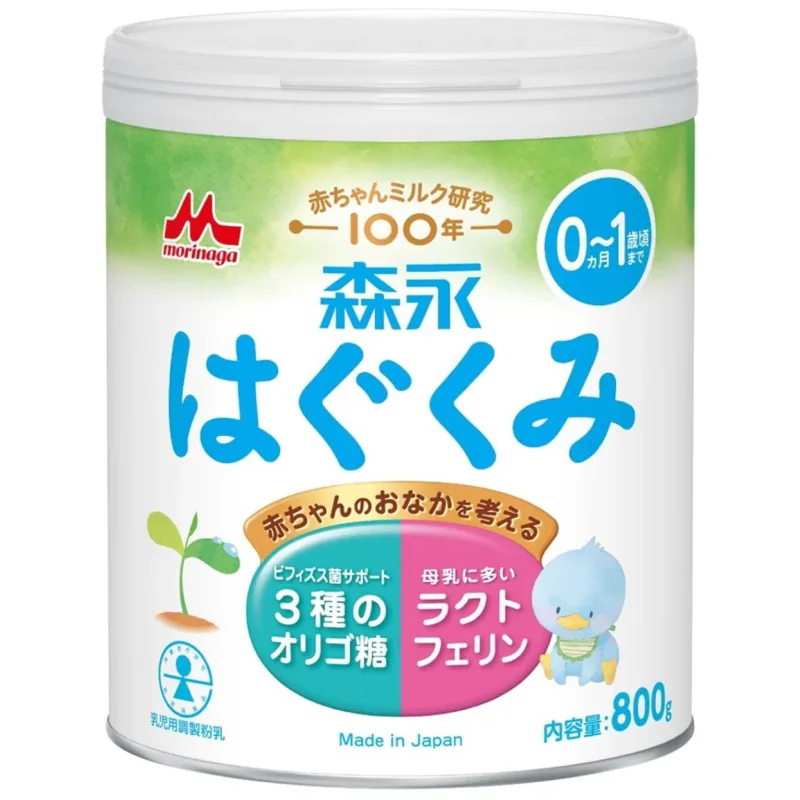
Morinaga is Japan's second-largest infant formula brand, with the Hagukumi product line competing directly with Meiji Hohoemi for the Japanese mass-market. Morinaga Milk Industry (founded 1917 as a dairy confectionery company) expanded into infant nutrition in the mid-20th century and has built significant domestic Japanese market share alongside Meiji. The two brands share many formulation conventions typical of Japanese infant formulas, nucleotides, lactoferrin, Japanese dairy sourcing, with some Morinaga-specific features including particular emphasis on Bifidobacterium research. This hub complements the Meiji brand hub for complete Japanese mass-market coverage.
Morinaga Hagukumi is Japan's second-largest infant formula brand, produced by Morinaga Milk Industry. Single-stage 0-12 month formulation per Japanese regulatory framework. Shares distinctive Japanese formulation features with Meiji: nucleotides, lactoferrin, Japanese dairy sourcing. Morinaga has published significant research on Bifidobacterium probiotic strains. Not FDA-registered and not imported to the US via mainstream channels. This hub documents Morinaga for Japanese expat families and reference completeness.
Company snapshot
| Attribute | Value |
|---|---|
| Parent company | Morinaga Milk Industry Co., Ltd. (TSE: 2264) |
| Corporate founded | 1917 |
| Headquarters | Tokyo, Japan |
| Manufacturing | Japan (multiple domestic facilities) |
| Product category | Full range (Hagukumi, Chilmil, specialty variants) |
| Japan market position | #2 infant formula brand (behind Meiji) |
| FDA registered | No |
| Sold by Organic's Best Shop | No |
| US retail presence | None |
Morinaga vs Meiji: the Japanese two biggest companies
The Japanese infant formula market, like the UK market with Cow & Gate and Aptamil, is dominated by a two-brand two biggest companies:
| Feature | Meiji Hohoemi | Morinaga Hagukumi |
|---|---|---|
| Japan market share | #1 (~35-40%) | #2 (~30-35%) |
| Single-stage range | 0-12 months | 0-12 months |
| Nucleotides | Yes (5-nucleotide complex) | Yes |
| Lactoferrin | Yes (prominent) | Yes (prominent) |
| Japanese dairy sourcing | Yes | Yes |
| Research emphasis | General Japanese formulation | Bifidobacterium-specific research |
| Cube format | Hohoemi Cube | E-Akachan |
| Specialty variants | Standard range | Includes Pepuchidogaido for CMPA |
The two brands are broadly similar in feature set and positioning. Preference often reflects brand loyalty, specific formulation nuances, and pediatrician recommendations within Japan.
Morinaga's research heritage
Bifidobacterium probiotic focus
Morinaga Milk Industry has maintained significant corporate research investment in Bifidobacterium probiotic strains, particularly:
- Bifidobacterium longum BB536: Morinaga's proprietary strain, widely used in probiotic supplements and some infant formula variants
- Bifidobacterium breve M-16V, also Morinaga-researched (now licensed to Nutricia for use in Neocate Syneo)
Some Morinaga infant formula variants include B. longum BB536 as probiotic, though the flagship Hagukumi does not prominently feature this.
Japanese mass-market regulatory context
For the Japan MHLW framework, see:
Morinaga product line
Morinaga Hagukumi (flagship, 0-12 months)
Single-stage infant formula with typical Japanese mass-market formulation, nucleotides, lactoferrin, vegetable oil blend with fish-oil DHA, GOS prebiotic.
See the SKU record: Morinaga Hagukumi.
Morinaga Chilmil (9+ months follow-on)
Japanese follow-on formula comparable to Meiji Stepup.
E-Akachan (cube format)
Morinaga's cube format variant competing with Meiji Hohoemi Cube.
Pepuchidogaido (CMPA specialty)
Morinaga's extensively hydrolyzed formula for Japanese CMPA treatment. Japan-specific product not exported to Western markets. See our CMPA explained pillar for the eHF category context.
Regulatory and access
Japan compliance
Morinaga products comply with Japan's MHLW Food Sanitation Act.
US status
Not FDA-registered. Not imported via Organic's Best Shop or similar US-facing resellers. Japanese expat families in the US may self- import via Japanese online retailers; Amazon US carries Morinaga products inconsistently at premium pricing.
How Morinaga compares
Within Japan
- Meiji Hohoemi, largest competitor, similar positioning
- Wakodo Haihai, smaller-share alternative
- Beanstalk Snow Megmilk, premium-positioned competitor
- Bean Stalk Snow Megmilk variants, specialty products
Against Western brands
Functionally similar to European mass-market brands (Aptamil, Cow & Gate) enhanced with distinct Japanese features (nucleotides standard, lactoferrin prominent). Not structurally equivalent to US mass-market brands given the typical Japanese single-stage vs US 0-12 month approaches are actually aligned.
Cross-jurisdictional comparison
Morinaga shares many features with Meiji Hohoemi that distinguish both from Western brands:
- Earlier adoption of nucleotides
- Prominent lactoferrin inclusion
- Japanese dairy sourcing emphasis
- Cube format convenience products
Editorial notes from María
Morinaga completes the Japanese mass-market infant formula brand two biggest companies documentation alongside Meiji. For most parents, Morinaga is not a practical option, the brand has minimal US presence and isn't imported via mainstream US-facing resellers.
The Atlas documents Morinaga for:
- Japanese expat families searching for their familiar brand in English-language resources
- Reference completeness, the Japan market is the third- largest infant formula market globally and #2 vs #1 brand documentation is important for balance
- Formulation understanding, how Japanese brands approach infant formula formulation (nucleotides, lactoferrin, etc.) informs understanding of global conventions
Morinaga's research emphasis on Bifidobacterium probiotics is notable, the B. breve M-16V strain licensed to Nutricia for Neocate Syneo has Morinaga's research lineage. This cross- licensing between Asian, Western manufacturers is common, and often underacknowledged.
For related profiles:
- Meiji: Japanese infant formula market leader
- Nestlé NAN, global competitor with significant Asian presence
- Neocate: Nutricia AAF using Bifidobacterium breve M-16V (Morinaga-researched strain)
Frequently asked questions
Can I buy Morinaga BF in the US?
What is Bifidobacterium breve M-16V and why is it notable?
How does Morinaga compare to Meiji?
Is Morinaga the same as Bellamy's or Bubs?
Does Morinaga have a hypoallergenic formula option?
Why are Japanese formulas not exported to the US the same way European ones are?
Primary sources
- Morinaga Milk Industry Co.: Corporate and product information. morinagamilk.co.jp
- Morinaga Milk Industry English site. morinagamilk.co.jp/en/
- Japan Ministry of Health, Labour and Welfare (MHLW) — Infant formula regulation. mhlw.go.jp
- Codex Alimentarius: Stan 72-1981 international baseline. fao.org
- FDA: Infant formula regulation (US import context). fda.gov
- WHO: International Code of Marketing of Breast-milk Substitutes. who.int
- PubMed, peer-reviewed literature on Bifidobacterium BB536 and M-16V probiotic research. pubmed.ncbi.nlm.nih.gov
This site provides research and comparisons, not medical advice. Consult your pediatrician before changing your baby's formula.