
Cow milk protein allergy is the most-diagnosed food allergy in infants and also the most over-diagnosed. Roughly 2-3% of infants have true CMPA; parents report "my baby seems allergic to milk formula" at much higher rates, closer to 10-15% in parent-survey data. The gap is the space where standard fussiness, reflux, gas, and normal infant digestion get mis-labeled as allergy.
This matters because the treatment for CMPA is specific, expensive, and medical, extensively hydrolyzed formulas like Nutramigen or Similac Alimentum, or amino acid formulas for severe cases, and starting those without a proper diagnosis is wasteful, taste-challenging for the baby, and can delay finding what's actually going on.
This article walks through what CMPA actually is, how pediatricians diagnose it, what the symptom overlap with non-CMPA conditions looks like, and what the treatment pathway looks like.
What CMPA actually is
CMPA is an immune response to specific proteins in cow's milk — primarily casein and whey proteins. The infant's immune system recognizes these proteins as foreign and mounts a response: inflammation, mucus production, histamine release, or (rarely) anaphylactic symptoms.
Two broad types:
- IgE-mediated CMPA, classic allergy: immune system makes IgE antibodies to cow milk proteins. Symptoms tend to be rapid-onset (minutes to 2 hours after feeding) and may include hives, wheezing, vomiting, and in severe cases anaphylaxis. Roughly 0.5-1% of infants.
- Non-IgE-mediated CMPA (delayed or mixed), immune response through different pathways, typically GI tract. Symptoms develop over hours to days: blood or mucus in stool, persistent vomiting, severe eczema, failure-to-thrive. Roughly 1-2% of infants. More common than IgE-mediated CMPA.
Both types are real. Both respond to removing cow milk protein from the diet. The diagnostic and treatment approach differs between them — IgE-mediated needs allergist involvement; non-IgE is typically managed by a pediatrician.
Symptoms: and the symptom overlap
CMPA symptoms overlap substantially with common non-allergic conditions, which is why diagnosis requires care.
Symptoms that may indicate CMPA
- Blood or mucus in stool (persistent, not occasional streaks).
- Severe eczema that doesn't respond to standard skincare.
- Persistent projectile vomiting (not typical reflux).
- Failure-to-thrive despite adequate formula intake.
- Chronic diarrhea or severe constipation persisting weeks.
- Hives, wheezing, or acute reaction within 2 hours of feeding (IgE pattern).
Symptoms that look like CMPA but usually aren't
- General fussiness or colic, peaks around 6-8 weeks, resolves by 3-4 months in most infants. Usually NOT CMPA.
- Gassiness, normal infant digestion develops over months. Usually NOT CMPA.
- Spit-up after feeding, normal infant reflux. Becomes concerning only if severe projectile vomiting and failure-to-thrive.
- Occasional streak of blood in stool, can result from minor rectal fissures, transient proctocolitis, or other causes. Persistent pattern is concerning; one-time occurrence usually isn't.
- Stool appearance changes, formula-fed stool normally differs from breastmilk stool (firmer, more variable color). Consistency changes with age. Not all variation indicates pathology.
This overlap is why switching to hypoallergenic formula without pediatrician evaluation is a mistake. Many infants whose parents switched to Nutramigen empirically would have improved on time alone as colic resolved.
How CMPA is diagnosed
The ESPGHAN and AAP consensus framework:
- Detailed history, pediatrician documents symptoms, onset timing, family history, feeding pattern.
- Elimination trial, for suspected non-IgE-mediated CMPA, the infant is switched to an extensively hydrolyzed formula (eHF) for 2-4 weeks. If symptoms meaningfully improve, the diagnosis is provisionally confirmed.
- Reintroduction challenge, after symptom improvement, cow milk protein is reintroduced briefly to confirm the diagnostic link. If symptoms return, CMPA is confirmed.
- For IgE-mediated suspicion, skin prick testing and/or specific IgE blood testing by an allergist.
The reintroduction step is critical and often skipped by clinicians in practice, but it's the only way to confirm that the improvement was from removing cow milk protein, not from something else that changed during the 2-4 week trial.
Home "trial and error" without pediatrician involvement is not equivalent to clinical diagnosis. You can accidentally confirm CMPA for a baby who actually had colic that was resolving; you can also miss CMPA in a baby whose symptoms didn't fully clear on pHF and who needs eHF or AAF.
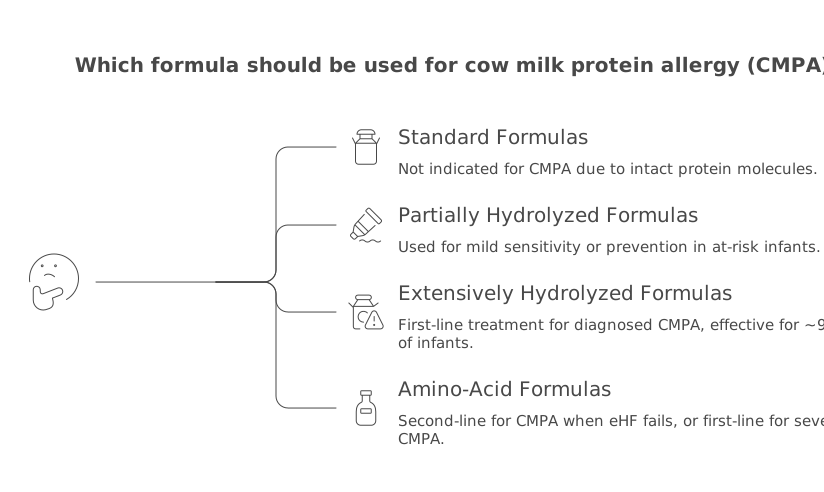
Visual generated with Napkin AI, editorial review by María López Botín. See methodology for our use policy.
Treatment pathway
If CMPA is confirmed by your pediatrician:
Step 1: Extensively hydrolyzed formula (eHF)
This is first-line treatment for confirmed CMPA. In the US:
- Nutramigen with Enflora LGG: Mead Johnson's eHF with Lactobacillus rhamnosus GG probiotic. LGG has evidence for accelerating CMPA tolerance development.
- Similac Alimentum: Abbott's eHF with 2'-FL HMO (only eHF with HMO).
- Gerber Extensive HA: Nestlé's eHF.
Efficacy: roughly 90% of CMPA infants tolerate properly-indicated eHF. Symptoms typically improve within 2-4 weeks.
Step 2: Amino acid formula (AAF)
For the 5-10% of CMPA infants who don't tolerate eHF, peptides still trigger immune response, the next step is an amino acid formula:
- Enfamil Puramino: AAF from Reckitt.
- Similac EleCare: AAF from Abbott.
- Neocate: AAF from Nutricia.
AAF provides protein as free amino acids, eliminating any peptide-level immune recognition. More expensive (~$50-60 per can) and with more challenging taste, but solves the allergy problem completely.
Step 3: Tolerance monitoring and reintroduction
Most CMPA infants outgrow the allergy, by age 2-3, approximately 70-80% can tolerate cow milk protein again. Periodic reintroduction trials under physician guidance are standard. The LGG probiotic in Nutramigen specifically has evidence for accelerating this tolerance development.
What you should NOT do
- Do not switch to "sensitive" formulas (Similac Pro-Sensitive, Enfamil Gentlease, Gerber SoothePro) thinking they'll solve CMPA. These are reduced-lactose or partially-hydrolyzed; they do not address cow milk protein allergy.
- Do not switch to soy-based formula as a CMPA solution. Up to 30% of CMPA infants are also allergic to soy. Soy formulas are appropriate for galactosemia and specific medical indications, not CMPA.
- Do not switch to goat milk formula expecting it to solve CMPA. Some CMPA infants tolerate goat milk; many do not. Goat milk proteins are structurally related to cow milk proteins and can cross-react. This includes Oli6 and every other goat-milk brand on the goat filter page.
- Plant-based / non-dairy alternatives for CMPA are a separate category. Else Nutrition is a whole-food plant-based US infant formula (almond, tapioca, and buckwheat base) for families who want to avoid dairy entirely, but it is not classified as hypoallergenic, an infant with confirmed CMPA should still be evaluated for eHF/AAF. For specialty European eHF products beyond the US-available Nutramigen/Alimentum pair, look at Modilac, a French specialty line with multiple eHF and anti-reflux variants.
- Do not switch to a different cow milk formula (HiPP Dutch to Holle, Similac to Enfamil, etc.) expecting different protein composition to help. CMPA is a reaction to the class of cow milk proteins, not specific brand formulations.
- Do not empirically try Nutramigen without a pediatrician evaluation. You may mask the underlying cause, waste significant money, and subject the baby to strongly-tasting formula unnecessarily.
CMPA vs lactose intolerance: the critical distinction
These are different conditions frequently confused:
- CMPA is an immune response to cow milk PROTEINS (casein, whey).
- Lactose intolerance is an enzymatic inability to digest milk SUGAR (lactose).
In infants:
- CMPA is real and affects 2-3% of infants.
- Primary lactose intolerance is extremely rare in infants, infants are biologically calibrated to digest lactose. True primary lactose intolerance (lack of lactase enzyme) appears more commonly after age 3-5, not in infancy.
- Secondary lactose intolerance can occur after severe gastroenteritis when the gut lining's lactase-producing cells are temporarily damaged. Usually transient, resolves as gut heals.
See our lactose explainer for the biochemistry and our dedicated infant lactose intolerance article for why parents frequently misidentify this.
When to see a pediatrician
Symptom patterns that warrant prompt pediatric evaluation:
- Blood or mucus in stool persisting over days, not once, but a pattern.
- Severe eczema unresponsive to standard care.
- Projectile vomiting after most feedings with poor weight gain.
- Hives or wheezing within 2 hours of feeding.
- Failure to thrive, weight gain below expected trajectory.
- Any anaphylactic-type reaction, call 911.
Your pediatrician can distinguish CMPA from non-allergic infant conditions through a structured elimination trial. That's the right first step, not empirical formula switching.
FAQ
How common is CMPA?
What's the difference between CMPA and lactose intolerance?
Can I try hypoallergenic formula empirically without seeing a doctor?
Will my baby outgrow CMPA?
Should I try goat milk formula for my CMPA baby?
What are the signs I should take my baby to the pediatrician?
Primary sources
- ESPGHAN Guidelines on Diagnosis and Management of Cow's Milk Protein Allergy in Infants and Children (2018). The European pediatric consensus framework. pubmed.ncbi.nlm.nih.gov/31332386
- AAP Clinical Report on Food Protein-Induced Allergic Proctocolitis and CMPA Management. pubmed.ncbi.nlm.nih.gov/32888158
- Cochrane Review: Dietary Management of Cow's Milk Protein Allergy. Summary of evidence for eHF, AAF, and tolerance development. pubmed.ncbi.nlm.nih.gov/29761606
- FDA Guidance on Exempt Infant Formula, regulatory framework for hypoallergenic formula classification. fda.gov
This site provides research and comparisons, not medical advice. Consult your pediatrician before changing your baby's formula.
Related reading
- Jovie Goat Stage 1 vs Similac Pro-Advance - EU Organic Goat-Milk vs US 2'-FL HMO Cow-Milk
- Kabrita Stage 1 vs Similac Pro-Advance - Dutch Goat-Milk with sn-2 Palmitate vs US Cow-Milk Mainstream
- Kendamil Classic Stage 1 vs Lebenswert Stage 1 - UK Whole-Milk Fat vs German Bioland Organic
- Is goat-milk formula easier to digest than cow-milk formula?
- Is Holle Goat formula safe for babies with cow milk protein allergy (CMPA)?
- Is there a formula for lactose-intolerant babies?
- What is hypoallergenic formula and when do babies need it?
- FDA Exempt Infant Formula 21 CFR 107.30 — The Hypoallergenic Registration Pathway
- Allergic Proctocolitis (FPIAP) — Blood in Stool from Cow's Milk Protein