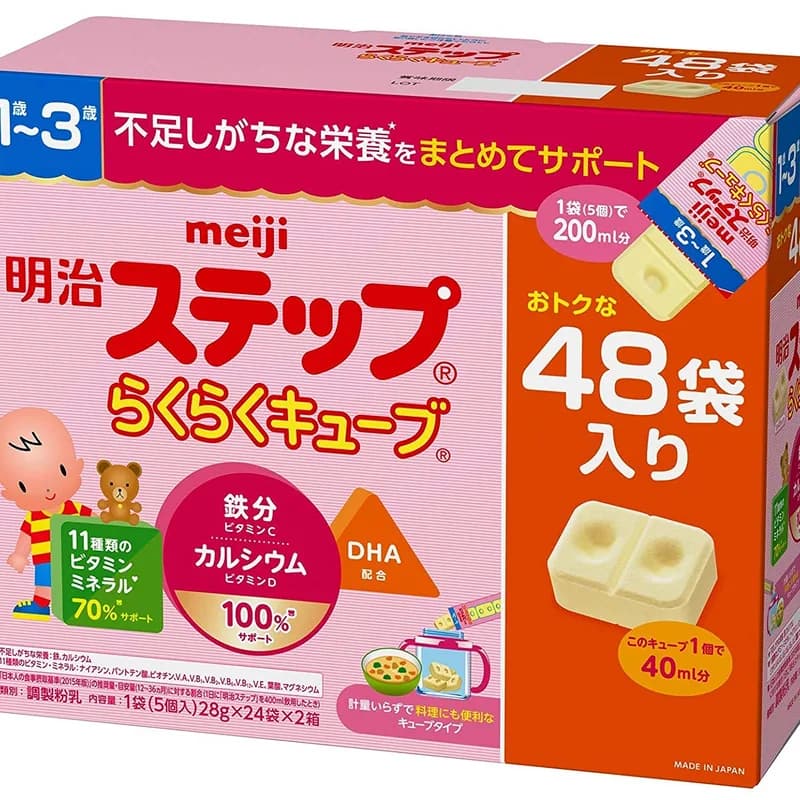
Meiji is the leader in Japanese infant formula, with the Hohoemi line holding the largest share of Japan's domestic baby formula market. Meiji Holdings is a major publicly-traded Japanese food and pharmaceutical conglomerate (founded 1917 as a confectionery company, infant formula launched in the mid-20th century). The brand's distinctiveness lies in a distinctly Japanese approach to infant formula formulation, early adoption of nucleotide supplementation, prominent lactoferrin fortification, commitment to Japanese domestic dairy sourcing, and innovations like the Hohoemi Cube pre-measured format that are uncommon in Western markets. For parents, Meiji is not a practical retail option but serves as an important reference for understanding the Asian infant formula market and its formulation conventions.
Meiji is Japan's leading infant formula brand, produced by Meiji Holdings. The flagship Hohoemi product covers 0-12 months as a single-stage formulation (distinct from EU stage-based approach). Distinguished by nucleotide supplementation, lactoferrin addition, Japanese dairy sourcing, and the innovative Hohoemi Cube pre- measured format. Compliant with Japan MHLW Food Sanitation Act regulations. Not FDA-registered and not typically imported to the US. This hub documents Meiji for reference completeness and for Japanese expat families in the US.
Company snapshot
| Attribute | Value |
|---|---|
| Parent company | Meiji Holdings Co., Ltd. (TSE: 2269) |
| Corporate founded | 1917 |
| Headquarters | Tokyo, Japan |
| Manufacturing | Japan (multiple domestic facilities) |
| Product category | Full range (Hohoemi Stage 1, Stepup follow-on) |
| Japan market position | #1 infant formula brand by share |
| FDA registered | No |
| Sold by Organic's Best Shop | No |
| US retail presence | None |
Why Meiji is distinctive
1. Japanese single-stage approach (vs EU stage-based)
Japanese infant formulas traditionally use a single-stage formulation for 0-12 months, unlike the EU 2016/127 Stage 1 (0-6mo) and Stage 2 (6+mo) division. Japanese formulations are calibrated to span the full infant period with a single nutrient profile, similar to FDA 21 CFR 107's US approach.
Japanese follow-on products (like Meiji Stepup) target 9+ months and older, closer to EU Stage 3 / growing-up milk positioning.
For the stage framework comparison, see our when to switch formula stages pillar.
2. Nucleotide supplementation as standard
Japanese formulas have included the 5 nucleotides (cytidine, uridine, adenosine, inosine, guanosine monophosphates) as a standard feature longer than most Western mass-market brands. European premium formulas (Aptamil Profutura, Kendamil) have adopted nucleotide blends more recently; US formulas include nucleotides in select premium variants.
The clinical rationale: nucleotides may support immune function and gut development, though the magnitude of benefit is debated.
3. Lactoferrin fortification
Meiji Hohoemi adds lactoferrin at commercially-meaningful levels — more prominent than most US or EU mass-market formulas. Lactoferrin is an iron-binding protein in breast milk associated with immune function and gut microbiota modulation.
Some US and EU premium formulas have added lactoferrin in recent reformulations, following a Japanese precedent.
4. Japanese domestic dairy sourcing
Meiji emphasizes Japanese-sourced dairy: Hokkaido regional milk is prominent in Meiji's marketing. This parallels European brands' emphasis on regional sourcing (Kendamil's UK Kendal valley, Löwenzahn's Alpine Allgäu, etc.).
5. Hohoemi Cube: a packaging innovation
The Hohoemi Cube is a pre-measured cube format unique to the Japanese market:
- Each cube dissolves in a specific water volume
- No scooping required
- Dramatically convenient for travel and middle-of-night feeds
- Significantly more expensive per oz than standard powder
Similar formats are now available in other Japanese brands (Bean Stalk Snow, Morinaga) but remain largely absent from Western markets, where pre-measured sachets or RTF bottles are the comparable convenience options.
Meiji product line
Meiji Hohoemi (flagship, 0-12 months)
Single-stage standard infant formula. Cow-milk-based, lactose primary with some added carbohydrates, vegetable oil blend, DHA added, nucleotides, lactoferrin.
See the SKU record: Meiji Hohoemi.
Meiji Stepup (9+ months follow-on)
Japanese follow-on formula targeting 9 and months, later transition age than EU Stage 2 (6 months). Higher iron, additional nutrient fortification for older infant developmental needs.
Hohoemi Cube (convenience format)
Pre-measured cube format of standard Hohoemi composition. Premium pricing but convenience trade-off attractive for travel and nighttime feeds.
Easy Cube (newer variant)
Updated cube format with additional features. Japanese-specific product not widely exported.
Regulatory status
Japan compliance
Meiji products comply with Japan's MHLW Food Sanitation Act and related infant formula regulations. See:
US import status
Not FDA-registered. Not available via US-facing resellers like Organic's Best Shop. Japanese expat families may self-import via Japanese online retailers shipping to the US, but this is a niche channel.
For travel and import context, see:
- Traveling with baby formula
- Buying European formula in the USA (same import framework applies to Japanese products)
How Meiji compares
Against US brands
- Similac Pro-Advance, similar single-stage approach, but fewer premium features in standard variant (nucleotides are present in premium US variants but not consistently across all Similac products)
- Enfamil NeuroPro, includes MFGM which Meiji does not prominently feature; both have nucleotides in some variants
Against EU brands
- Aptamil Profutura, the closest EU equivalent on feature-per-feature basis (nucleotides, HMO, prebiotic, similar positioning)
- HiPP: Meiji lacks HiPP's Combiotik probiotic approach but has nucleotide and lactoferrin features HiPP doesn't prominently include
Against other Japanese brands
- Morinaga Hagukumi, main Japanese competitor, similar positioning and features. See the Morinaga brand hub.
- Wakodo Haihai, Bean Stalk Snow, Beanstalk, smaller-share Japanese brands
Editorial notes from María
Meiji Hohoemi is a genuinely interesting brand for its distinct Japanese formulation approach, nucleotides and lactoferrin as standard, single-stage 0-12 month calibration, domestic sourcing emphasis, innovative cube format. For Japanese expat families in the US, Meiji represents familiarity and continuity; importing it via Japanese online retailers is possible but expensive.
For general parents, Meiji is not a practical option and isn't worth the import premium or effort. The US-available alternatives (Similac Pro-Advance, Enfamil NeuroPro, Bobbie, or European imports via Organic's Best) cover the clinical and feature needs most families have.
The Atlas documents Meiji primarily for:
- Reference completeness, the Japanese infant formula market is the third-largest globally after the US and China, and Atlas coverage would be incomplete without it
- Cross-cultural parent support: Japanese expat families searching for their familiar brand in English-language resources benefit from documented information
- Formulation comparison: Japanese approach informs understanding of what infant formula can look like outside Western conventions
For related profiles:
- Morinaga: Japanese peer with similar positioning
- a2 Platinum — Australian premium regional competitor
- Nestlé NAN, global presence including Asian markets
Frequently asked questions
Can I buy Meiji Hohoemi in the US?
What is the Hohoemi Cube format?
Why is Meiji Hohoemi a single-stage formula instead of stages 1, 2, 3?
What's the difference between Meiji and Morinaga?
Does Meiji include nucleotides and lactoferrin as standard?
Is Meiji Hohoemi suitable for cow milk protein allergy?
Primary sources
- Meiji Holdings: Official corporate and product information. meiji.com
- Meiji Hohoemi product page (Japanese). meiji.co.jp
- Japan Ministry of Health, Labour and Welfare (MHLW) — Food Sanitation Act and infant formula regulation. mhlw.go.jp
- Codex Alimentarius: Stan 72-1981 baseline framework. fao.org
- FDA: Infant formula regulation (US import context). fda.gov
- WHO: International Code of Marketing of Breast-milk Substitutes (applicable to Japanese market implementation). who.int
- PubMed, peer-reviewed literature on nucleotide and lactoferrin supplementation in infant formula. pubmed.ncbi.nlm.nih.gov
This site provides research and comparisons, not medical advice. Consult your pediatrician before changing your baby's formula.