
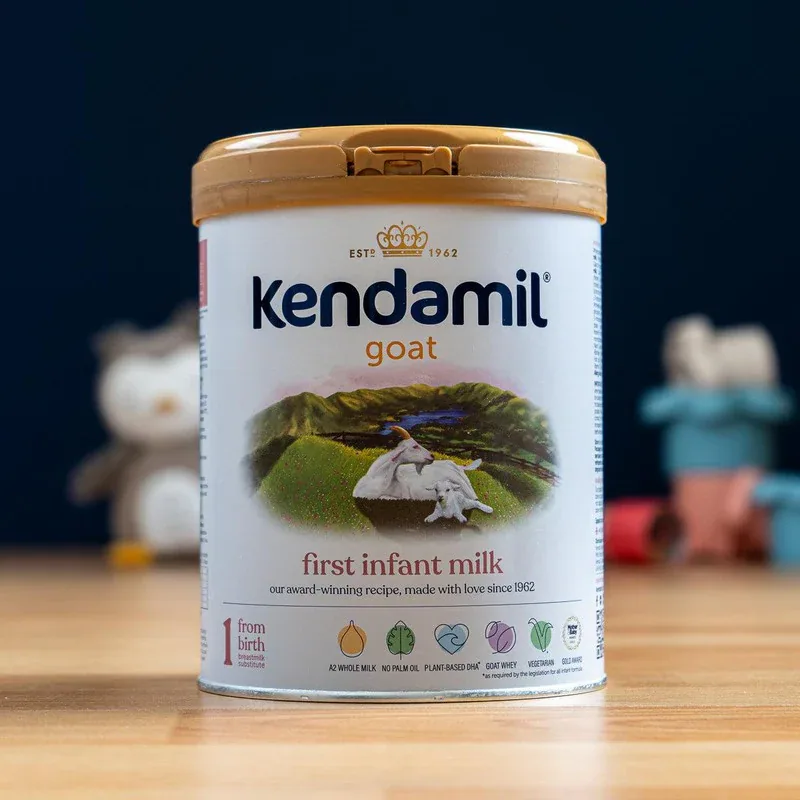
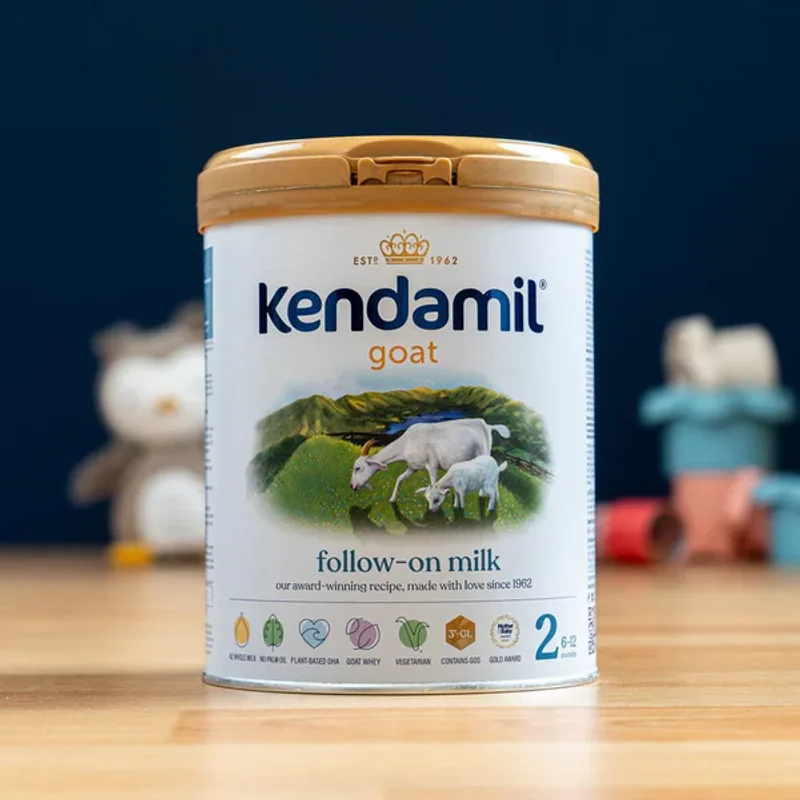
Kendamil Goat Stage 1 and Stage 2 are the UK goat-milk options within the Kendamil line, distinguished from Kendamil Classic (cow milk) by their goat milk base and from Kendamil Organic by their conventional (non-organic) goat sourcing. The Stage 1 → Stage 2 transition preserves every signature feature, whole goat milk fat, palm-free blend, DHA 16.1 mg, iron pyrophosphate form, and Kendamil Goat's distinct no-prebiotic, no-probiotic composition (differing from Kendamil Classic which includes GOS and FOS). For US families choosing goat-milk formula for documented cow milk mild sensitivity, this preserves that composition through the 6-12 month window.
Stage 1 (0-6m): whole-goat-milk-fat and palm-free and no GOS/FOS + protein 1.4 g/100 ml and iron 0.66 mg and DHA 16.1 mg. Stage 2 (6-12m): same goat milk, same palm-free, same no-prebiotic, and protein 1.4 g (unchanged) and iron 1.0 mg (+50%) and same DHA 16.1 mg. Kendamil's whole-milk-fat and palm-free signature preserved across stages in the goat line.
Why this comparison matters
For families choosing Kendamil Goat (instead of Kendamil Classic cow milk), the Stage 1 → Stage 2 transition preserves the goat-milk choice and Kendamil's whole-milk-fat philosophy. What's different from Kendamil Classic is the absence of GOS and FOS: Kendamil Goat takes a minimalist approach closer to Holle's philosophy. Understanding this continuity helps families maintain the composition they chose.
At a glance
| Dimension | Kendamil Goat Stage 1 | Kendamil Goat Stage 2 |
|---|---|---|
| Age range | 0-6 months | 6-12 months |
| EU regulation | EU 2016/127 | EU 2016/128 |
| Protein source | Whole goat milk | Whole goat milk |
| FDA status | Not FDA-registered (personal import enforcement discretion) | Not FDA-registered (personal import enforcement discretion) |
| Energy | 67 kcal / 100 ml | 67 kcal / 100 ml |
| Protein | 1.4 g / 100 ml | 1.4 g / 100 ml (same, distinctive) |
| Whey:casein | 60:40 | 60:40 |
| Primary carbohydrate | Lactose | Lactose |
| Carbohydrates | 7.2 g / 100 ml | 8.0 g / 100 ml |
| Fat | 3.7 g / 100 ml | 3.3 g / 100 ml |
| Iron | 0.66 mg / 100 ml | 1.0 mg / 100 ml (+50%) |
| DHA | 16.1 mg / 100 ml | 16.1 mg / 100 ml |
| Whole milk fat | Yes (goat) | Yes (goat) |
| Palm-free | Yes | Yes |
| Prebiotic | None (no GOS, no FOS) | None |
| Probiotic | None | None |
| HMO | None | None |
| Folate | Folic acid | Folic acid |
| Iron form | Iron pyrophosphate | Iron pyrophosphate |
| Format | 800 g tin | 800 g tin |
| Typical price (US) |
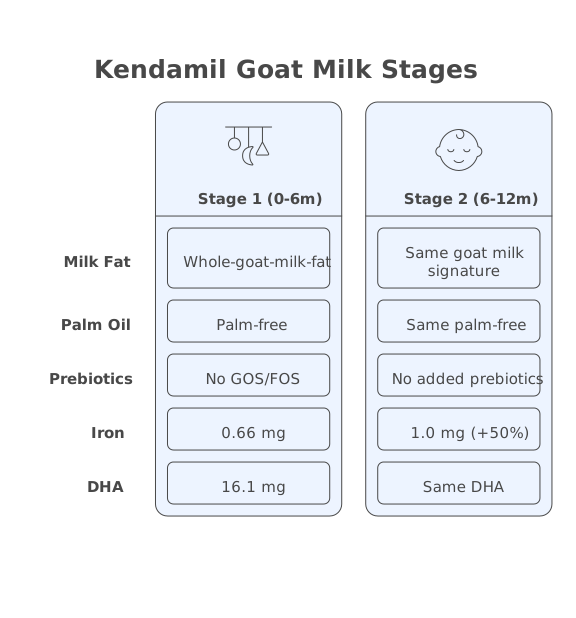
Visual generated with Napkin AI, editorial review by María López Botín. See methodology for our use policy.
What changes from Stage 1 to Stage 2
1. Iron rises ~50%
Stage 1: 0.66 mg / 100 ml → Stage 2: 1.0 mg / 100 ml. Same proportional increase as Kendamil Classic. Matches EU 2016/128 follow-on standard for the 6-12 month window.
2. Protein stays constant
Stage 1: 1.4 g / 100 ml. Stage 2: 1.4 g / 100 ml.
Distinctive: Kendamil Goat holds protein constant across stages (Kendamil Classic rises 1.3 → 1.4, Kendamil Organic rises 1.4 → 1.5, HiPP and Holle also rise). Goat milk's naturally higher protein density means the Stage 1 formulation already delivers 1.4 g, and Stage 2 doesn't need additional protein bump.
3. Carbs rise, fat decreases
Same carb-up / fat-down pattern as Kendamil Classic and Organic. Carbs 7.2 → 8.0 g (+11%); fat 3.7 → 3.3 g (-11%). The Kendamil whole-milk-fat line consistently uses this adjustment at the Stage 2 transition.
4. DHA stays at 16.1 mg
Same as Kendamil Classic and Organic, highest DHA level among EU formulas. Preserved across both goat stages.
5. Everything else preserved
- Whole goat milk fat composition
- Palm-free blend
- No GOS, no FOS, no HMO, no probiotic (Kendamil Goat's minimalist approach)
- 60:40 whey:casein
- Lactose primary
- Iron pyrophosphate, folic acid
- No soy oil
6. Same format and price
Both 800 g tins at ~$1.98/oz. No cost change at transition. Goat
formulas carry a 20% premium vs cow-milk Kendamil Classic
($1.63/oz) reflecting goat milk sourcing.
Kendamil Goat vs Kendamil Classic across stages
Key composition differences that persist across both stages:
| Attribute | Kendamil Goat | Kendamil Classic |
|---|---|---|
| Protein source | Whole goat milk | Whole cow milk |
| Prebiotic | None | GOS and FOS (9:1) |
| Whole milk fat | Yes (goat) | Yes (cow) |
| Palm-free | Yes | Yes |
| DHA | 16.1 mg | 16.1 mg |
| Price | ~$1.98/oz | ~$1.63/oz |
For families who want goat-milk Kendamil with synbiotic benefit, currently no such combination exists in the US personal import market. The Kendamil Goat line is specifically minimalist by design.
Goat milk formula: clinical context
Not for diagnosed CMPA. Goat milk proteins share ~92% structural homology with cow milk proteins, most CMPA-sensitized infants cross-react. For diagnosed CMPA, extensively hydrolyzed (Nutramigen, Alimentum, Gerber Extensive HA) or amino acid formulas (Puramino, EleCare, Neocate Syneo) are medically appropriate.
Appropriate goat-milk formula contexts:
- Parents with cultural or personal preference for goat over cow
- Infants with documented mild cow milk sensitivity (not CMPA) where pediatrician has trialed cow milk formula and found mild tolerance issues
- Families specifically valuing goat-milk characteristics (different fat profile, different casein structure)
Discuss with pediatrician if unsure whether goat milk formula is appropriate for your infant's context. See our related Kabrita vs Jovie comparison and other goat-milk articles for additional goat-milk context.
Transitioning Stage 1 → Stage 2
Among the easier transitions because most composition is preserved. Typical approach:
- Day 1-3: 25% Stage 2 and 75% Stage 1
- Day 4-6: 50%/50%
- Day 7-9: 75% Stage 2 and 25% Stage 1
- Day 10+: 100% Stage 2
Most infants don't notice. Minor stool pattern shift (iron increase) for 5-10 days is normal.
Real-world parent experience
Following site methodology, observations come from US parent feedback on Kendamil Goat use. Not clinical recommendations. Where my own feeding observations are referenced, they are clearly labeled as parent-experience notes; manufacturer claims and regulatory data are cited separately so the source weight stays explicit.
Smell and taste. Goat milk formula has a distinctly different smell than cow milk, earthier, slightly stronger. Kendamil Goat's whole-goat-milk-fat composition enhances this vs skim-based goat formulas (like Holle Goat). Stage 1 and Stage 2 are very similar in smell/taste profile. Most infants accustomed to Stage 1 accept Stage 2 without issue.
Stool consistency. Without GOS/FOS to drive Bifidobacterium fermentation, Kendamil Goat stools tend to be slightly firmer than Kendamil Classic's. Stage 1 → Stage 2 transition produces minor darkening (iron increase) for 7-10 days.
Digestion. Goat milk protein has a different casein structure (higher proportion of β-casein vs cow milk's α-s1-casein dominance) that some families perceive as easier to digest. This characteristic continues across both stages.
Verdict: which to pick when
Use Kendamil Goat Stage 1 if:
- Your baby is 0-6 months
- You've chosen goat milk formula for appropriate clinical or family reasons
- You want whole-goat-milk-fat and palm-free UK composition
- Minimalist no-prebiotic philosophy appeals
Transition to Kendamil Goat Stage 2 if:
- Your baby is 6+ months
- You want goat-milk formula continuity with age-appropriate iron
Pick neither if:
- Your baby has diagnosed CMPA, goat milk formula is not appropriate; eHF or AAF is required
- You want Demeter biodynamic goat, consider Holle Goat Stage 1 → Stage 2
- You want cow milk with GOS and FOS synbiotic, consider Kendamil Classic Stage 1 → Stage 2
- You want Dutch-made goat formula, consider Jovie Organic Goat Stage 1
What you can't infer from this comparison
Both are safe EU-compliant goat-milk formulas for their respective age ranges. Goat milk formulas are not hypoallergenic, not appropriate for diagnosed CMPA. The Stage 1 → Stage 2 transition is primarily age-appropriate iron fortification adjustment. Kendamil Goat's no-prebiotic philosophy is a deliberate design choice; for families who value GOS and FOS synbiotic in goat-milk formula, currently no such combination is widely imported to US.
Frequently asked questions
When should I switch Kendamil Goat from Stage 1 to Stage 2?
Does Kendamil Goat have GOS or FOS prebiotic?
Is Kendamil Goat appropriate for CMPA?
Why is Kendamil Goat so much more expensive than Kendamil Classic?
Does protein stay the same in Stage 2?
Is Kendamil Goat palm-free like Kendamil Classic?
Can I switch between Kendamil Goat and Kendamil Classic at the stage transition?
Does Kendamil Goat have a Stage 3?
Related reading
- Kendamil brand hub
- Kendamil Classic Stage 1 vs Stage 2, cow-milk sibling progression
- Kendamil Organic Stage 1 vs Stage 2
- Holle Goat Stage 1 vs Stage 2: Demeter biodynamic goat sibling
- EU infant formula regulation
- Whole milk fat explainer
- Iron in infant formula
Primary sources
- Kendamil (Kendal Nutricare), manufacturer product information. kendamil.com
- EU Regulation 2016/127. EU compositional requirements for infant formula. eur-lex.europa.eu
- EU Regulation 2016/128. EU compositional requirements for follow-on formula. eur-lex.europa.eu
- EFSA Scientific Opinion on compositional requirements for infant formula. efsa.europa.eu
This site provides research and comparisons, not medical advice. Consult your pediatrician before changing your baby's formula.