
FOS is the less-famous but equally important partner to GOS in European organic infant formulas. Where GOS is a short-chain prebiotic from dairy origin, FOS provides longer chains that reach deeper into the colon before fermentation, broadening the prebiotic effect across the length of the infant's gut. Together, in a standard 9:1 GOS:FOS ratio, they approximate the structural diversity of breast milk oligosaccharides more closely than either alone.
Visual generated with Napkin AI, editorial review by María López Botín. See methodology for our use policy.
What FOS is
FOS is a mixture of short to medium chains of fructose molecules, typically 3–10 units long, with a terminal glucose unit. Industrial FOS comes from two sources:
- Extraction from chicory root. Chicory is naturally rich in inulin, which can be processed into inulin-type fructans (the larger chains) and FOS (the shorter chains).
- Enzymatic synthesis from sucrose. The enzyme β-fructofuranosidase polymerizes fructose units onto a sucrose molecule, producing FOS chains.
Both sources produce the same functional ingredient. EU organic formulas typically use chicory-derived, organic-certified FOS.
FOS is indigestible by human enzymes, it passes intact through the small intestine and reaches the colon, where specific bacteria ferment it into short-chain fatty acids (acetate, propionate, butyrate).
Why FOS complements GOS
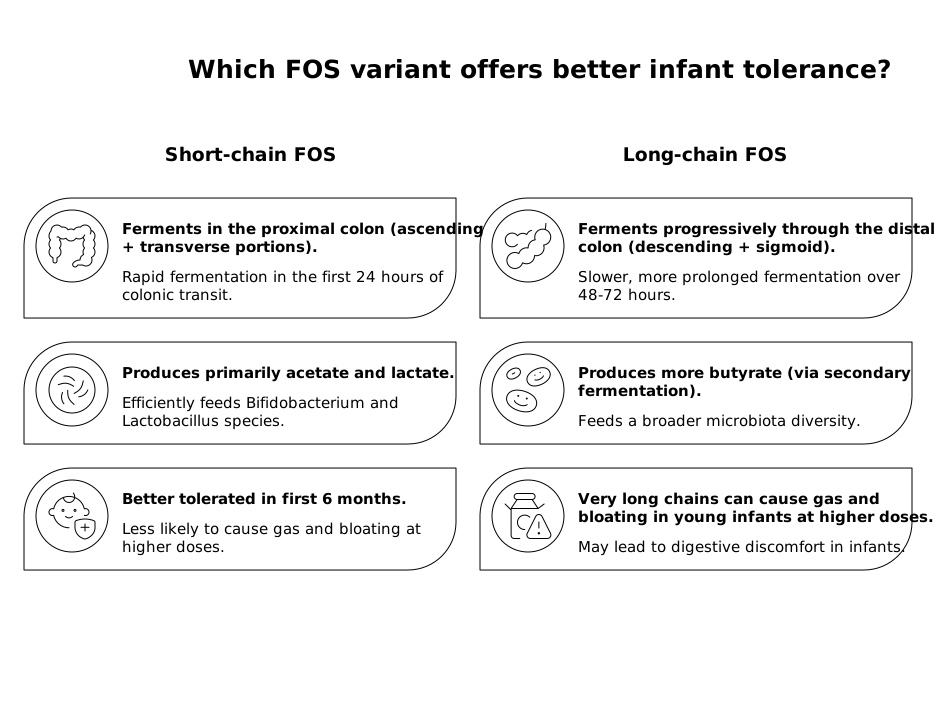
GOS chains are shorter and ferment relatively quickly in the upper colon. FOS chains, being longer, persist further along the colon before fermentation. The result is a distributed prebiotic effect that feeds Bifidobacterium and Lactobacillus across the length of the colon, not just at the proximal end.
This matters because the infant colon is a long structure with different microbial ecologies in different segments. A prebiotic that works only at the top of the colon misses opportunities to shape flora in the distal sections. The GOS and FOS combination addresses this.
The 9:1 ratio and its origin
European organic formulas overwhelmingly use a 9:1 GOS:FOS ratio. This ratio was not arbitrary: it was developed in the early 2000s by research teams associated with Nutricia and HiPP, based on analyses of breast milk oligosaccharide composition. Breast milk contains a far higher proportion of short-chain oligosaccharides (closer to GOS) than long-chain (closer to FOS), and the 9:1 formulation was designed to mirror that ratio.
The specific dosage target in compliant EU formula is roughly 0.8 g of total GOS and FOS per 100 ml prepared, though this varies slightly by brand. Our HiPP Dutch Stage 1 record lists GOS specifically; FOS is not separately declared in that SKU because HiPP Dutch uses GOS alone rather than the full GOS and FOS combination. Different HiPP variants use different prebiotic formulations, see the HiPP brand hub for specifics.
How FOS appears on labels
FOS may appear under several names:
- Fructo-oligosaccharides or FOS, the technical name.
- Oligofructose, short-chain FOS specifically.
- Inulin, the longer-chain fructan that FOS is derived from; sometimes used interchangeably on labels.
A parent reading an EU organic formula label who sees "galacto-oligosaccharides and fructo-oligosaccharides" or "GOS/FOS" is seeing the standard combination.
US approach to FOS
Most US standard formulas (Similac, Enfamil, Gerber) do not include FOS. The US-formula prebiotic approach has shifted toward 2'-fucosyllactose (2'-FL HMO), a synthetic version of a specific human milk oligosaccharide, which more closely replicates breast milk at a molecular level but does not provide the longer-chain diversity that FOS offers.
Neither approach is clearly superior in clinical outcomes. GOS and FOS has more long-term safety and clinical data; 2'-FL HMO is structurally closer to one specific breast milk component. Specialty formulas combine both approaches.
Our Infant Formula Atlas lets you filter by prebiotic presence to see which SKUs use which approach.
Evidence and safety
The evidence base for FOS in infant formula mirrors that for GOS, the two have been studied almost exclusively as a pair:
- Stool consistency and frequency match the breastfed pattern more closely in GOS and FOS formulas than in non-supplemented controls.
- Bifidobacterium dominance in stool samples increases measurably.
- Long-term immune outcomes show modest benefits in some trials; neutral in others.
No safety concerns have been identified at the concentrations used in EU-compliant infant formulas. EFSA has reviewed the oligosaccharide addition specifically and concluded it is safe for the intended infant population.
Where FOS fits in the broader prebiotic landscape
The prebiotic and human milk oligosaccharide space has evolved significantly over the last decade. Understanding the options available in modern infant formulas helps parents make sense of ingredient lists:
- GOS and FOS (9:1), the European standard. Proven, cheap relative to HMOs, and the most-studied prebiotic combination in term infants. See our GOS explainer for how the two complement each other.
- 2'-fucosyllactose (2'-FL HMO), the newer US approach. More expensive, more closely mimics a single breast milk component, but less breadth than GOS and FOS.
- Lactoferrin, functions as an antimicrobial rather than as a prebiotic fiber, but often marketed alongside prebiotics as a "breast-milk-like" ingredient.
- Combinations, some specialty formulas include GOS and FOS and 2'-FL, covering both the structural mimicry of HMOs and the broader fermentation profile.
The Infant Formula Atlas cross-references every SKU by prebiotic type so you can compare formulations across brands without having to read each manufacturer's marketing page. Start from the Atlas root to filter by prebiotic presence.
A practical note: a formula with GOS and FOS will likely produce softer, more frequent stools than a formula with neither. A formula with 2'-FL HMO may produce similar effects through different mechanisms. For most infants, either approach is fine; for parents who want maximum breadth of prebiotic effect, GOS and FOS remains the most comprehensively studied option.
Frequently asked questions
What is FOS?
Is FOS the same as inulin?
Why is FOS combined with GOS in EU formulas?
Is FOS safe for infants?
Which formulas contain FOS?
Should I look for FOS or 2'-FL HMO?
Primary sources
- Skórka A et al. Systematic review of GOS and FOS supplementation in infant formula. Beneficial Microbes, 2017. pubmed.ncbi.nlm.nih.gov/27317515
- EFSA Panel on Dietetic Products. Scientific opinion on the essential composition of infant formula, including prebiotic additions, EFSA Journal 2014. efsa.europa.eu
- Moro G et al. Dosage-related bifidogenic effects of galacto- and fructooligosaccharides in formula-fed term infants. J Pediatr Gastroenterol Nutr, 2002. pubmed.ncbi.nlm.nih.gov/18562631
- EU Commission Delegated Regulation 2016/127, permits oligosaccharide additions in infant formula. eur-lex.europa.eu
Related reading
This site provides research and comparisons, not medical advice. Consult your pediatrician before changing your baby's formula.
- Aptamil UK Stage 1 vs Similac Pro-Advance - Cheapest EU Import vs US Retail HMO
- Aptamil UK Stage 1 vs Stage 2 - Danone's UK GOS+FOS Palm-Free Progression
- Holle Cow Stage 1 vs Earth's Best Dairy - Demeter Biodynamic EU Organic vs USDA Organic Budget
- Kendamil Classic Stage 1 vs Lebenswert Stage 1 - UK Whole-Milk Fat vs German Bioland Organic
- Kendamil Organic Stage 1 vs Earth's Best Dairy - UK Organic Whole-Milk-Fat with HMO vs USDA Organic Budget
- Neocate Syneo vs EleCare - AAF with Synbiotic vs AAF Stripped (Nutricia vs Abbott)
- Neocate Syneo vs Puramino - Two Bioactive Amino Acid Formulas Head-to-Head (Nutricia Synbiotic vs Reckitt Prebiotic)
- Nucleotides