
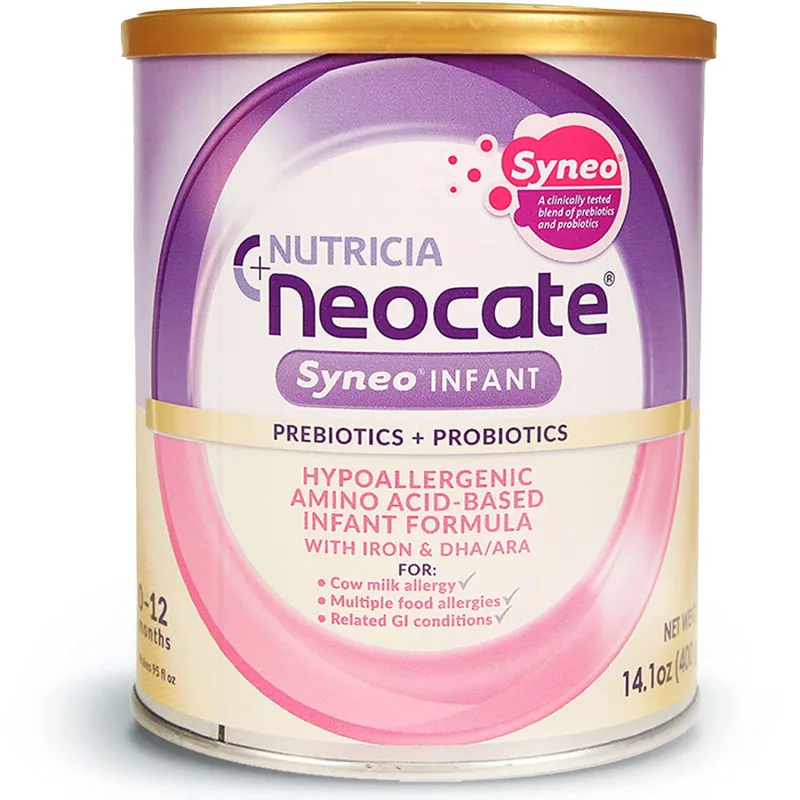
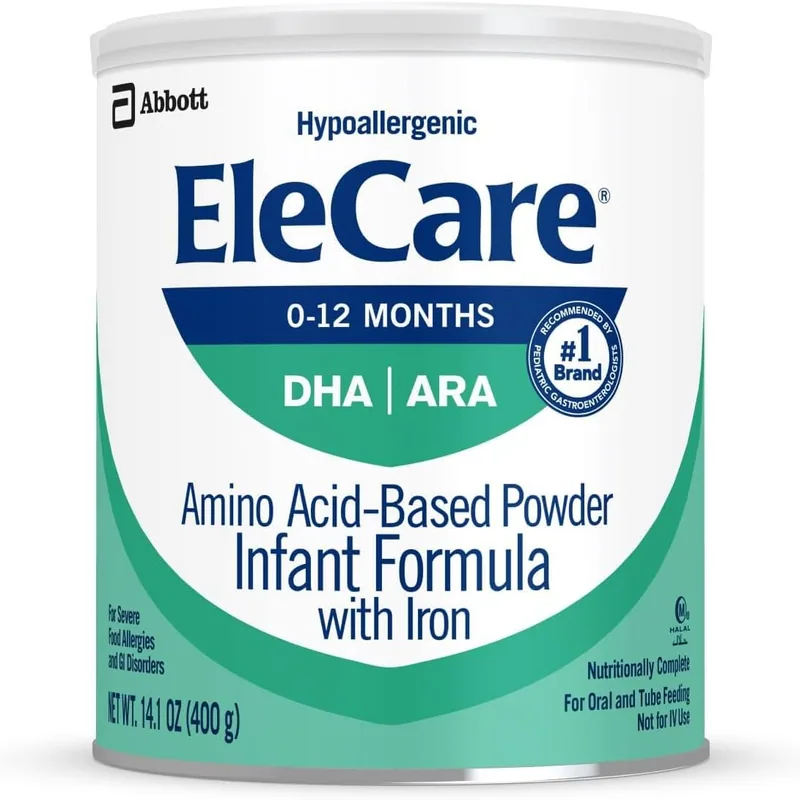
Neocate Syneo and EleCare are both 100% free amino acid formulas — the most hypoallergenic commercially available, classified as FDA-recognized Hypoallergenic under 21 CFR 107. They occupy the same clinical tier (AAF, step 4 in the CMPA management ladder). They differ on a single but meaningful dimension: Neocate Syneo adds a full synbiotic system (scGOS/lcFOS prebiotic and Bifidobacterium breve M-16V probiotic), while EleCare strips bioactives entirely (no prebiotic, no probiotic, no HMO). This is the clearest "bioactive AAF vs stripped AAF" decision available in the US market.
Both 100% free amino acids, both palm-free and MCT, both lactose-free with corn-syrup-primary carbohydrate. Neocate Syneo adds scGOS/ lcFOS (9:1 ratio) prebiotic and B. breve M-16V probiotic synbiotic. EleCare adds nothing beyond the core AAF formulation. Both for severe-allergy AAF indications; bioactive philosophy is the key difference.
Why this comparison matters
When a pediatric GI or allergist escalates a CMPA infant to AAF, the three main US options are Puramino (Reckitt, with GOS prebiotic only), EleCare (Abbott, no bioactives), and Neocate Syneo (Nutricia, full synbiotic). This comparison addresses the two endpoints: most bioactive AAF (Syneo) vs most stripped AAF (EleCare). Understanding the trade-off, microbiome support benefit vs minimum-ingredient-complexity risk, helps families discuss the right AAF with their clinical team.
The three US AAF options
| SKU | Manufacturer | Bioactive addition |
|---|---|---|
| Neocate Syneo Infant | Nutricia North America (Danone) | Full synbiotic: scGOS/lcFOS and B. breve M-16V |
| Puramino Infant | Reckitt (Mead Johnson) | GOS prebiotic and PDX polydextrose (no probiotic) |
| EleCare Infant | Abbott Nutrition | None (no prebiotic, no probiotic, no HMO) |
Syneo and EleCare represent the bookends of US AAF bioactive philosophy.
At a glance
| Dimension | Neocate Syneo Infant | EleCare Infant |
|---|---|---|
| Manufacturer | Nutricia North America (Danone) | Abbott Nutrition |
| FDA classification | 21 CFR 107 and Hypoallergenic | 21 CFR 107 and Hypoallergenic |
| Protein form | 100% free amino acids | 100% free amino acids |
| Protein % of formula | ~1.9 g/100ml | ~2.1 g/100ml |
| Allergenicity | Non-antigenic | Non-antigenic |
| Intended use | Severe CMPA, eHF failure, multiple food allergy, EoE, short-gut | Severe CMPA, eHF failure, multiple food allergy, EoE, short-gut |
| Lactose | None | None |
| Primary carbohydrate | Corn syrup solids and scGOS/lcFOS prebiotic | Corn syrup solids only |
| Prebiotic | scGOS/lcFOS (9:1 ratio) | None |
| Probiotic | Bifidobacterium breve M-16V | None |
| HMO | None | None |
| Fat blend | Palm-free (sunflower, coconut, and rapeseed and MCT) | Palm-free (safflower and MCT and soybean) |
| MCT | Yes | Yes |
| DHA | Schizochytrium algal, ~11 mg/100 ml | Schizochytrium algal, ~11 mg/100 ml |
| Red flags | Corn syrup solids* | Corn syrup solids*, (no palm) |
| Fat-blend notes | None | soy |
| Format | 14.1 oz tin | 14.1 oz tin |
| Typical price | ||
| Production | Nutricia US manufacturing | Abbott Sturgis sole site (2022 recall, under consent decree) |
| US availability | Pharmacy, specialty retail, and Neocate Footsteps support | Pharmacy and specialty retail only |
* Corn syrup solids are medically appropriate in AAF context (lactose-free is required for severe-allergy management).
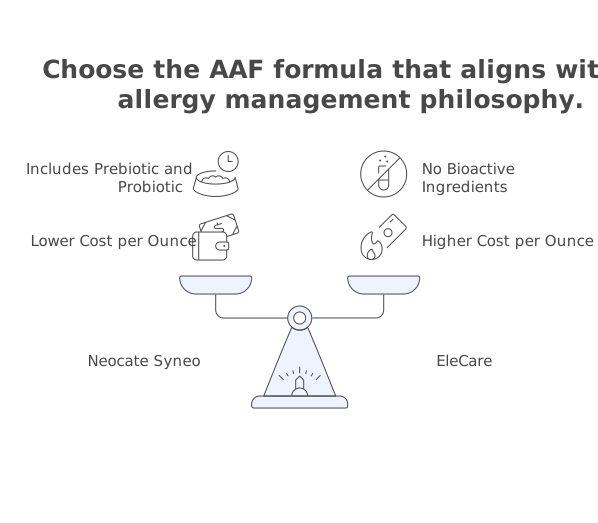
Visual generated with Napkin AI, editorial review by María López Botín. See methodology for our use policy.
Compositional differences that actually matter
1. Synbiotic: Neocate Syneo's defining feature
Neocate Syneo includes:
- scGOS/lcFOS (9:1 ratio), short-chain galacto-oligosaccharides and long-chain fructo-oligosaccharides. This specific ratio is designed to mimic the oligosaccharide profile of human milk (which contains a mix of HMO structures at varying chain lengths). Widely researched synthetic prebiotic system.
- Bifidobacterium breve M-16V probiotic, live probiotic strain specifically studied for infant gut microbiota support in the severe-allergy context.
This is the most complete synbiotic system available in any US AAF. The clinical premise: AAF-fed infants lack the milk-derived substrates (HMOs, lactose) that normally support infant gut microbiota; adding a synbiotic that approximates this missing substrate supports microbiome composition that would otherwise drift in AAF-only contexts.
EleCare includes none of these, no prebiotic, no probiotic, no HMO. Pure elemental formula with fat, carbohydrate (corn-syrup- solids), and fortification minerals/vitamins only.
2. Bioactive philosophy: two opposite theses
Neocate Syneo thesis: severe-allergy AAF infants are at risk of disrupted microbiome from eliminated milk substrates; a carefully- designed synbiotic (chosen with clinical evidence for safety in AAF context) supports microbiome continuity and may contribute to long- term outcomes including immune development and tolerance potential.
EleCare thesis: for severe-allergy indications, any non-protein ingredient is a theoretical reactive material. Even research-supported prebiotics and probiotics are added complexity that could (rarely) contribute to residual reactions in the most severely-sensitized infants. Stripping to minimum ingredients prioritizes avoidance over microbiome support.
Both theses are legitimate. Pediatric GI and allergist communities have been gradually shifting toward the Syneo model (bioactive AAF) for most severe-CMPA cases, but EleCare remains widely used, particularly in contexts where ingredient simplicity is specifically valued (eosinophilic GI diseases with broad food reactivity, severe refractory cases).
3. Same amino acid base, similar composition otherwise
Both use 100% free amino acids as protein, the clinical core of AAF. Both are palm-free and MCT (medium-chain triglycerides for fat absorption support). Both are lactose-free with corn-syrup- solids primary. Both supply ~11 mg DHA / 100 ml (algal). The bioactive layer is the single compositional axis of difference.
Minor note: Neocate Syneo's protein is 1.9 g/100ml vs EleCare's 2.1 g/100ml: EleCare has slightly higher protein density (design choice to compensate for AAF metabolic efficiency). Both deliver adequate protein for infant growth.
4. Price: Neocate Syneo ~11% less expensive
Neocate Syneo ~$5.80/oz. EleCare ~$6.50/oz. ~11% less expensive per-oz for Syneo. This is notable, the AAF-with-synbiotic is cheaper than the stripped AAF.
Reasons: (a) Nutricia's manufacturing cost structure differs from Abbott Sturgis sole-source production, (b) EleCare's premium positioning and post-2022 Sturgis constraints, (c) Syneo's synbiotic ingredients add marginal cost that's offset by Nutricia's scale advantages in AAF production.
Most US private insurance and Medicaid cover both AAFs with pediatrician letter of medical necessity documenting CMPA and eHF failure or severe indication.
5. Manufacturing: different facility profiles
Neocate Syneo (Nutricia): Nutricia North America US manufacturing; different production network from Abbott/Reckitt. No active recall events specific to Neocate Syneo in recent history.
EleCare (Abbott): sole-sourced at Abbott Sturgis, Michigan. Affected by the 2022 Cronobacter recall, had the longest shortage of Sturgis SKUs because AAF sourcing alternatives are limited. Sturgis reopened July 2022 under consent decree with enhanced FDA oversight. Current compliance is FDA-inspected and stable.
For families weighing the 2022 Abbott recall context in AAF choice: Neocate Syneo's non-Abbott production is a differentiation point. This factored into some post-2022 escalations, particularly for families with continuing AAF needs through the shortage.
6. Neocate Footsteps patient support
Nutricia offers a Neocate Footsteps patient support program — free sample programs, nutritional counseling, insurance navigation support for families starting on Neocate products. This is a differentiator vs EleCare (Abbott does not offer an equivalent patient-direct support program at the same depth for EleCare).
For families new to AAF, who are often overwhelmed by the diagnosis and the logistics: Nutricia's patient support can make the onboarding meaningfully easier.
7. Recall history: advantage Neocate Syneo
Covered above but worth isolating: Neocate Syneo has no significant recall events in recent history; EleCare experienced the 2022 Sturgis shortage. Current FDA compliance status is stable for both.
Regulatory framework
Both are FDA-registered under 21 CFR Part 107 with FDA-recognized Hypoallergenic classification. Both appropriate for the severe- allergy / eHF-failure AAF indications. Both medically appropriate lactose-free with corn-syrup-solids primary.
When to pick Neocate Syneo vs EleCare
Discuss with pediatric GI or allergist. Typical clinical factors:. The decision is rarely binary — the recommendation below documents the typical pediatric-aligned threshold plus the family circumstances that justify staying on the current formula a little longer.
Factors favoring Neocate Syneo:
- Pediatric team values microbiome support alongside AAF
- Post-2022 Sturgis recall context: Nutricia production preferred
- Family benefits from Neocate Footsteps patient support
- Cost-conscious: Syneo is ~11% cheaper per-oz
- Long-duration AAF use expected (microbiome support compounds over months to years of use)
Factors favoring EleCare:
- Extreme ingredient sensitivity suspected (rare; pediatric GI guided)
- Eosinophilic GI disease with broad food reactivity
- Pediatric team specifically trained/experienced with EleCare
- Local pharmacy stocks EleCare reliably but not Neocate Syneo
Factors where either works:
- Standard severe-CMPA escalation from eHF failure
- Multiple food protein allergy without extreme ingredient concerns
- Short-gut syndrome (both have MCT for fat absorption support)
Real-world parent experience
Following site methodology, observations come from US parent feedback. Not clinical recommendations. Where my own feeding observations are referenced, they are clearly labeled as parent-experience notes; manufacturer claims and regulatory data are cited separately so the source weight stays explicit.
Taste and smell. Both are notably bitter (inherent to free amino acid formulas). Neocate Syneo's prebiotic contribution adds mild sweetness that some parents report improves palatability slightly vs EleCare. Transition to either typically takes 3-7 days; infants often resist initially. Pediatric team may approve small rice cereal flavoring (for >4-6 month infants) if severe aversion.
Stool consistency. Neocate Syneo's scGOS/lcFOS and B. breve synbiotic produces softer stools than EleCare, closer to Nutramigen/Puramino patterns than to EleCare's firmer AAF stools. The synbiotic fermentation drives this. Some families see this as favorable (more breast-milk-like); others find it harder to manage.
Feeding difficulty. Some families report Neocate Syneo mixes more cleanly than EleCare; EleCare can be slightly lumpy at standard prep temperatures. Both require careful preparation per package instructions to preserve ingredient integrity (Syneo's probiotic is temperature-sensitive, follow prep temperature guidelines exactly).
Transition between. Going EleCare → Neocate Syneo: adds synbiotic, may produce softer stool, may improve taste slightly. Going Neocate Syneo → EleCare: removes synbiotic, may firm stools, may worsen taste slightly. Use 7-10 day gradual transition. Some families never transition; others move between them based on insurance formulary changes, facility preference, or pediatric GI recommendation.
Verdict: when to pick each
Pick Neocate Syneo if:
- Pediatric GI / allergist recommends microbiome support in AAF context (increasingly standard approach)
- Post-2022 Sturgis recall context favors Nutricia production
- Cost-conscious (~11% less expensive per-oz)
- Value Neocate Footsteps patient support during onboarding
- Family prefers synbiotic AAF philosophy (the mainstream approach in current pediatric GI practice)
Pick EleCare if:
- Pediatric team specifically recommends maximum ingredient simplicity (rare indication)
- Eosinophilic GI disease with broad food reactivity where any additional ingredient is concerning
- Local pharmacy stocks EleCare reliably
- Prior clinical experience with EleCare that informs ongoing use
- Your pediatric team's preference
Pick neither if:
- Not at AAF tier, first-line CMPA is eHF (Nutramigen, Alimentum)
- You want intermediate-bioactive AAF (prebiotic only, no probiotic) , consider Puramino (Reckitt AAF with GOS prebiotic)
What you can't infer from this comparison
Both are clinically effective AAFs when used for appropriate severe-allergy indications. The synbiotic addition in Neocate Syneo is research-supported but clinical outcome magnitude varies by infant; not every Syneo-fed baby benefits equivalently. EleCare's stripped composition is appropriate for specific clinical contexts but is not universally "safer", for most severe-CMPA cases, microbiome-supportive AAF (Syneo) is the increasingly preferred approach in pediatric GI practice. Individual infant response varies; the choice is guided by pediatric clinical judgment and family-specific factors.
Frequently asked questions
Is Neocate Syneo or EleCare better for severe CMPA?
Does EleCare really have no prebiotic or probiotic?
Is the probiotic in Neocate Syneo safe for severe-allergy infants?
Why is Neocate Syneo cheaper than EleCare?
Was Neocate Syneo affected by the 2022 Abbott recall?
What is Neocate Footsteps and does it actually help?
Can I switch between Neocate Syneo and EleCare?
Are both insurance-covered?
Related reading
- Neocate brand hub
- EleCare brand hub
- Nutramigen vs Puramino, intra-Reckitt eHF → AAF
- Similac Alimentum vs EleCare, intra-Abbott eHF → AAF
- Nutramigen vs EleCare, cross-manufacturer Reckitt eHF → Abbott AAF
- Similac Alimentum vs Puramino, cross-manufacturer Abbott eHF → Reckitt AAF
- CMPA and formula
- Abbott 2022 recall aftermath
- Amino acid formulas explainer
- GOS explainer
- FOS explainer
- Probiotics in formula
- Neocate Syneo vs Puramino - Two Bioactive Amino Acid Formulas Head-to-Head (Nutricia Synbiotic vs Reckitt Prebiotic)
Primary sources
- Neocate / Nutricia North America (Danone), manufacturer product information. neocate.com
- EleCare / Abbott Nutrition, manufacturer product information. abbottnutrition.com/elecare
- FDA 21 CFR Part 107. US infant formula regulation. ecfr.gov
- FDA infant formula guidance documents. fda.gov
- FDA Abbott recall investigation summary (2022). fda.gov
- ESPGHAN position on CMPA management: Koletzko et al., JPGN.
This site provides research and comparisons, not medical advice. Consult your pediatrician before changing your baby's formula.