
Colic is a diagnosis of exclusion defined by sustained unexplained crying in an otherwise healthy infant. About 1 in 5 babies experience it to some degree in weeks 2-16 of life. The crying peaks around week 6, follows a predictable daily pattern (often late afternoon and evening), and the baby is otherwise well, feeding, growing, and developing normally. There is no single cause, no single cure, and the formula industry has responded by producing a large catalog of products marketed as colic relief. The evidence base for these products is narrower than the aisle suggests.
This guide walks through what colic actually is, what the AAP and Cochrane systematic reviews say about formula and probiotic interventions, and how to decide whether another formula switch is worth attempting.
Infantile colic is defined by the "rule of threes", crying more than 3 hours per day, 3 or more days per week, for more than 3 weeks, in an otherwise healthy, well-fed infant aged 2 weeks to 4 months. Most cases resolve spontaneously by 4 months. Formula change produces modest benefit in a subset of cases: partially hydrolyzed formulas, reduced-lactose formulas, and extensively hydrolyzed formulas for suspected CMPA each have some evidence. Probiotic supplementation (particularly Lactobacillus reuteri DSM 17938) has the strongest single-intervention evidence base for breastfed infants; less clear for formula-fed. Cow milk protein allergy should be considered in severe or refractory cases.
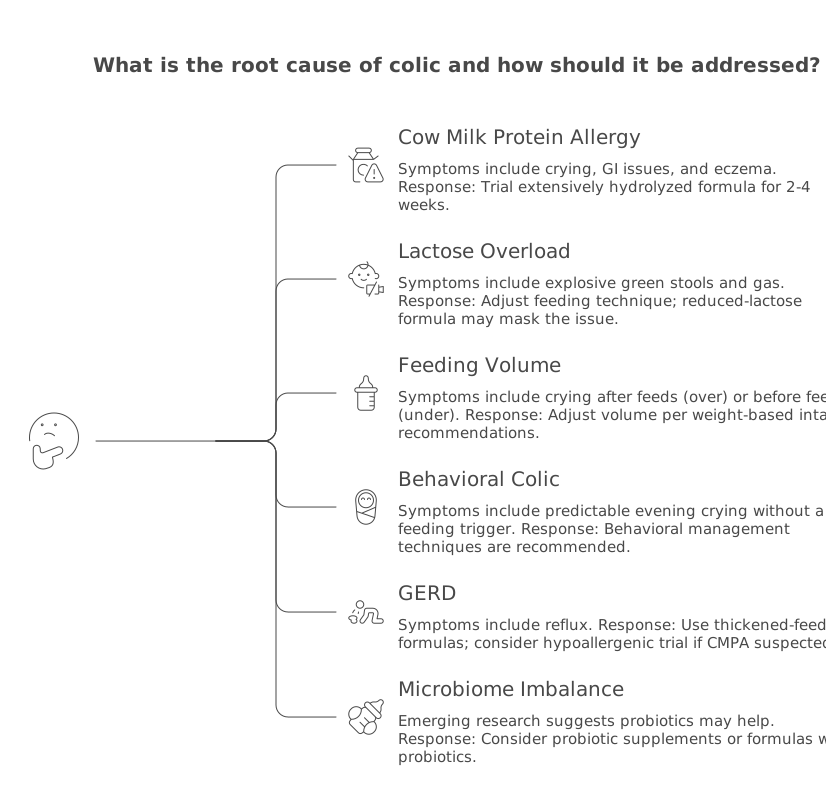
Visual generated with Napkin AI, editorial review by María López Botín. See methodology for our use policy.
What colic actually is (and isn't)
The Wessel criteria: "rule of threes"
The classic definition of colic (Morris Wessel, 1954) requires all three:
- Crying more than 3 hours per day
- On more than 3 days per week
- For longer than 3 weeks
In an otherwise healthy infant between 2 weeks and 4 months of age.
The Rome IV criteria (modern)
Updated criteria focus on:
- Parent-reported prolonged periods of crying, fussing, or irritability without obvious cause
- Infant is younger than 5 months when symptoms start and stop
- No evidence of failure to thrive, fever, or illness
Both frameworks agree on the core point: colic is not an illness. It is a pattern of crying behavior in a well infant.
What colic is not
- Not caused by gas (though babies with colic may have normal gas that seems pathological when combined with crying)
- Not caused by "bad formula" in most cases
- Not caused by parenting technique or maternal diet (for formula-fed infants)
- Not a sign of something being wrong with the baby physically
- Not related to "fussy" vs "easy" baby temperament per se
- Not the same as constipation in formula-fed babies (distinct presentation, different work-up), nor the same as disrupted sleep in formula-fed infants (correlates with overfeeding more than with formula choice).
Why the crying happens: current theories
No single cause has been established. Working theories include:
- Intestinal discomfort from gas or transient dysbiosis. Some infants with colic have different gut microbiome profiles and may benefit from probiotic intervention.
- Immature neurological regulation. The infant's ability to self-soothe and regulate arousal is still developing; certain infants cross a threshold more easily into prolonged crying.
- Overstimulation accumulation. The classic late-afternoon colic pattern suggests sensory overload accumulation through the day.
- Undiagnosed CMPA or feeding intolerance in a subset.
- Migraine precursor. Some research links colic to later childhood migraine propensity, suggestive of neurological regulation involvement.
The absence of a single cause is why no single intervention works for all colicky babies.
What the formula industry offers
Walk the US formula aisle and you'll encounter multiple product categories marketed implicitly or explicitly for colic:
Partially hydrolyzed formulas
- Enfamil Gentlease, Gerber Good Start GentlePro, HiPP HA, Kendamil Comfort (European)
- Partially broken-down whey protein; theoretical basis: easier digestion reduces crying
- Evidence: a 2015 Cochrane review found modest benefit in some studies; overall quality of evidence low
Reduced-lactose or lactose-free formulas
- Similac Sensitive, Enfamil Sensitive, HiPP Comfort
- Theoretical basis: "lactose intolerance" causes gas and crying
- Evidence: no meaningful effect in healthy term infants. Primary lactase deficiency is extremely rare in infants, see infant lactose intolerance for the full picture.
Extensively hydrolyzed formulas
- Nutramigen, Alimentum, Gerber Extensive HA
- Theoretical basis: CMPA causing colic symptoms
- Evidence: effective for diagnosed CMPA-associated colic but not recommended as routine colic treatment. See CMPA explained.
Probiotic-fortified formulas
- HiPP Combiotik (L. fermentum hereditum)
- Nutramigen with Enflora LGG (L. rhamnosus GG)
- Gerber Good Start Soothe Pro (B. lactis DSM 10140)
- Evidence: modest benefit in some studies; strongest for L. reuteri DSM 17938, which is typically given as a drops supplement rather than added to formula
"Comfort" / Anti-Colic formulas
- HiPP Comfort, Aptamil Comfort (European)
- Combines partial hydrolysate, reduced lactose, and modified fat
- Theoretical basis: address multiple proposed mechanisms at once
- Evidence: limited high-quality RCT data; generally positioned as option rather than clear recommendation
What the evidence actually supports
Probiotics: best evidence, particularly for breastfed infants
Lactobacillus reuteri DSM 17938 has the strongest evidence:
- Multiple RCTs and meta-analyses show reduced crying time in breastfed colicky infants
- Typical dose: 10^8 CFU per day, administered as drops (BioGaia or equivalent)
- Mechanism: reduces gut inflammation and modulates gut microbiome
Evidence in formula-fed infants is less consistent. Some studies show benefit, others no effect. The Cochrane 2019 review concluded:
"Moderate-certainty evidence suggests that probiotics, particularly Lactobacillus reuteri, reduce crying time in breastfed infants with colic. Evidence in formula-fed infants is inconclusive."
Practical implication: if you're formula feeding, a probiotic drop supplement (not a probiotic-fortified formula) is worth trying under pediatric guidance. For breastfed combo-feeding families, the evidence is stronger.
Hydrolyzed protein: benefit in CMPA-associated colic
If colic is severe, associated with other CMPA signs (blood in stool, eczema, severe reflux, family history), a 2-4 week trial of extensively hydrolyzed formula can confirm or rule out CMPA. Full framework: cow milk protein allergy explained.
Partial hydrolysates show modest but real benefit in some colicky infants without diagnosed CMPA. Mechanism unclear, may be mild protein sensitivity, smaller peptide size easing digestion, or placebo contribution.
Lactose reduction: no meaningful evidence
Reduced-lactose and lactose-free formulas show no consistent benefit for colic in healthy term infants. Primary lactase deficiency in infants is extremely rare. Despite this, these formulas persist as a commercial category driven by consumer marketing.
Feeding technique: often overlooked
- Paced bottle feeding (15-20 minutes per bottle, not 5-10)
- Frequent burping (every 1-2 oz)
- Appropriate bottle flow rate (slow-flow nipples for infants under 3 months)
- Adequate burping after feeds before laying flat
These interventions reduce swallowed air and the subsequent gas that can contribute to discomfort. For preparation and feeding patterns, see how to prepare baby formula safely.
Soothing interventions: parent-level, not formula
- Swaddling (for infants under 2 months, until they begin rolling)
- Side or stomach positioning while soothing (never sleeping)
- Shushing (white noise, continuous background sound)
- Swinging (rocking, baby swings)
- Sucking (pacifier, finger)
Dr. Harvey Karp's "5 S's" framework is well-validated for active soothing though not specific to colic.
A practical decision framework
Rather than cycling through formulas hoping for a match, consider this sequence:
Step 1: Rule out underlying causes
- Normal pediatric exam confirming no illness, no feeding refusal, no poor weight gain
- No CMPA red flags (blood in stool, severe eczema, family history)
- Normal feeding volume (not overfeeding)
Step 2: Optimize feeding technique
- Paced bottle feeding
- Appropriate nipple flow
- Frequent burping
- Upright position during and after feeds for 20-30 minutes
Step 3: Consider a probiotic drop supplement
- L. reuteri DSM 17938 (BioGaia or equivalent), 10^8 CFU daily
- 2-4 week trial
- Discuss with pediatrician before starting
Step 4: If severe and persistent, consider CMPA trial
- 2-4 week trial of extensively hydrolyzed formula (Nutramigen, Alimentum)
- Under pediatric guidance
- Assess for sustained improvement before concluding
Step 5: If all of the above fail, accept and wait
Most colic resolves by 3-4 months. Parental support, respite care, and patience are the interventions that matter at this stage. Aggressive formula rotation is more likely to destabilize feeding than to resolve colic.
What doesn't help (and may hurt)
- Frequent formula switching, disrupts infant digestion, generates stool and feeding changes that can be misattributed to "new formula not working"
- Colic drops with simethicone, no consistent evidence of benefit
- Gripe water, unregulated, variable composition, some formulations contain alcohol or bicarbonate that can be harmful
- Restrictive maternal diet (for breastfed infants), modest evidence for dairy elimination in severe cases; otherwise not supported
- Colic "wraps" or tight binding, can interfere with breathing, not recommended
When to consult a pediatrician
- Crying pattern doesn't fit Wessel/Rome IV criteria (outside the 2-week to 4-month window, or no typical daily pattern)
- Poor weight gain or feeding refusal
- Blood in stool (indicates possible CMPA or other issue)
- Severe eczema alongside the crying
- Projectile vomiting
- Fever, lethargy, or other illness signs
Colic itself is not an emergency. These adjacent signs are.
The parental side
Colic is hard. Managing 3-4 hours of inconsolable crying daily for weeks on end, often during the post-birth period when parental sleep is already severely limited, is a significant strain. Practical supports:
- Rotate caregivers, no single parent should handle the worst hours alone if a partner or family member is available
- Use respite care, an hour's walk outside while the baby is cared for reduces parental cortisol and helps regulate mood
- Normalize the experience, 20% of families go through this; it's common and not a parenting failure
- Safe place the baby, if frustration reaches dangerous levels, it is genuinely safer to place the baby in a crib, walk away for 10 minutes, and return composed. The "pause" is recommended by the AAP specifically to prevent shaken baby incidents.
Postpartum depression screening during and after the colic period is appropriate, the exhaustion and distress of colic overlap with PPD symptoms and can mask or amplify them.
FAQ
What is infantile colic?
Does switching formulas help with colic?
What probiotic is recommended for colic?
Is my formula causing colic?
Should I try anti-colic formulas like HiPP Comfort?
When does colic typically end?
Are colic drops with simethicone effective?
What if the crying is making me feel like I can't cope?
Primary sources
- American Academy of Pediatrics: Clinical Report on Infantile Colic. Pediatrics, 2016. publications.aap.org
- Cochrane Review: Probiotics for the prevention and treatment of infantile colic. 2019. cochrane.org
- NASPGHAN: Functional Gastrointestinal Disorders in Infants. naspghan.org
- Wessel Criteria (original): Wessel MA et al. "Paroxysmal fussing in infancy, sometimes called colic." Pediatrics, 1954.
- Rome IV Criteria: Functional Gastrointestinal Disorders in Infants and Toddlers.
- AAP: Safe Sleep and Crying Pause Recommendations. aap.org
Related reading
This site provides research and comparisons, not medical advice. Consult your pediatrician before changing your baby's formula.