

The question "when do I move from Stage 1 to Stage 2" has two kinds of answers. The short answer is whatever the manufacturer's age range on the label says, usually 6 months. The long answer is that the stages were designed for a specific European regulatory framework, they matter more for some nutrients than others, and in many cases staying on an earlier stage longer is perfectly fine and sometimes preferable. This guide explains what the numbering means in practice and when the switch is worth making deliberately.
European infant formulas are regulated in two categories under EU Regulation 2016/127: "infant formula" (for 0-6 months, labeled Stage 1 or PRE) and "follow-on formula" (for 6 and months, labeled Stage 2 or Stage 3). The nutrient profile differences are modest, primarily higher iron in Stage 2 and and a shift from lactose-dominant to mixed-carbohydrate profiles. The AAP does not require stage progression: most US formulas use a single 0-12 month profile. Parents can stay on Stage 1 through 12 months if the baby tolerates it.
The two regulatory frameworks
EU: two categories, multiple labels
EU Regulation 2016/127 defines two regulated categories of infant formula:
- Infant formula (the Regulation's term): intended for infants from birth up to 6 months. Known commercially as Stage 1 or PRE (short for "PREmium" or "PREnatal-adjacent," depending on brand, labeling varies).
- Follow-on formula: intended for infants over 6 months as part of a diet with complementary foods. Commercially these are Stage 2 (~ 6 to 10-12 months) and Stage 3 (~ 10-12 months onwards, often marketed as toddler-adjacent).
Some brands add a Stage 4 or Junior tier for 18 and months, but Stage 4 sits outside the follow-on formula regulation entirely, it's a "growing-up milk" (GUM) category that EU law treats more loosely. Whether any toddler formula is actually needed is its own question, covered in the is toddler formula necessary? clinical review. AAP and WHO generally say no for healthy toddlers eating varied diets, and the transition to whole cow milk at 12 months is the standard alternative.
For the full EU regulatory framework, see EU infant formula regulation.
US: one category, "infant formula"
FDA 21 CFR 107 defines a single category, "infant formula," covering birth to 12 months. Most US brands (Similac, Enfamil, Bobbie) sell a single SKU per product line covering this entire window, with the nutrient profile calibrated to be acceptable across the full 0-12 month range.
A separate "toddler formula" category exists for 12 and months. The AAP has historically been skeptical of the toddler formula category on grounds that most toddlers can transition directly to whole cow milk at age 1. Toddler formulas are not FDA-regulated under 21 CFR 107 — they fall under general food regulations. See our FDA infant formula regulation explainer for the full framework.
This regulatory asymmetry is why parents researching European formulas get confused by stage numbering: there's no US equivalent concept.
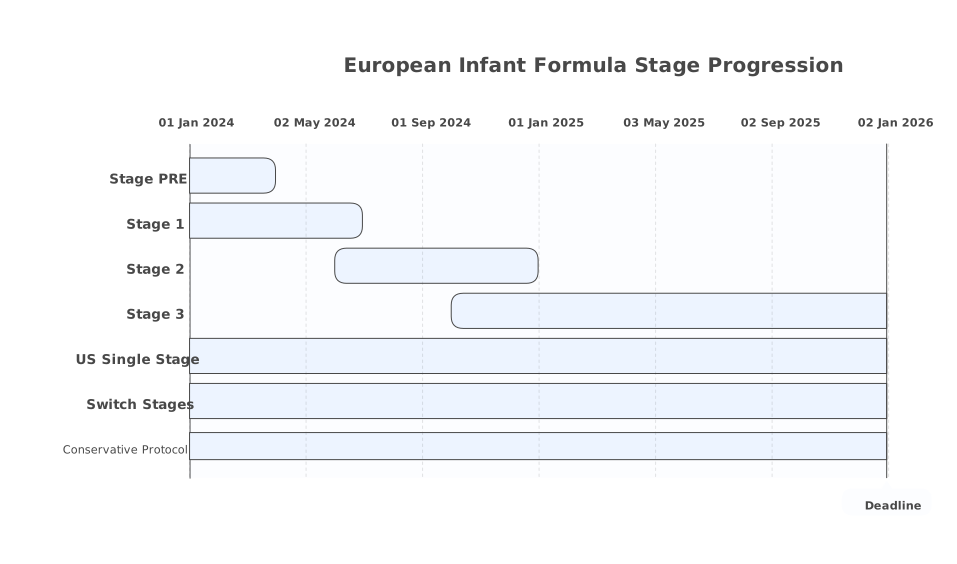
Visual generated with Napkin AI, editorial review by María López Botín. See methodology for our use policy.
What actually changes between stages
Across the major European brands (HiPP, Holle, Kendamil, Lebenswert, Loulouka), four things typically shift between Stage 1 and Stage 2:
1. Iron: goes up
- Stage 1: typically 0.3-0.7 mg / 100 kcal (EU minimum is 0.3 mg)
- Stage 2: typically 0.6-1.3 mg / 100 kcal
The rationale is that after 6 months, iron stores from birth deplete and the infant's iron requirement per kg body weight rises. US 21 CFR 107 formulas carry higher iron throughout (1.8-3 mg / 100 kcal), which is why many parents describe US formulas as "more fortified" than EU Stage 1, they are, on iron specifically.
For the underlying biology, see iron in infant formula.
2. Carbohydrate: lactose-only becomes mixed
- Stage 1: EU Regulation requires lactose to be the primary carbohydrate, and most Stage 1 formulas are lactose-only or near-lactose-only.
- Stage 2+: maltodextrin, starch, or glucose syrup solids may be added alongside lactose. This is nutritionally acceptable under the follow-on formula rules.
The change reflects both (a) a regulatory permission that doesn't apply to Stage 1 and (b) a cost factor (maltodextrin is cheaper than lactose) and (c) a satiety/texture argument (some parents find Stage 2 produces a thicker, more satiating bottle).
For parents who are strict about lactose-first carbohydrate profile, staying on Stage 1 longer, or selecting a Stage 2 that remains lactose-only (Kendamil Organic Stage 2 is a notable example), is a reasonable choice. See lactose and maltodextrin for the full explainers.
3. Protein: may shift
Some brands increase total protein content in Stage 2 and to match the greater growth demands of older infants. Others keep protein steady and just adjust the whey:casein ratio (Stage 1 often 60:40, Stage 2 sometimes 50:50 or 40:60 more casein-dominant for satiety).
4. Vitamins and minerals: adjusted
Minor adjustments to zinc, vitamin D, iodine, and B-vitamin levels are common between stages to match the EU Regulation 2016/127 specifications for each age category. These changes are typically small and not clinically decisive for healthy term infants.
When the stage switch matters
For most healthy term infants on a single European brand, the stage switch is a mild adjustment, not a clinical event. Parents can generally:
- Stay on Stage 1 past 6 months if the baby is tolerating it well and complementary foods are not yet providing substantial iron.
- Switch to Stage 2 at 6 months as the manufacturer label suggests, particularly if the baby is eating iron-rich solids (meat, fortified cereals) and the increased iron in Stage 2 offsets the dietary gap.
- Skip Stage 3 entirely and transition to whole cow milk at 12 months per AAP guidance: Stage 3 and Stage 4 are optional commercial products, not a clinical requirement.
When the switch is worth making deliberately
- Diagnosed iron deficiency or pediatrician-flagged iron concern: Stage 2's higher iron is a meaningful intervention.
- Increased appetite past 6 months that Stage 1 isn't satisfying: Stage 2's higher calorie density and casein-shift may help.
- The baby's current Stage 1 is being discontinued or reformulated: practical switch for supply reasons.
When it's OK to delay
- Baby is tolerating Stage 1 well (growth on track, feeding well, stools normal) and eating iron-rich complementary foods.
- Family dietary preferences favor lactose-only carbohydrate and Stage 2 would introduce maltodextrin you'd rather avoid.
- European brand availability has shifted, sometimes the Stage 1 of your preferred brand is easier to source than Stage 2 via import channels.
When it's OK to stay on Stage 1 indefinitely (through 12 months)
Yes, this is fine for most babies on most brands. US formulas are already calibrated for the 0-12 month window, choosing a European Stage 1 through 12 months is roughly equivalent to using a US formula through 12 months. The AAP does not require stage transition. The baby's pediatrician is the best source of guidance if there's any concern about iron status or growth.
Special-indication formulas don't follow the stage pattern
Some European formulas exist outside the Stage 1 / 2 / 3 progression:
- HiPP HA (hypoallergenic, partially hydrolyzed whey) has its own Stage 1 / Stage 2 numbering but the stages refer to the HA product range, not the standard line.
- HiPP AR (anti-reflux) is typically sold as a single Stage 1 product, used through the period of reflux, then transitioned back to the standard range.
- HiPP Comfort (for colic, constipation) is typically a single product for 0-6 months.
For parents navigating CMPA hierarchy (partially hydrolyzed → extensively hydrolyzed → amino acid-based), see our cow milk protein allergy explainer. The CMPA product hierarchy is separate from stage transition.
The 12-month transition: the one that actually matters
The most clinically meaningful transition is from formula to whole cow's milk at 12 months (for non-CMPA infants). Per the AAP:
- Before 12 months: breast milk or iron-fortified infant formula. Whole cow milk is not appropriate as a primary beverage.
- 12-24 months: whole cow milk (3.25% fat) is recommended as the primary milk. Fat content is nutritionally important in this period.
- 24 months +: lower-fat cow milk is acceptable; whole milk is still fine.
The reasons whole cow milk is inappropriate before 12 months:
- Higher protein and mineral load than infant kidneys handle ideally
- Insufficient iron (and cow milk can impair iron absorption)
- Can contribute to micro-hemorrhagic gut bleeding in some infants under 12 months
The transition from Stage 2 or Stage 3 formula to whole cow milk is the one that matters clinically. Stages 1 → 2 and 2 → 3 are manufacturer category shifts; 12-month-formula → whole cow milk is an AAP-level clinical recommendation.
How to execute a stage switch
If you do switch, the standard approach:
- Gradual transition over 5-7 days. Mix the new stage with the old, start 75% old / 25% new, then 50/50, then 25/75, then 100% new.
- Watch stool and feeding behavior. Small transient changes (slightly looser stool, less frequent feeds from satiety) are common. Persistent changes (diarrhea, vomiting, feeding refusal beyond 5-7 days) warrant pediatrician consultation.
- Stay consistent on water and equipment. Don't change water source, bottle type, or preparation routine at the same time, if a problem arises you want to know which variable to attribute it to.
For preparation and storage details that don't change between stages, see how to prepare baby formula safely and storing baby formula.
FAQ
When should I switch from Stage 1 to Stage 2 formula?
Can my baby stay on Stage 1 formula until 12 months?
Do I need Stage 3 formula?
What's the difference between European Stage 1 and a US infant formula?
Is toddler formula (12+ months) necessary?
How long does the stage transition take?
Why do European formulas have stages and US formulas don't?
Primary sources
- EU Regulation 2016/127: Infant formula and follow-on formula compositional requirements. eur-lex.europa.eu
- FDA 21 CFR Part 107: Infant Formula regulation. ecfr.gov
- American Academy of Pediatrics: HealthyChildren.org, "Infant Feeding" and "Transition to Whole Milk" guidance. healthychildren.org
- European Food Safety Authority: Scientific opinion on the essential composition of infant and follow-on formulae. efsa.europa.eu
- WHO: Global Strategy for Infant and Young Child Feeding. who.int
Related reading
This site provides research and comparisons, not medical advice. Consult your pediatrician before changing your baby's formula.