
Every US infant formula on every store shelf exists because of one specific regulation: FDA 21 CFR Part 107. That's it. No other US law directly governs infant formula composition and safety at the federal level. When you see "FDA-registered infant formula" on a Similac, Enfamil, Bobbie, or Earth's Best label, it means the manufacturer has cleared the requirements of Part 107.
This matters for parents in two specific ways. First, it sets what's guaranteed about any infant formula you can legally buy at US retail — the nutrient minimum and maximum ranges, the safety testing requirements, the facility standards. Second, it's the framework against which European alternatives (HiPP, Holle, Kendamil) are compared, because those formulas are NOT registered under Part 107, parents want to know whether that matters for safety.
The honest answer: it mostly doesn't, but the details matter.
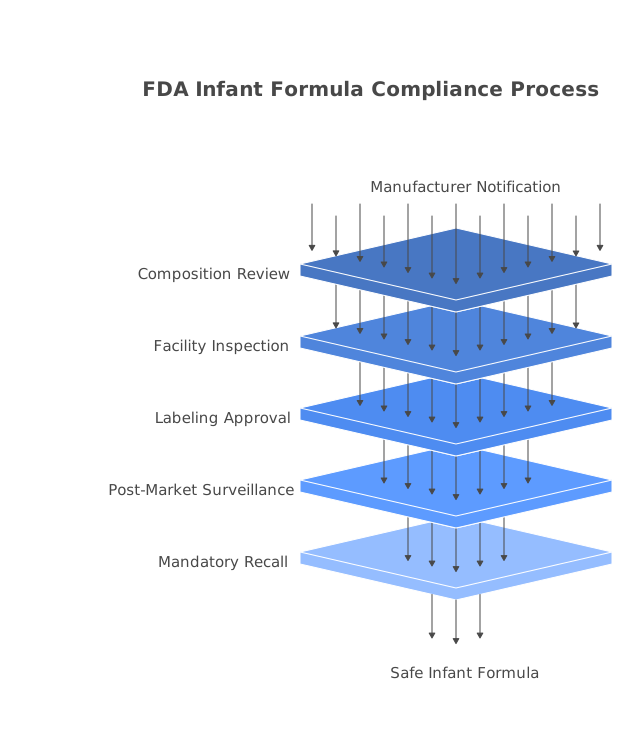
Visual generated with Napkin AI, editorial review by María López Botín. See methodology for our use policy.
What 21 CFR Part 107 covers
Part 107 is a technical regulation that's more readable than most FDA rules. It breaks down into these sections:
- Part 107.3, definitions of "infant formula" and regulatory terms.
- Part 107.10, labeling requirements (ingredient lists, nutrition panels, allergen declarations, preparation instructions).
- Part 107.20, nutrient minimums for essential vitamins, minerals, and macronutrients.
- Part 107.30, exempt formulas (specialty medical formulas like Neocate or Puramino that have different composition for medical reasons).
- Part 107.100, nutrient requirements for normal infant formula (specific values per 100 kcal for 29 essential nutrients).
- Part 107.200–107.280, manufacturer notifications to FDA and recall procedures.
The regulation is available in full at the Electronic Code of Federal Regulations. Let's walk through the parts that affect what you buy.
The nutrient minimums and maximums (Part 107.100)
Part 107.100 specifies the nutrient composition requirements. The most important numbers for parents:
| Nutrient | FDA minimum per 100 kcal | FDA maximum per 100 kcal |
|---|---|---|
| Protein | 1.8 g | 4.5 g |
| Fat | 3.3 g | 6.0 g |
| Linoleic acid | 300 mg | , |
| Vitamin A | 250 IU | 750 IU |
| Vitamin D | 40 IU | 100 IU |
| Vitamin C | 8 mg | , |
| Iron (iron-fortified) | 1.0 mg | 3.0 mg |
| Calcium | 60 mg | , |
| Sodium | 20 mg | 60 mg |
| DHA | No minimum required | , |
That last line is the most important one for understanding US/EU differences. Since 2020, EU Regulation 2016/127 has required DHA at 20–50 mg per 100 kcal as a mandatory minimum. US 21 CFR 107 does not. US manufacturers voluntarily include DHA in most premium lines (Similac Pro-Advance, Enfamil NeuroPro, Bobbie, Earth's Best, ByHeart) but a budget US infant formula could in principle be sold without DHA and still meet federal nutrient requirements.
For context, the parallel EU Regulation 2016/127 sets some minimums higher than FDA (DHA) and some lower (iron. EU minimum is 0.3 mg per 100 kcal, roughly a third of the US floor). Neither regulatory framework is uniformly stricter; they reflect different scientific interpretations by EFSA vs the FDA.
What 21 CFR 107 does not regulate
Notable gaps in US infant formula regulation that parents are often surprised to learn about:
- Carbohydrate source. Part 107.100 sets the total carbohydrate minimum but does not specify that lactose must be the primary source. This is why US formulas like Enfamil Gentlease can use corn syrup solids as the primary carb while remaining fully compliant. EU Regulation 2016/127 Article 5.1 is stricter on this specific axis.
- Organic vs non-organic. 21 CFR 107 is silent on organic. The parallel USDA National Organic Program is what governs USDA Organic certification for infant formula (Bobbie, Earth's Best). Both frameworks are US federal; they just come from different agencies.
- Prebiotic and HMO content. No minimum or requirement for prebiotics, 2'-FL HMO, MFGM, lactoferrin, or similar bioactive ingredients. These are voluntary additions by manufacturers.
- DHA source. FDA doesn't specify whether DHA must come from fish oil, algal oil, or otherwise. Manufacturers choose (see our DHA explainer).
- Palm oil vs other fat sources. The regulation specifies total fat and specific essential fatty acid minimums but does not regulate the fat blend composition.
This is not a critique of Part 107, the regulation focuses on the nutrient minimums, safety fundamentals, and intentionally leaves formulation choices to manufacturers. But it explains why US organic formulas (Bobbie, Earth's Best) differ meaningfully from non-organic US formulas even though all are FDA- compliant.
FDA registration process
Under Part 107.50, a manufacturer introducing a new infant formula must submit a pre-market notification to the FDA at least 90 days before marketing. The notification includes:
- Full composition specifications.
- Manufacturing process description.
- Facility information.
- Quality control procedures.
- Stability testing data.
The FDA reviews the notification, can request additional information, and grants (implicitly, by not objecting) or denies marketing approval. This is how brands like Bobbie (launched 2020) and ByHeart (launched 2022) became registered: they submitted Part 107 notifications, passed FDA review, and began sales.
Facility inspections happen under the separate FDA Food Safety Modernization Act (FSMA) framework. Infant formula facilities are inspected at a higher frequency than most food manufacturers, typically every 1–2 years for domestic producers, with more frequent checks when issues are flagged.
Labeling requirements
21 CFR Part 107.10 specifies what must appear on an infant formula label:
- Common or usual name of the product.
- Net quantity (ounces or grams).
- Nutrient content (per 100 calories, per serving, and per 100 grams of reconstituted formula).
- Ingredient list in descending order by weight.
- Allergen declaration (milk, soy, etc.).
- Preparation instructions.
- Manufacturer name and address.
- Production lot identifier and expiration date.
The "per 100 calories" format is a US convention that differs from the EU "per 100 ml prepared" format. Our SKU records convert between the two so you can compare US and European formulas directly.
The 2022 Abbott event and what changed
The February 2022 recall of Similac, Alimentum, and EleCare powder formulas manufactured at Abbott's Sturgis, Michigan plant was the most significant US infant formula safety event in decades. The FDA investigation identified Cronobacter sakazakii and Salmonella concerns tied to the Sturgis facility. Infant illnesses and deaths were documented.
What the event exposed about Part 107 compliance:
- The nutrient composition requirements worked as intended (Similac was nutritionally compliant).
- The manufacturing/sanitation requirements had gaps that allowed contamination to occur undetected.
- FDA inspection frequency was insufficient to catch the issues before the outbreak.
- Recall procedures worked slowly, contaminated product remained on shelves longer than ideal.
Since 2022, the FDA has:
- Increased inspection frequency at powder infant formula facilities.
- Updated Part 107 compliance procedures for Cronobacter and Salmonella testing specifically.
- Formalized the enforcement discretion framework for imported infant formula (which had been informal before), helping open the US market to European alternatives during the shortage. See our FDA-status Outer pillar.
- Issued guidance to retailers on rapid recall compliance, relevant after the 2025 ByHeart recall when retailers were found still stocking recalled product weeks after notification.
The 2025 ByHeart infant botulism event (Nov 2025, 51 hospitalizations) was a second major test of the post-2022 framework. The recall timeline and FDA response were faster than in 2022, but retailer compliance was still cited as inadequate.
How to know if a formula is FDA-registered
Every legitimate FDA-registered US infant formula displays the manufacturer's name, address, and "Distributed by" line on the package. The FDA maintains a public infant formula database where you can look up specific products. For parents buying at US retail, all major brands (Similac, Enfamil, Bobbie, ByHeart, Earth's Best, Gerber, Happy Baby, private-label store brands) are FDA-registered. Kabrita and Kendamil operate under enforcement discretion rather than direct Part 107 registration; see their brand pages for detail.
European imports (HiPP, Holle, Lebenswert, Loulouka, Löwenzahn, Nannycare, Jovie) are NOT FDA-registered under Part 107. They are imported under the personal-use enforcement discretion framework. This is legal for personal consumption, the FDA has explicit guidance permitting it, but it is a different legal status than FDA registration. See our FDA enforcement discretion explainer for the full context.
FAQ
Does FDA approve infant formulas like it approves drugs?
Are FDA nutrient minimums stricter than EU standards?
Why did the 2022 Abbott recall happen if Similac is FDA-registered?
If European formulas aren't FDA-registered, are they legal to buy?
Do US private-label formulas (Parent's Choice, Up&Up) meet Part 107?
Where can I read 21 CFR Part 107 directly?
Primary sources
- FDA 21 CFR Part 107, the canonical US infant formula regulation. ecfr.gov
- FDA Infant Formula Guidance and Regulatory Information, the policy hub. fda.gov
- FDA 2022 Cronobacter Investigation, the Abbott recall documentation. fda.gov
- EU Commission Delegated Regulation 2016/127, the parallel European framework for comparison. eur-lex.europa.eu
This site provides research and comparisons, not medical advice. Consult your pediatrician before changing your baby's formula.
Related reading
- ByHeart Whole Nutrition vs Earth's Best Organic Dairy - Premium Bioactive Whole-Milk (Recalled) vs Budget Supermarket Organic
- EU Regulation 2016/127 Annex II — The Mandatory Nutrient Reference Table
- FDA Exempt Infant Formula 21 CFR 107.30 — The Hypoallergenic Registration Pathway
- Infant Formula Labeling Rules — What FDA and EU Mandate on the Tin