

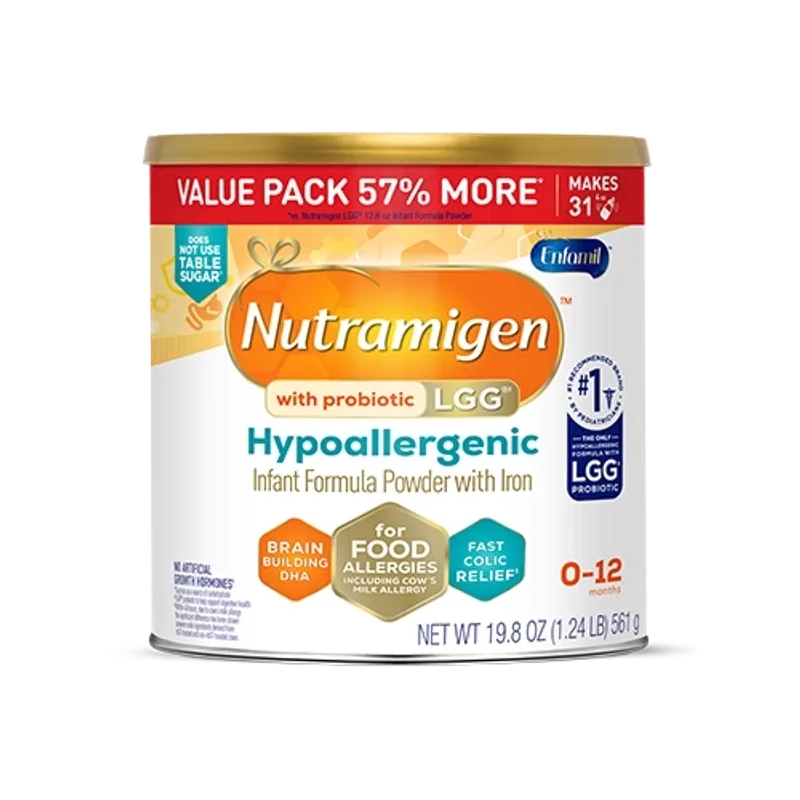
Enfamil ProSobee and Nutramigen with LGG are both Reckitt products but serve very different clinical indications. ProSobee is a soy protein isolate formula, indicated for galactosemia (inborn error of metabolism), for religious/ethical vegan feeding, and (historically) for some lactose-related indications. Nutramigen is an extensively hydrolyzed casein formula: FDA-recognized Hypoallergenic, first-line for diagnosed cow milk protein allergy. Parents sometimes assume ProSobee is a cheaper alternative to Nutramigen for CMPA (since both are "not standard cow milk formula" and ProSobee costs significantly less). This assumption is clinically incorrect and can harm CMPA infants. This comparison exists to clarify that.
ProSobee: soy protein isolate and corn-syrup primary, no HMO, and no probiotic, palm, soy oil, and DHA 11 mg, ~$1.50/oz. For galactosemia, vegan feeding, or documented indications, NOT for diagnosed CMPA. Nutramigen: extensively hydrolyzed casein + LGG probiotic, corn-syrup primary, palm, soy oil, and DHA 11.3 mg, ~$4.37/oz. FDA-recognized Hypoallergenic first-line eHF for CMPA.
Why this comparison matters
On US retail shelves, ProSobee sits near Nutramigen and costs roughly one-third the price (~$30/tin vs ~$55/tin). Parents whose infant has suspected CMPA symptoms sometimes reach for ProSobee thinking "it's not cow milk, so it can't be the allergen." This is clinically incorrect. Cow milk protein allergy (CMPA) infants have a ~10-14% rate of soy co-sensitization, using soy formula for these infants perpetuates or worsens symptoms. Additionally, the AAP has specifically not recommended soy formula as first-line for CMPA since 2008. Understanding this matters because the price difference is tempting, but the clinical consequence of substituting can be significant.
Clinical indications: very different
| Indication | ProSobee appropriate? | Nutramigen appropriate? |
|---|---|---|
| Diagnosed CMPA | No (10-14% soy co-sensitization risk; AAP does not recommend) | Yes (first-line eHF) |
| Galactosemia | Yes (required, inborn metabolic disease, cannot tolerate any lactose, including residual in hydrolyzed formulas) | No |
| Vegan feeding (religious / ethical) | Yes (dairy-protein-free) | No (casein-derived) |
| Congenital lactase deficiency (extremely rare) | Yes (alternative) | Also acceptable (lactose-free) |
| Post-diarrhea temporary lactose intolerance | Historically yes; less commonly recommended now | Not typical first choice |
| Standard CMPA first-line treatment | No | Yes |
The indications overlap only marginally (congenital lactase deficiency, some vegan feeding contexts). For the most common parent-facing question, "my baby has CMPA, what do I use?", the answer is unambiguously Nutramigen (or Alimentum or Gerber Extensive HA), not ProSobee.
At a glance
| Dimension | Enfamil ProSobee | Nutramigen with LGG |
|---|---|---|
| Manufacturer | Reckitt / Mead Johnson | Reckitt / Mead Johnson |
| FDA classification | 21 CFR 107 (standard) | Exempt infant formula 21 CFR 107.30 and Hypoallergenic |
| Category | Soy protein formula | Extensively hydrolyzed (eHF) |
| Protein source | Soy protein isolate (intact soy) | Extensively hydrolyzed casein (peptides <3,000 Da) |
| Appropriate for CMPA? | No (soy co-sensitization risk) | Yes (first-line) |
| Appropriate for galactosemia? | Yes | No |
| Lactose | None | None |
| Primary carbohydrate | Corn syrup solids | Corn syrup solids and modified corn starch |
| Prebiotic | None | None |
| Probiotic | None | LGG (L. rhamnosus GG) |
| HMO | None | None |
| Fat blend | Palm, soy oil, coconut, and safflower | Palm, soy oil, coconut, and safflower |
| DHA | Fish oil, ~11 mg/100 ml | Algal, ~11.3 mg/100 ml |
| Red flags | Corn syrup solids* | Corn syrup solids* |
| Fat-blend notes | palm oil, soy protein and soy oil | palm oil, soy (oil only) |
| Format | ~20.9 oz tin | 12.6 oz tin |
| Typical price | ||
| WIC coverage | Broad (soy formulas are in WIC contracts) | With CMPA documentation |
| US availability | Broad US retail | Broad US retail and pharmacy |
* Corn syrup solids medically appropriate in both contexts (lactose-free for different clinical reasons).
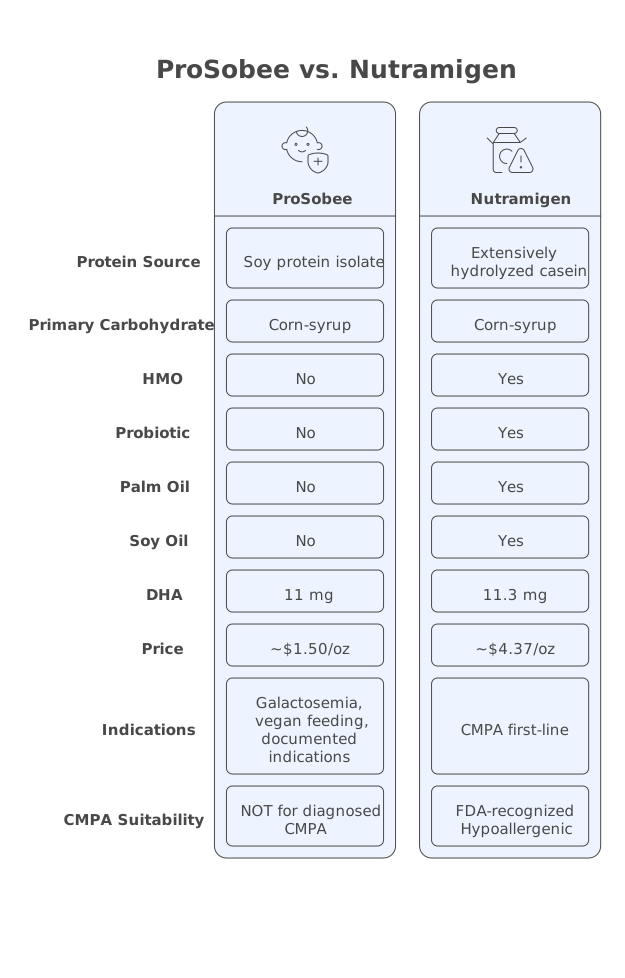
Visual generated with Napkin AI, editorial review by María López Botín. See methodology for our use policy.
Compositional differences that actually matter
1. Protein source: soy vs extensively hydrolyzed casein
ProSobee: soy protein isolate, whole intact soy proteins. Soy is a different protein family from cow milk (no cross-species allergenic identity), but soy is itself a major food allergen in US and global regulatory classification. Soy protein isolate is the dominant protein in the formula.
Nutramigen: extensively hydrolyzed casein, cow milk casein proteins broken into peptides <3,000 Da. The extensive hydrolysis reduces allergenic potential to FDA-Hypoallergenic standards.
Clinical context: for CMPA infants, ProSobee's soy protein does not solve the CMPA problem and introduces a new allergen (soy) to a population with documented cross-sensitization risk. Nutramigen's hydrolyzed casein is small enough to evade most CMPA immune recognition.
2. Soy co-sensitization: the clinical reason ProSobee ≠ CMPA treatment
The AAP and ESPGHAN have documented soy co-sensitization rates of 10-14% in CMPA infants. This means: for every 7-10 CMPA infants given soy formula, one has a documented soy protein allergic reaction on top of their CMPA. Symptoms of soy allergy mimic CMPA (reflux, blood in stool, eczema, poor weight gain), making it difficult to distinguish continued CMPA symptoms from new soy reactions without clinical workup.
The AAP's 2008 clinical report on soy formula specifically states soy formula is not recommended for management of cow milk protein allergy due to this cross-sensitization risk. ESPGHAN guidance is consistent. This is the fundamental clinical reason for the comparison: price is tempting, but the clinical outcome is often worse, not better.
3. Galactosemia: where ProSobee IS the appropriate choice
Galactosemia is an inborn error of metabolism where infants cannot metabolize galactose (a component of lactose). Affected infants cannot tolerate any lactose-containing formula or breast milk, including eHFs like Nutramigen (which are lactose-free but derived from lactose-containing dairy; trace galactose is theoretically a concern in severe cases). For diagnosed galactosemia, soy formula (ProSobee) or elemental amino acid formula is the appropriate choice, not eHF.
This is one of the few contexts where ProSobee is actually the correct clinical choice; the other major context is religious/ ethical vegan feeding where the family has specifically chosen to avoid all dairy products.
4. Bioactive layer: neither significant, but Nutramigen has LGG
ProSobee: no probiotic, no prebiotic, no HMO. Standard soy formula formulation with no bioactive additions.
Nutramigen: includes LGG probiotic specifically studied for CMPA tolerance acceleration. This is a meaningful addition in the CMPA management context.
5. Fat blend: similar profile
Both use palm, soybean oil, coconut, and safflower. Note that ProSobee contains soy oil (in addition to soy protein as its main protein source); Nutramigen contains soy oil (not soy protein). For CMPA infants with soy sensitivity, ProSobee's soy protein is the primary concern, soy oil trace proteins are minimal and rarely trigger reactions.
6. Same DHA level
Both supply ~11 mg DHA / 100 ml. Same algal source for Nutramigen (Schizochytrium); fish oil source for ProSobee. Both meet FDA adequacy.
7. Price: ProSobee ~67% cheaper per-oz
ProSobee ~$1.44/oz vs Nutramigen ~$4.37/oz. ~67% price difference: ProSobee is under a third of Nutramigen's price.
This price difference drives the "cheaper CMPA alternative" misconception. The reality: price reflects regulatory tier, not interchangeability. ProSobee is a standard infant formula (21 CFR 107); Nutramigen is an exempt infant formula (21 CFR 107.30) for medical indications with higher production standards and testing. You're comparing a standard formula to a specialty medical formula — the price difference is structural, not quality-based.
8. WIC coverage
ProSobee: broadly WIC-covered in US states (soy formulas are in standard WIC contracts).
Nutramigen: WIC-covered for diagnosed CMPA with documentation. Standard practice is pediatrician letter of medical necessity for WIC approval.
For families relying on WIC: ProSobee is accessible but only appropriate for specific clinical contexts (not CMPA). Nutramigen is accessible through WIC with proper CMPA diagnosis documentation.
9. Recall history
ProSobee (Reckitt): no active ProSobee-specific recall.
Nutramigen (Reckitt Zeeland): Nutramigen Powder voluntarily recalled December 2023 for Cronobacter sakazakii at Zeeland facility. Recall resolved; current production FDA-inspected.
Regulatory framework
ProSobee is regulated under FDA 21 CFR 107 as a standard infant formula (not under the 107.30 exempt category). It meets standard compositional requirements for soy-based infant formula, including specific adjustments for soy's lower PDCAAS (protein quality score) and naturally lower methionine and taurine levels.
Nutramigen is regulated under FDA 21 CFR 107.30 as an exempt infant formula for special medical purposes, with FDA-recognized Hypoallergenic classification. Different regulatory tier, different oversight standards, different indications.
AAP position on soy formula: "Soy formulas are not recommended for routine management of colic, fussiness, or atopic disease prevention. Soy formulas should not be considered a routine substitute for extensively hydrolyzed formulas in infants with documented cow's milk protein allergy." (AAP Clinical Report, Committee on Nutrition, 2008, standing guidance).
When ProSobee is clinically appropriate
- Diagnosed galactosemia (required)
- Religious / ethical vegan feeding (family choice, dairy-free)
- Severe primary lactase deficiency (extremely rare; one option among several)
- Post-diarrhea temporary secondary lactose intolerance (older clinical practice; less commonly used now; transient condition)
- Hereditary fructose intolerance (some variants)
When Nutramigen is clinically appropriate
- Diagnosed cow milk protein allergy (CMPA), first-line
- Suspected CMPA pending diagnostic workup (clinician guidance)
- Mild eosinophilic GI disease (pediatric GI recommendation)
- Multiple food protein allergy including cow milk (note: if multiple including soy, may require AAF like Puramino)
Real-world parent experience
Following site methodology, observations come from US parent feedback. Not clinical recommendations. Where my own feeding observations are referenced, they are clearly labeled as parent-experience notes; manufacturer claims and regulatory data are cited separately so the source weight stays explicit.
The "my baby seems better on ProSobee" observation. Sometimes parents switching from standard formula to ProSobee observe symptom improvement and interpret this as CMPA resolution. Multiple explanations: (a) the underlying issue may have been primary lactose fermentation (resolved by any lactose-free formula including ProSobee; ProSobee doesn't treat CMPA but removes lactose), (b) normal newborn digestive adjustment happened to coincide with the switch, (c) the baby wasn't CMPA-positive in the first place. This observation does NOT mean ProSobee is treating CMPA. For babies with confirmed CMPA symptoms (blood in stool, severe eczema, failure to thrive), pediatric workup with proper CMPA diagnosis and eHF trial is the correct clinical pathway.
Transition Nutramigen → ProSobee. Not clinically indicated for CMPA infants. If a family has been using Nutramigen for CMPA and considers switching to ProSobee (typically cost-motivated), this should be discussed with pediatrician first, high risk of CMPA symptom return and soy co-sensitization.
Transition ProSobee → Nutramigen. Appropriate if CMPA is discovered during ProSobee use (symptoms develop or persist indicating soy reaction or underlying CMPA). Use a 7-10 day gradual transition with pediatric guidance.
Verdict: when each is appropriate
Pick Enfamil ProSobee if:
- Your infant has diagnosed galactosemia (clear indication)
- Your family is religious / ethical vegan (family choice)
- Pediatric team has specifically indicated soy formula for a documented non-CMPA reason
- You are NOT using it as CMPA alternative
Pick Nutramigen with LGG if:
- Your baby has diagnosed cow milk protein allergy, first-line treatment
- Pediatrician has prescribed eHF for confirmed CMPA
- You need FDA-recognized Hypoallergenic designation for insurance coverage
Pick neither if:
- You have a healthy infant without CMPA diagnosis or specific soy-indication, standard cow milk formula (e.g., Enfamil NeuroPro) is appropriate
- Your CMPA infant ALSO has soy co-sensitization: AAF is the appropriate escalation ( Puramino or EleCare)
- You want EU-style eHF, not available in US retail, but HiPP HA Stage 1 (pHF, not eHF, different clinical tier) is the EU option
- You have a CMPA baby and are considering ProSobee for cost reasons , discuss with pediatrician; soy formula is not clinically appropriate for CMPA
What you can't infer from this comparison
ProSobee is a safe, FDA-registered soy infant formula for its appropriate indications. Nutramigen is a safe, FDA-recognized Hypoallergenic eHF for its appropriate indications. The comparison is not about quality but about clinical indication match. Using either formula outside its indicated use doesn't match safety, it creates a clinical mismatch. The price difference is structural (standard vs exempt infant formula regulatory tiers), not a measure of relative worth. If your pediatric team recommends ProSobee for CMPA (which is non-standard guidance), ask specifically about soy co-sensitization risk and whether the AAP 2008 clinical report has been considered.
Frequently asked questions
Can I use Enfamil ProSobee instead of Nutramigen for CMPA?
Why is ProSobee so much cheaper than Nutramigen?
What is ProSobee actually for?
Does soy formula cause any developmental concerns?
My baby seems better on ProSobee than standard formula, should I continue?
What if my CMPA baby also reacts to soy?
Is ProSobee WIC-covered?
Can I switch between ProSobee and Nutramigen?
Related reading
- Enfamil brand hub
- Nutramigen brand hub
- Nutramigen vs Similac Alimentum, eHF head-to-head
- Nutramigen vs Puramino, eHF → AAF escalation
- Gerber Extensive HA vs Nutramigen, whey vs casein eHF
- Cow milk protein allergy explained pillar
- Hydrolyzed protein explainer
- Best hypoallergenic formulas
Primary sources
- Enfamil / Reckitt (Mead Johnson), manufacturer product information. enfamil.com
- Nutramigen / Reckitt (Mead Johnson), manufacturer product information. nutramigen.com
- FDA 21 CFR Part 107 (incl. 107.30 exempt infant formula). ecfr.gov
- FDA infant formula guidance documents. fda.gov
- American Academy of Pediatrics: Clinical Report on Soy Protein-Based Formulas (Committee on Nutrition, 2008 and updates). aap.org
- ESPGHAN position on CMPA management: Koletzko et al., JPGN.
This site provides research and comparisons, not medical advice. Consult your pediatrician before changing your baby's formula.