
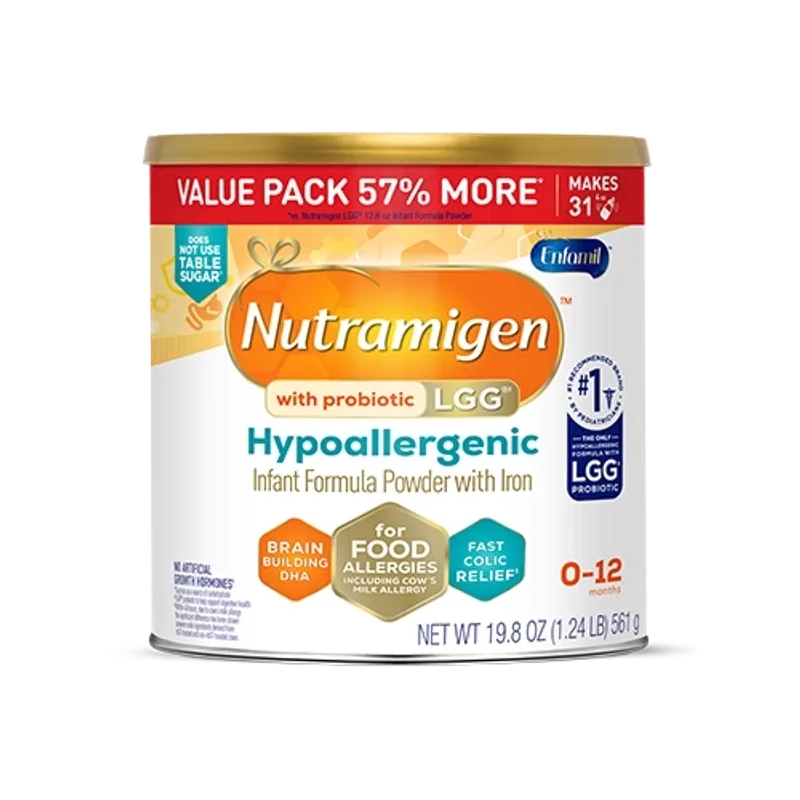
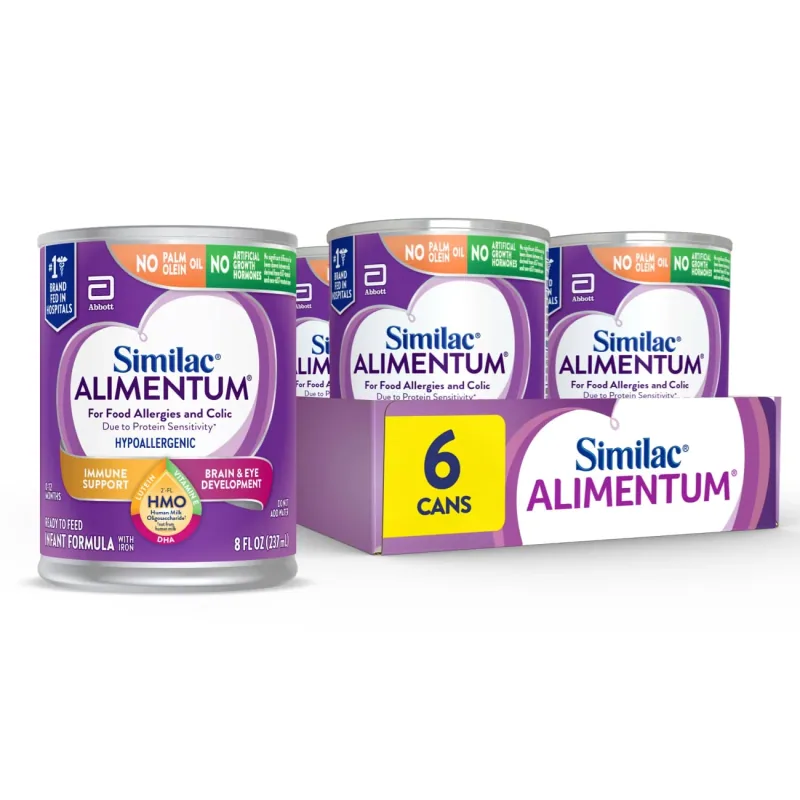
Nutramigen with LGG (Reckitt) and Similac Alimentum (Abbott) are the two most-prescribed extensively hydrolyzed (eHF) formulas in the US for diagnosed CMPA. Both use extensively hydrolyzed casein (peptides <3,000 Da), both are lactose-free, both exceed FDA exempt-infant- formula requirements. They diverge on bioactive strategy: Nutramigen adds LGG probiotic (documented to accelerate CMPA tolerance); Alimentum adds 2'-FL HMO, MCT, and palm-free fat blend. For families with a CMPA diagnosis, this is the first-line choice your pediatrician is likely to discuss.
Nutramigen: eHF casein and LGG probiotic and corn-syrup-solids primary and palm, soy, and DHA 11.3 mg. Alimentum: eHF casein and 2'-FL HMO + maltodextrin primary and palm-free and MCT and DHA 11.3 mg. Both lactose- free, both for diagnosed CMPA, both FDA exempt infant formulas. LGG (tolerance acceleration) vs HMO, MCT, and palm-free (bioactive and fat composition) is the core decision.
Why this comparison matters
CMPA affects an estimated 2-3% of infants. When a pediatrician confirms CMPA, the first-line treatment in the US is an extensively hydrolyzed formula (eHF), with ~90% of CMPA infants responding adequately to eHF; the remaining ~10% require amino-acid formulas (AAF) like Puramino or EleCare. Within the eHF tier, Nutramigen and Alimentum are the dominant choices. Understanding their specific compositional differences, rather than just "which does my pediatrician prefer", helps families make an informed choice or discuss the alternative when one isn't tolerated.
At a glance
| Dimension | Nutramigen with LGG | Similac Alimentum |
|---|---|---|
| Manufacturer | Reckitt / Mead Johnson Nutrition | Abbott Nutrition |
| FDA classification | Exempt infant formula 21 CFR 107.30 | Exempt infant formula 21 CFR 107.30 |
| Intended use | Diagnosed CMPA | Diagnosed CMPA |
| Protein | Extensively hydrolyzed casein (<3,000 Da) | Extensively hydrolyzed casein (<3,000 Da) and free amino acids |
| Protein % of formula | ~17% | ~17% |
| Lactose | None (lactose-free) | None (lactose-free) |
| Primary carbohydrate | Corn syrup solids and modified corn starch | Maltodextrin and sucrose |
| Prebiotic | None | None |
| HMO | None | 2'-FL HMO (only eHF with HMO in US) |
| Probiotic | Lactobacillus rhamnosus GG (LGG) | None |
| MFGM | None | None |
| DHA source | Schizochytrium algal, ~11.3 mg/100 ml | Schizochytrium algal, ~11.3 mg/100 ml |
| ARA | Yes (fungal) | Yes (fungal) |
| Fat blend | Palm olein, coconut, soy, and safflower | Palm-FREE (safflower and MCT and soy) |
| Red flags | Corn syrup solids* | Maltodextrin*, synthetic β-carotene, (no palm) |
| Fat-blend notes | palm oil, soy | soy |
| Format | 12.6 oz tin | 12.1 oz tin |
| Typical price | ||
| Insurance / WIC | Often covered with CMPA diagnosis | Often covered with CMPA diagnosis |
| US availability | Broad US retail and pharmacy | Broad US retail and pharmacy |
* Corn syrup solids and maltodextrin are medically appropriate in eHF context (see regulatory section below), the red-flag label tracks the ingredient, not the context.
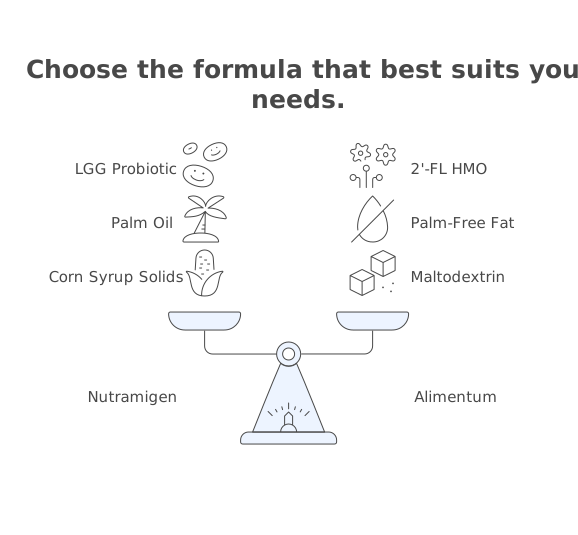
Visual generated with Napkin AI, editorial review by María López Botín. See methodology for our use policy.
Compositional differences that actually matter
1. LGG probiotic: Nutramigen's CMPA-specific differentiator
Nutramigen with LGG includes live Lactobacillus rhamnosus GG (Enflora LGG), one of the most-studied probiotic strains globally. Specifically for CMPA infants, LGG supplementation has clinical evidence for accelerated tolerance development, some published trials show earlier CMPA resolution (i.e., earlier return to cow-milk- containing diet) in LGG-fed infants vs eHF-only controls. This is Nutramigen's core clinical differentiation within the eHF tier.
Similac Alimentum has no live probiotic. Abbott's eHF relies on the 2'-FL HMO addition for its bioactive differentiation.
For CMPA-diagnosed infants where the family wants the option of earlier tolerance reintroduction, Nutramigen's LGG inclusion is a legitimate evidence-backed choice. The specific magnitude of tolerance acceleration varies by study and infant; not every infant benefits equally, but the mechanism and evidence are solid.
2. 2'-FL HMO: Alimentum's CMPA-specific differentiator
Similac Alimentum includes 2'-FL HMO: Abbott positions it as "the first and only hypoallergenic extensively hydrolyzed casein-based infant formula with 2'-FL." This is the only eHF in the US market with HMO inclusion currently. See our 2'-FL HMO explainer.
Nutramigen has no HMO. Reckitt's decision was to prioritize the LGG probiotic instead, different bioactive investment, similar price.
The 2'-FL HMO is research-supported as immune and gut-microbiota support; in the eHF context (where the gut microbiome is already disturbed by CMPA and altered protein profile), HMO supplementation has a theoretical mechanism for microbiome support, though clinical outcome evidence specific to CMPA infants is still emerging.
3. Fat blend: palm-free Alimentum vs palm-inclusive Nutramigen
Similac Alimentum uses a palm-free fat blend: high-oleic safflower and MCT (medium-chain triglycerides) and soybean oil. MCT inclusion is specifically designed for easier fat absorption — relevant for infants with GI tract compromise (CMPA commonly causes mild gut inflammation; MCT bypasses normal fat digestion pathways).
Nutramigen uses a palm-inclusive blend: palm olein, coconut, soy, and safflower, standard US Enfamil fat archetype, no MCT.
For parents specifically wanting palm-free eHF and MCT for absorption support: Alimentum is the distinct choice. For standard eHF fat blend: Nutramigen.
4. Primary carbohydrate: corn-syrup-solids vs maltodextrin
Nutramigen: corn syrup solids as primary (~47% of formula) + modified corn starch secondary (~4%).
Alimentum (powder): corn maltodextrin as primary (~39%) and sucrose secondary (~9%).
Both are lactose-free (the eHF process strips most lactose, and CMPA babies often benefit from lactose-free composition anyway). Both use glucose-polymer-based carbohydrates appropriate for CMPA. Maltodextrin (Alimentum) has a slightly lower glycemic response than corn syrup solids (Nutramigen), but the practical difference in the CMPA infant context is minimal. Important: the Alimentum RTF liquid formulation differs from the powder, it uses sugar and modified tapioca starch instead of maltodextrin. Parents should not assume powder and RTF are in their ingredients identical.
5. Soy lecithin: both contain it
Both formulas contain soy oil and soy lecithin as fat-blend emulsifier. This makes both unsuitable for concurrent CMPA and soy protein allergy, which affects ~10-14% of CMPA-diagnosed infants. For that subset, amino-acid formulas (Puramino, EleCare) are the next step, since they are both cow-milk-protein-free AND soy-protein-free.
6. Similar price: both premium specialty tier
Both are ~$55 per can, with Alimentum being a slightly smaller tin (12.1 vs 12.6 oz), bringing Alimentum to ~$4.55/oz vs Nutramigen ~$4.37/oz. Both are ~2-3× the cost of standard formula. Most US private insurance and Medicaid programs cover eHF with pediatrician letter of medical necessity for diagnosed CMPA; check your specific coverage.
7. Recall history
Nutramigen (Reckitt): Nutramigen Powder was recalled voluntarily in December 2023 for Cronobacter sakazakii contamination in lots produced at Reckitt's Zeeland, Michigan facility. Recall resolved; current production passed FDA inspection. Reckitt implemented additional testing protocols.
Similac Alimentum (Abbott): Alimentum was among Abbott's Sturgis, Michigan-produced SKUs affected by the 2022 Cronobacter recall. Alimentum production resumed after Sturgis remediation; no active recall on current stock.
Both manufacturers have had serious recall events specifically on their eHF lines in recent years; neither has a clean CMPA-SKU recall record. Choose based on current stock and FDA compliance state, not on historical impression alone.
Regulatory framework
Both are classified as FDA exempt infant formulas under 21 CFR 107.30, a specific sub-category for formulas "represented and labeled for use by an infant who has an inborn error of metabolism or a low birth weight, or who otherwise has an unusual medical or dietary problem." This classification requires distinct manufacturing and labeling standards but still requires overall adequate nutrition under 21 CFR 107.100.
The corn-syrup-solids / maltodextrin primary carbohydrate in both is medically appropriate in the eHF context: CMPA requires lactose- free (extensively hydrolyzed casein protein is mostly lactose-free naturally) and the glucose-polymer alternative is the standard replacement. The red-flag labels in the Atlas track ingredient identity, not context-specific appropriateness.
International equivalents: in the EU, eHF formulas like HiPP HA, Aptamil Pepti, and Nutrilon Pepti fill a similar clinical role. These are regulated under a different framework (EU Regulation 2016/128 for "food for special medical purposes") with some different permissible ingredients (Metafolin as active folate, lower iron, etc.). See the HiPP HA explainer for EU-parallel eHF context.
Real-world parent experience
Following site methodology, the observations below come from my own feeding experience and a stable pool of US parent feedback. These observations carry the parent-experience label; CMPA management is fundamentally a clinical decision with your pediatrician.
Smell and taste. Both are notably bitter and "medicinal" smelling — this is inherent to extensively hydrolyzed casein (small peptides expose bitter-tasting sequences). Nutramigen's LGG probiotic doesn't change taste noticeably; Alimentum's 2'-FL HMO adds marginal sweetness that many parents report as slightly more palatable. Most CMPA-diagnosed infants initially resist either; the transition typically takes 3-7 days and often requires some creative preparation (sometimes warmer water within safety limits, sometimes mixed with residual safe formula during crossover). Speak with your pediatrician if the infant refuses the eHF entirely.
Stool consistency. Both produce dark-green to olive-colored, soft-to-loose stools, normal for eHF. Stool color alone is not a CMPA-improvement indicator; look for reduction in blood in stool, improved feeding comfort, reduced reflux, and improved skin manifestations (eczema). Nutramigen's LGG contribution may slightly soften stool further in the first 1-2 weeks; Alimentum's MCT contribution may slightly loosen stool (MCT absorbs differently than long-chain fats).
Mixability. Both dissolve adequately but less cleanly than standard formulas (hydrolyzed casein is somewhat clumpy). Follow manufacturer prep instructions precisely.
Switching between them. For CMPA infants already stable on one, switching is a clinical decision, discuss with your pediatrician. If the pediatric team recommends a switch, use a 7-10 day gradual transition (longer than typical because CMPA-stabilized infants tolerate composition changes poorly). Multiple simultaneous changes: probiotic add/remove, HMO add/remove, fat blend (palm-inclusive ↔ palm-free and MCT), primary carbohydrate (corn-syrup-solids ↔ maltodextrin). Expect 1-2 weeks of stool variation.
Verdict: when to pick each
Pick Nutramigen with LGG if:
- Your pediatrician specifically recommends LGG probiotic for tolerance acceleration
- You want the option of earlier tolerance reintroduction trial
- 2'-FL HMO is not a priority in CMPA management for your family
- Palm-inclusive fat blend is acceptable
- Reckitt's Zeeland facility current FDA compliance state is acceptable
Pick Similac Alimentum if:
- Palm-free fat blend and MCT matters for your infant (absorption support)
- 2'-FL HMO matters in CMPA bioactive support
- Your infant tolerates maltodextrin better than corn syrup solids (individual variation)
- Live probiotic in eHF context is not a priority for your family
Pick neither if:
- Your baby has CMPA + confirmed or suspected soy protein allergy , consider Puramino (amino acid, Reckitt) or EleCare (amino acid, Abbott), these are cow-milk-free AND soy-free
- Your baby failed the eHF trial with continued symptoms — pediatrician escalation to amino acid formula (AAF) is the next step
- You want EU-style eHF with Metafolin and EU Organic, consider HiPP HA Combiotik (imported, different regulatory framework)
What you can't infer from this comparison
Both are safe, FDA-registered CMPA management formulas. Neither is definitively "better" for every CMPA infant, individual response varies. The LGG tolerance-acceleration evidence is real but not guaranteed for every infant; the 2'-FL HMO support is research- backed but clinical outcome magnitude in CMPA infants is still emerging. Palm-free and MCT in Alimentum is a real composition difference but doesn't mean it's universally better, some infants do fine on Nutramigen's standard fat blend. CMPA management is an iterative clinical process; if the first eHF doesn't resolve symptoms within 2-4 weeks, your pediatrician may trial the other eHF or escalate to amino acid formula.
Frequently asked questions
Is Nutramigen or Alimentum better for CMPA?
Does Alimentum really have HMO?
Does Nutramigen really accelerate CMPA tolerance?
Why do these formulas have corn syrup solids / maltodextrin?
Is Alimentum palm-free and Nutramigen palm-inclusive?
Can I use either for soy allergy and CMPA?
What happens if my baby doesn't respond to eHF?
Are these formulas covered by insurance or WIC?
Can I switch between Nutramigen and Alimentum?
Related reading
- Nutramigen brand hub
- Similac / Alimentum brand hub
- Enfamil brand hub
- Similac brand hub
- Hydrolyzed casein explainer
- 2'-FL HMO explainer
- Probiotics in formula
- CMPA and formula
- Enfamil ProSobee vs Nutramigen - Soy Formula vs eHF (Different Clinical Categories, Don't Confuse Them)
- Gerber Extensive HA vs Nutramigen - Whey-Based eHF vs Casein-Based eHF (Nestlé vs Reckitt)
- HiPP HA Combiotik vs Nutramigen - EU Partial Hydrolysate vs US Extensively Hydrolyzed (Not the Same Category)
- Nutramigen vs EleCare - Cross-Manufacturer eHF to AAF Step-Up (Reckitt eHF vs Abbott AAF)
- Similac Alimentum vs Gerber Extensive HA - Casein eHF vs Whey eHF (Both with 2'-FL HMO and MCT)
- Similac Alimentum vs Puramino - Cross-Manufacturer eHF to AAF Step-Up (Abbott eHF vs Reckitt AAF)
- FDA Exempt Infant Formula 21 CFR 107.30 — The Hypoallergenic Registration Pathway
Primary sources
- Nutramigen / Reckitt (Mead Johnson), manufacturer product information. nutramigen.com
- Similac Alimentum / Abbott Nutrition, manufacturer product information. similac.com
- FDA 21 CFR Part 107 (incl. 107.30 exempt infant formula). ecfr.gov
- EFSA Scientific Opinion on compositional requirements for infant formula. efsa.europa.eu
- ESPGHAN position on CMPA management: Koletzko et al., JPGN, multiple years.
This site provides research and comparisons, not medical advice. Consult your pediatrician before changing your baby's formula.