
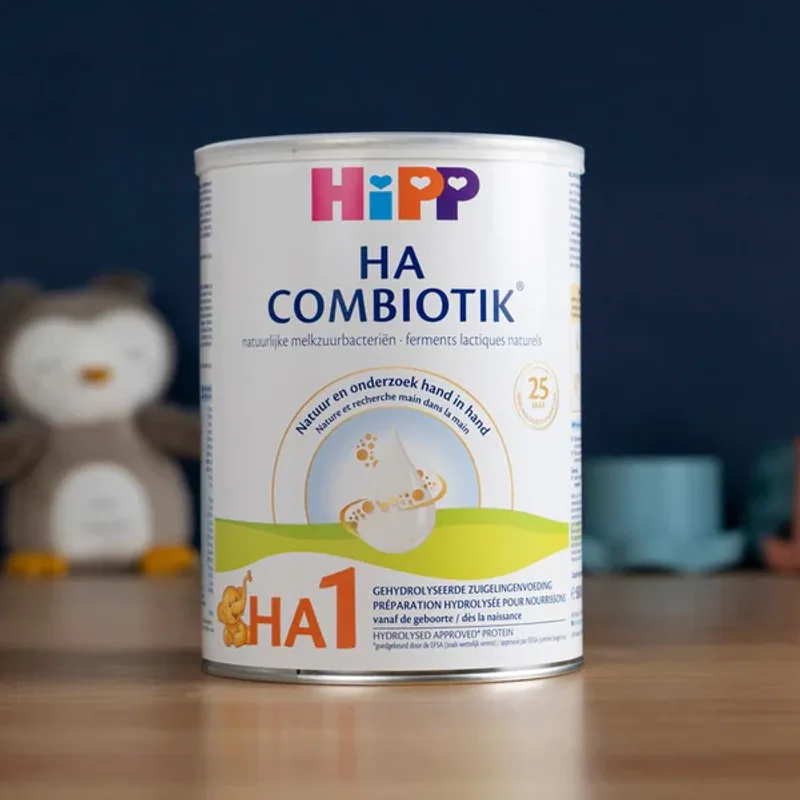
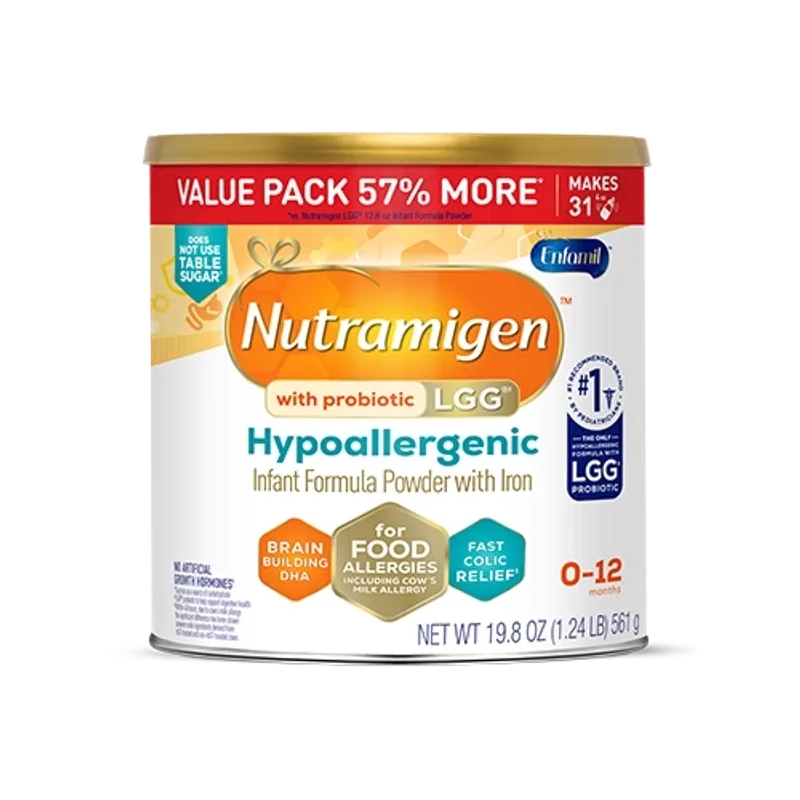
HiPP HA Combiotik and Nutramigen are both marketed with "hypoallergenic" messaging in their respective markets, but they occupy different clinical tiers. HiPP HA is a partially hydrolyzed whey formula under EU Regulation 2016/127, positioned for atopic-risk prophylaxis with mixed clinical evidence. Nutramigen with LGG is an extensively hydrolyzed casein formula under FDA 21 CFR 107.30 exempt infant formula classification, the appropriate medical option for diagnosed CMPA. Understanding this difference matters because a parent whose baby has diagnosed CMPA cannot substitute HiPP HA for Nutramigen.
HiPP HA: partially hydrolyzed 100% whey and lactose-primary + maltodextrin secondary and GOS prebiotic and L. fermentum and L. rhamnosus probiotics (Combiotik) and RSPO palm and DHA 14 mg, ~$40. Nutramigen: extensively hydrolyzed casein (<3,000 Da) and corn- syrup primary (lactose-free) and LGG probiotic, palm, soy, and DHA 11.3 mg, ~$55. Different hydrolysis depths, different protein sources, different clinical indications. Not interchangeable.
Why this comparison matters
parents with atopic family history who discover EU infant formula options often encounter HiPP HA and assume it's the EU equivalent of Nutramigen. It isn't. HiPP HA is a pHF with Combiotik system — a different clinical tier than Nutramigen's eHF. Conflating the two can lead to: (a) using HiPP HA when an eHF is clinically required (CMPA under-treatment, can result in continued symptoms and growth issues), (b) using Nutramigen when pHF and Combiotik would have sufficed (overuse of specialty medical formula and unneeded cost). The correct choice depends on the clinical indication, not the "European" branding.
The clinical category difference
| Category | What it means | Examples | When appropriate |
|---|---|---|---|
| Partial hydrolysate (pHF) | Protein peptides partially broken; larger than eHF peptides | HiPP HA, Gentlease, Pro-Total Comfort | Mild protein digestion issue, atopic-risk prophylaxis (mixed evidence) |
| Extensively hydrolyzed (eHF) | Protein peptides <3,000 Da; small enough to evade most immune recognition | Nutramigen, Alimentum | Diagnosed CMPA first-line |
| Amino acid formula (AAF) | Protein as free amino acids; non-antigenic | Puramino, EleCare, Neocate | Severe CMPA, eHF failure |
HiPP HA sits at the pHF tier. Nutramigen sits at the eHF tier. The jump from pHF to eHF is the single biggest step in the hypoallergenic formula hierarchy, it's not a minor upgrade.
At a glance
| Dimension | HiPP HA Stage 1 Combiotik | Nutramigen with LGG |
|---|---|---|
| Manufacturer | HiPP GmbH (Germany) | Reckitt / Mead Johnson (US) |
| Regulation | EU Regulation 2016/127 | FDA 21 CFR 107.30 (exempt infant formula) |
| FDA status | Not FDA-registered (enforcement discretion for personal import) | FDA-registered as exempt infant formula |
| Clinical category | Partial hydrolysate (pHF) | Extensively hydrolyzed (eHF) |
| FDA-recognized Hypoallergenic | No (pHF does not meet the US "Hypoallergenic" designation) | Yes |
| Protein | Partially hydrolyzed 100% whey | Extensively hydrolyzed casein (<3,000 Da) |
| Peptide size | Larger peptides (partial) | <3,000 Da (often <1,500 Da) |
| Intended use | Atopic-risk prophylaxis, mild sensitivity | Diagnosed CMPA |
| Primary carbohydrate | Lactose and maltodextrin and glucose syrup | Corn syrup solids and modified corn starch (lactose-free) |
| Prebiotic | GOS (Combiotik component) | None |
| Probiotic | L. fermentum and L. rhamnosus (Combiotik) | L. rhamnosus GG (LGG) |
| HMO | None | None |
| Iron | 0.5 mg/100 ml (EU standard, lower) | 1.2 mg/100 ml (US standard) |
| Folate | Metafolin (EU) | Folic acid (US) |
| DHA | Fish oil, ~14 mg/100 ml | Schizochytrium algal, ~11.3 mg/100 ml |
| Fat blend | RSPO palm and rapeseed, sunflower, and coconut | Palm olein, coconut, soy, and safflower |
| Red flags | Palm (RSPO-certified), maltodextrin | Corn syrup solids* |
| Fat-blend notes | None | palm oil, soy |
| Format | 600 g tin | 12.6 oz (357 g) tin |
| Typical price (US) | ||
| US availability | Personal import only (not US retail) | Broad US retail and pharmacy |
* Corn syrup solids in Nutramigen are medically appropriate (CMPA lactose-free requirement).
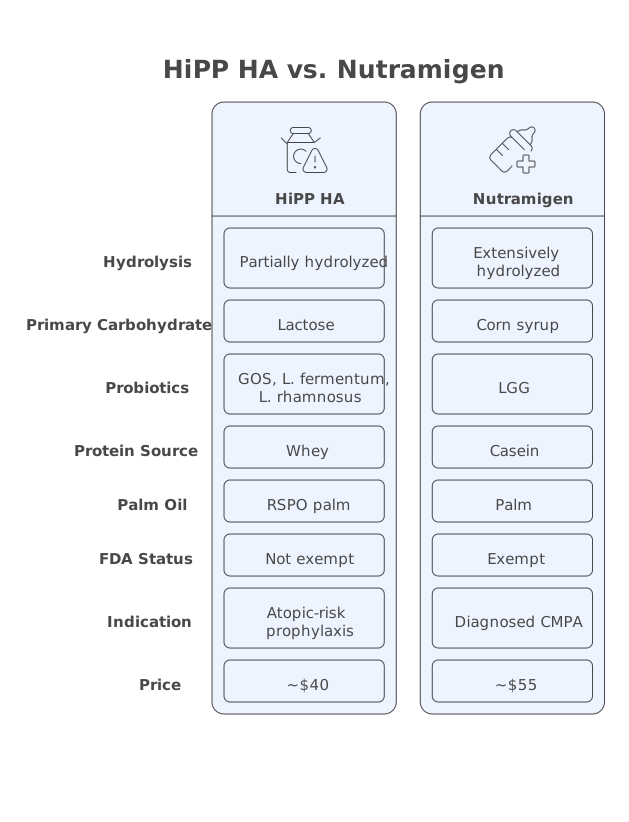
Visual generated with Napkin AI, editorial review by María López Botín. See methodology for our use policy.
Compositional differences that actually matter
1. Hydrolysis depth: the defining difference
HiPP HA: partially hydrolyzed 100% whey protein. Peptide size is larger than eHF, big enough to retain potential allergenicity for CMPA-sensitized infants. pHFs are positioned for atopic-risk prophylaxis (with mixed evidence, see AAP and ESPGHAN position statements) or mild sensitivity.
Nutramigen: extensively hydrolyzed casein. Peptides <3,000 daltons (often <1,500). Small enough to be non-allergenic for ~90% of CMPA infants. FDA-recognized as Hypoallergenic under exempt infant formula designation.
This is the single most important difference. For an infant with diagnosed CMPA, HiPP HA's partial hydrolysis does NOT provide adequate protein processing, symptoms will likely persist or worsen. For an infant without CMPA diagnosis but with atopic-risk family history, HiPP HA's Combiotik system provides a prophylactic option that Nutramigen's eHF wouldn't be indicated for (overuse).
2. Primary carbohydrate: lactose vs corn-syrup-solids (both medically appropriate)
HiPP HA: lactose as primary, maltodextrin, and glucose syrup secondary. Lactose retention is a design choice, lactose supports bifidogenic fermentation (favorable for the Combiotik probiotic strains) and is well-tolerated by infants without documented lactose issues.
Nutramigen: corn syrup solids and modified corn starch (lactose- free). Lactose-free is medically appropriate for CMPA, the extensive hydrolysis process removes most lactose naturally, and lactose-free composition avoids any residual lactose fermentation in an already-disturbed CMPA gut.
These are different carbohydrate compositions because they serve different clinical contexts. HiPP HA's lactose-primary is appropriate for its non-CMPA use case; Nutramigen's corn-syrup- primary is appropriate for CMPA.
3. Bioactive layer: Combiotik vs LGG alone
HiPP HA: Combiotik system, L. fermentum CECT5716 (native HiPP strain) and L. rhamnosus probiotic and GOS prebiotic. Multi-strain and prebiotic synbiotic approach. The combination is HiPP's signature bioactive addition across the HA and Dutch/German Combiotik lines.
Nutramigen: LGG (L. rhamnosus GG, Enflora LGG) alone. No prebiotic. LGG is specifically studied for CMPA tolerance acceleration, the focused probiotic approach fits Nutramigen's CMPA indication.
Different philosophies: HiPP's multi-organism synbiotic supports a broader microbiome; Nutramigen's single LGG strain targets a specific CMPA-tolerance outcome.
4. Fat blend: RSPO palm vs palm-inclusive
HiPP HA: RSPO-certified palm oil and rapeseed, sunflower, and coconut. RSPO (Roundtable on Sustainable Palm Oil) certification is the EU-standard approach to sustainable palm sourcing. No soy oil.
Nutramigen: standard palm olein, coconut, soy, and safflower — US palm-inclusive archetype without RSPO certification (Reckitt's sourcing policies vary; not typically marketed with RSPO label).
For parents prioritizing sustainable palm sourcing or avoiding soy oil entirely, HiPP HA has structural advantages.
5. Iron and folate: EU vs US standards
HiPP HA: iron 0.5 mg/100 ml (EU standard); folate as Metafolin (bioactive L-methylfolate). These reflect EU regulatory standards under Regulation 2016/127.
Nutramigen: iron 1.2 mg/100 ml (US standard, ~2.4× higher); folate as folic acid. Standard US fortification.
The iron difference is significant: EU iron levels are intentionally lower because research has suggested that excess iron in infant formula may not be beneficial and may have downsides for gut microbiome. US levels follow historic fortification standards. Metafolin is a bioactive folate form that bypasses MTHFR gene variants (which affect ~40-60% of populations). For parents valuing EU-style iron and Metafolin: HiPP HA. For CMPA: Nutramigen's US standard fortification is still clinically appropriate.
6. DHA: HiPP HA higher
HiPP HA: ~14 mg DHA / 100 ml. Nutramigen: ~11.3 mg DHA / 100 ml. HiPP HA's higher DHA reflects EU standards which often target upper-range breast-milk DHA. Both levels meet regulatory adequacy.
7. Price and availability
HiPP HA: ~$40 per 600 g tin via US personal import, roughly ~$1.89/oz. Not available at US retail; requires trusted EU reseller (Organic's Best and similar). Shipping adds time (~3-7 business days typical).
Nutramigen: ~$55 per 12.6 oz tin at US retail, roughly ~$4.37/oz. Broadly available at Target, Walmart, CVS, Walgreens, Amazon. Often covered by insurance with CMPA documentation.
Nutramigen is ~2.3× more expensive per ounce but is available at US retail immediately. HiPP HA is less expensive per ounce but requires import logistics and is not insurance-covered.
8. Recall history
HiPP HA (HiPP GmbH): no active HA-specific recall. HiPP's quality-control record is generally strong across their Combiotik line.
Nutramigen (Reckitt): Nutramigen Powder was voluntarily recalled December 2023 for Cronobacter sakazakii contamination at Reckitt's Zeeland facility. Recall resolved; current production passed FDA inspection.
Regulatory framework
HiPP HA: regulated under EU Regulation 2016/127 (compositional requirements for infant formula) and EU food safety regulations. For families, personal import is legal under FDA enforcement discretion, the FDA has chosen not to enforce import restrictions for personal-use small quantities of EU-compliant infant formula, though technical legality is specific. See our is it legal to buy European formula in USA explainer for depth.
Nutramigen: regulated under FDA 21 CFR Part 107.30 (exempt infant formula for special medical purposes). This is a specific sub-category with distinct regulatory requirements for CMPA/metabolic-indication formulas.
The key practical difference: Nutramigen has the US FDA-recognized Hypoallergenic designation; HiPP HA does not. This designation matters for: (a) insurance coverage eligibility (typically requires Hypoallergenic classification and CMPA diagnosis documentation), (b) pediatrician recommendation (US pediatricians typically recommend FDA-recognized Hypoallergenic formulas for CMPA), (c) WIC coverage.
Real-world parent experience
Following site methodology, observations below come from US and EU parent feedback. Not clinical recommendations. Where my own feeding observations are referenced, they are clearly labeled as parent-experience notes; manufacturer claims and regulatory data are cited separately so the source weight stays explicit.
Atopic-risk prophylaxis context (HiPP HA use case). HiPP HA is commonly used by EU families with strong atopic family history (parental atopic dermatitis, asthma, food allergies) as a potential prophylactic. The evidence for pHF-for-allergy-prevention is mixed — some studies (GINI study) support it; other meta-analyses are more skeptical. HiPP HA's Combiotik system adds probiotic and prebiotic support that may contribute to immune modulation independent of the pHF effect. For families with atopic-risk context: discuss with pediatrician whether pHF and Combiotik is indicated.
CMPA treatment context (Nutramigen use case). For diagnosed CMPA, Nutramigen is first-line. Do not substitute HiPP HA, the partial hydrolysis is insufficient for CMPA symptom resolution. If a parent with diagnosed-CMPA infant tries HiPP HA (perhaps hoping the EU composition is gentler or more natural), symptoms typically persist. This is a real clinical observation that occasionally surfaces in US pediatric GI clinics.
Taste and smell. HiPP HA is less bitter than Nutramigen. Partial hydrolysis produces smaller taste impact than extensive hydrolysis; HiPP HA's lactose retention adds natural sweetness. Nutramigen is notably bitter (hydrolyzed casein peptides expose bitter sequences); infants often resist transitioning to Nutramigen for 3-7 days.
Stool consistency. HiPP HA stools are typical standard-formula soft/formed (similar to standard EU formula). Nutramigen stools are dark-green to olive, softer/looser, typical eHF pattern.
Switching. If an infant is genuinely on HiPP HA for atopic-risk prophylaxis and is discovered to have CMPA (symptoms emerge despite pHF), clinical escalation to Nutramigen (or Alimentum) is appropriate, use a 5-7 day gradual transition with pediatric guidance. Expect significant smell/taste shift and stool changes.
Verdict: when each applies
Use HiPP HA Combiotik if:
- You have atopic-risk family history and pediatric team has discussed pHF prophylaxis as an option
- Your infant has mild sensitivity signs without CMPA diagnosis
- You value lactose-primary and Combiotik (GOS and probiotic) bioactive system
- You value EU regulatory standards (Metafolin, lower iron, RSPO palm)
- You can source via personal import and manage the logistics
Use Nutramigen with LGG if:
- Your baby has diagnosed CMPA (the primary indication)
- You need FDA-recognized Hypoallergenic designation for insurance
- You need broad US retail and pharmacy availability
- You want the LGG probiotic specifically for CMPA tolerance acceleration
Pick neither if:
- Your baby has CMPA but is in the ~10% who don't respond to eHF — consider Puramino (AAF, Reckitt) or EleCare (AAF, Abbott)
- You want the Abbott US eHF alternative, consider Similac Alimentum
- You want the US standard pHF alternative to HiPP HA, consider Enfamil Gentlease or Similac Pro-Total Comfort
What you can't infer from this comparison
The pHF-to-eHF clinical distinction is not optional, it reflects real differences in peptide size and allergenic potential. HiPP HA cannot substitute for Nutramigen in CMPA management. Conversely, Nutramigen is not universally "better" than HiPP HA, the eHF step is an escalation with real cost and availability tradeoffs. The right choice depends on the clinical indication. "European = better" and "US = better" are both oversimplifications in this specific clinical category.
Frequently asked questions
Can I use HiPP HA instead of Nutramigen for CMPA?
Is HiPP HA hypoallergenic?
Why does HiPP HA have lactose but Nutramigen doesn't?
Is HiPP HA's Combiotik better than Nutramigen's LGG?
Is HiPP HA legal in the USA?
Which has better sourced palm oil?
Does insurance cover HiPP HA?
Why is HiPP HA cheaper per ounce?
Can I start with HiPP HA and upgrade to Nutramigen if symptoms persist?
Related reading
- HiPP brand hub
- Nutramigen brand hub
- Nutramigen vs Similac Alimentum. US eHF head-to-head
- Enfamil Gentlease vs Similac Pro-Total Comfort. US pHF head-to-head (structural parallel to HiPP HA)
- CMPA and formula
- Is it legal to buy European formula in USA
- EU infant formula regulation
- Hydrolyzed whey explainer
- Hydrolyzed casein explainer
- GOS explainer
- Probiotics in formula
- HiPP HA Stage 1 vs Enfamil Gentlease - EU pHF Combiotik vs US pHF (Apples-to-Apples)
Primary sources
- HiPP GmbH, manufacturer product information. hipp.de
- Nutramigen / Reckitt (Mead Johnson), manufacturer product information. nutramigen.com
- EU Regulation 2016/127. EU compositional requirements for infant formula. eur-lex.europa.eu
- FDA 21 CFR Part 107 (incl. 107.30 exempt infant formula). ecfr.gov
- FDA infant formula guidance documents. fda.gov
- EFSA Scientific Opinion on compositional requirements for infant formula. efsa.europa.eu
- ESPGHAN position on CMPA management: Koletzko et al., JPGN.
This site provides research and comparisons, not medical advice. Consult your pediatrician before changing your baby's formula.