
Metafolin is one of the quiet differentiators of HiPP infant formulas, a small but real edge that rarely gets discussed in parenting forums and almost never gets explained properly. The question isn't whether your baby needs folate (every infant does, folate is vitamin B9, essential for DNA synthesis, red blood cell formation, and neural development). The question is what form of folate is in the formula, and whether that form matters. For most babies it doesn't. For the 10–15% with specific MTHFR gene variants, it can.
The two forms of folate in infant formula
Folate exists naturally in food as a family of related molecules, collectively the B9 vitamin. In fortified foods and supplements, two specific forms are used:
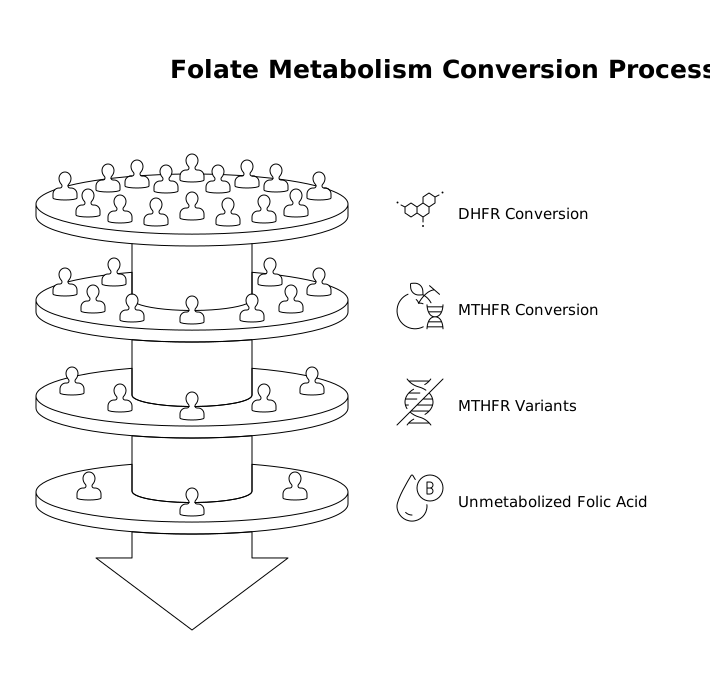
- Folic acid. The fully oxidized synthetic form. Cheap, stable, effective for most people. Used in essentially every US and EU fortified food program since the 1990s. Requires metabolic activation through the MTHFR enzyme (methylene- tetrahydrofolate reductase) to become the biologically active L-5-MTHF form.
- Metafolin / L-5-MTHF. The already-active, reduced form. No MTHFR conversion required. Bioidentical to the folate circulating in human blood and the folate found naturally in breast milk and leafy greens.
Both are legally permitted as folate sources in infant formula under both EU Regulation 2016/127 and US FDA 21 CFR 107. The choice is at the brand's discretion.
Visual generated with Napkin AI, editorial review by María López Botín. See methodology for our use policy.
The MTHFR question
The MTHFR enzyme has a common polymorphism, the C677T variant, that reduces enzyme activity. People with the TT genotype (homozygous for the variant) have roughly 30–40% of normal MTHFR function. People with the CT genotype (heterozygous) have about 65–70%. The prevalence varies by population:
- Non-Hispanic white US: ~12% TT, ~42% CT
- Hispanic US: ~21% TT, ~47% CT
- African American US: ~2% TT, ~25% CT
- European populations: varies widely, generally 10–20% TT
For people with reduced MTHFR function, folic acid supplementation works less efficiently because the conversion step is slowed. They still get enough folate for most purposes, but the conversion bottleneck is real and measurable. L-5-MTHF (Metafolin) bypasses this step entirely.
Does this matter for a healthy infant?
Clinically, for the average formula-fed baby: the difference between folic acid and Metafolin is small. Folic acid is effective, safe, and adequate at the fortification levels used in infant formula. The infant's MTHFR enzyme, even with a variant, gets enough substrate through and maintains folate status.
The cases where it matters more:
- Infants with MTHFR TT who also have suboptimal folate intake from other sources. Rare but theoretically relevant.
- Parents of MTHFR-variant infants who are themselves aware of the polymorphism and want to optimize early nutrition. A minority but vocal group in the parenting-forum world.
- Long-term health signaling. Some researchers argue that lifetime exposure to unmetabolized folic acid (UMFA), the synthetic form that hasn't been converted , may have independent effects on methylation, epigenetics, or cancer risk. This is contested and the evidence is not definitive.
Which formulas use which
- HiPP across its product lines uses calcium L-methylfolate (Metafolin) rather than folic acid. Our HiPP Dutch Stage 1 record confirms this, and the full HiPP brand hub details this across the Dutch, German, and UK lines. HiPP has positioned Metafolin as a deliberate differentiator for years.
- Holle historically uses folic acid, though their newer biodynamic line has been reformulated.
- Kendamil uses folic acid in standard formulations.
- Most US major brands (Similac, Enfamil, Bobbie) use folic acid.
- Specialty or "premium" US formulas occasionally use L-methylfolate.
A parent specifically wanting Metafolin for MTHFR reasons or for theoretical optimization will find HiPP the most widely available option in the US-import channel. Our Infant Formula Atlas lets you cross-reference by folate form as additional SKU records are documented.
Evidence summary
- Bioavailability. L-5-MTHF is bioavailable for everyone; folic acid is bioavailable for people with normal MTHFR function but less efficient for variant carriers. Trials in adults show L-5-MTHF produces more stable blood folate levels than equivalent folic acid doses.
- Infant-specific trials. There are few head-to-head trials comparing the two forms specifically in formula-fed infants. The EFSA scientific opinion on L-methylfolate calcium salt (2004) concluded it is a safe and effective folate source in infant nutrition, comparable to folic acid in healthy infants.
- No documented harm from either form at infant-formula fortification levels.
What a parent should actually do
If your pediatrician hasn't flagged a folate or MTHFR concern, both forms work and the difference is small. If you know you or your baby's other parent has an MTHFR variant, or if you prefer to match the breast-milk folate form as closely as possible on principle, HiPP is the straightforward choice among widely-available formulas.
The decision is one of those optimization questions that matters to a minority of parents but is very meaningful to that minority. Our documentation exists to make the choice visible rather than to push either answer.
Frequently asked questions
What's the difference between Metafolin and folic acid?
Which infant formulas use Metafolin?
Does my baby need Metafolin if neither parent has MTHFR variants?
How do I know if I or my baby has MTHFR variants?
Is folic acid harmful?
Does breast milk contain Metafolin or folic acid?
Primary sources
- Scaglione F, Panzavolta G. Folate, folic acid and 5-methyltetrahydrofolate are not the same thing. Xenobiotica 2014, bioavailability and metabolism review. pubmed.ncbi.nlm.nih.gov/31852059
- EFSA Panel on Food Additives, Flavourings, Processing Aids and Materials in Contact with Food. Scientific opinion on calcium L-methylfolate as source of folate in food, EFSA Journal 2004. efsa.europa.eu
- Yafei W et al. MTHFR C677T polymorphism prevalence. Gene 2012. pubmed.ncbi.nlm.nih.gov/19926955
- EU Commission Delegated Regulation 2016/127, permits calcium L-methylfolate and folic acid as folate sources. eur-lex.europa.eu
Related reading
- Brands and comparisons featuring Metafolin, HiPP Dutch Stage 1 vs Bobbie Original (the Metafolin vs folic acid decision expressed as a product choice), HiPP brand hub (uses Metafolin across the Combiotik line), Holle brand hub, Kendamil brand hub
- EU Regulation 2016/127, why Metafolin
- FDA vs EFSA standards compared
This site provides research and comparisons, not medical advice. Consult your pediatrician before changing your baby's formula.