
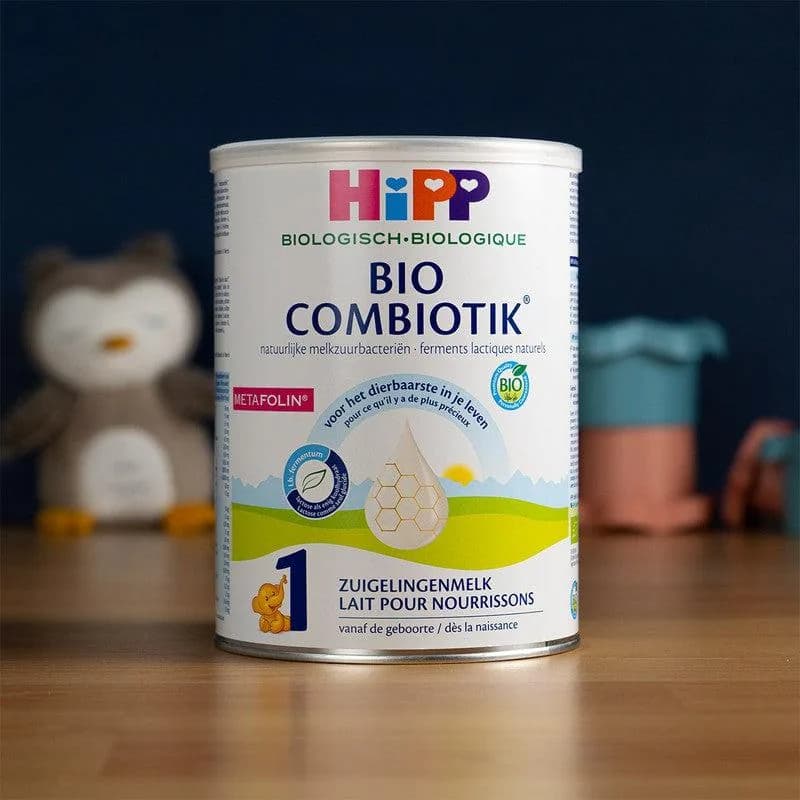
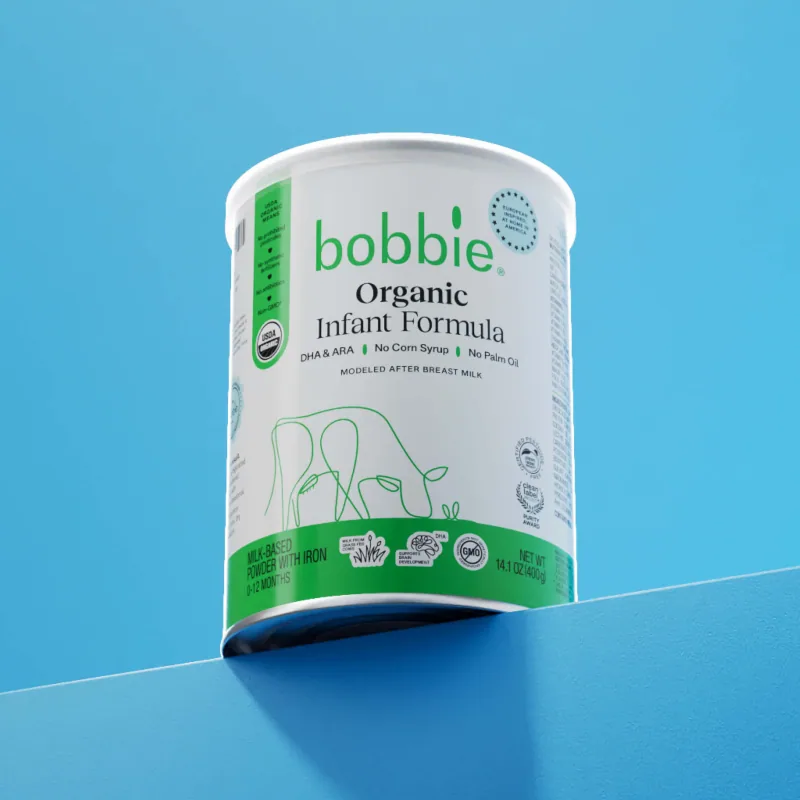
Of every head-to-head a US parent asks about, "HiPP Dutch vs Bobbie" is near the top of the list. One is the flagship EU Organic import: clean composition, Metafolin folate, added probiotic, imported through Organic's Best Shop with multi-day shipping. The other is the flagship US organic: USDA Organic certified, FDA-registered under 21 CFR 107, shipped domestically with next-day retail at Target and Amazon. Both are lactose-primary. Both are pediatrician-acceptable for healthy term infants. The real question is which trade-offs fit your family, not which formula is "better."
HiPP Dutch Stage 1 and Bobbie Original are both EU/US flagship Stage 1 organic cow-milk formulas with lactose-primary composition. HiPP adds Metafolin folate (bioactive form), GOS prebiotic, and L. fermentum probiotic; Bobbie keeps a simpler additive-light profile but carries USDA Organic and FDA registration. HiPP imports via Organic's Best Shop with 5–10 day shipping and ~$1.80/oz; Bobbie ships domestically via subscription or Target/Amazon at ~$1.84/oz. The right choice is driven by supply resilience priorities and whether bioactive depth is worth the import logistics.
Why this comparison exists
HiPP and Bobbie occupy the same place in most parents' mental model: "the good stuff." Both are talked about in the same breath on Reddit, Instagram parent groups, and pediatrician recommendations. Both have grown fast since 2020 as parents have moved away from corn-syrup- primary conventional formulas toward lactose-first organic options.
They are also, in their ingredients, closer than most parents realize. The differences that actually distinguish them are narrow but specific: bioactive additions, folate form, fish-oil vs algal DHA, manufacturing location, and, operationally, how you actually get the can in your kitchen. That last point is often the real tiebreaker.
At a glance
| Dimension | HiPP Dutch Stage 1 | Bobbie Original |
|---|---|---|
| Manufacturer | HiPP GmbH (Netherlands) | Bobbie Baby Inc. (US, Perrigo contract) |
| Origin | Netherlands (EU Organic, SKAL certified) | USA (USDA Organic certified) |
| Age range | 0–6 months (EU Stage 1) | 0–12 months (US standard) |
| Regulation | EU 2016/127 and Organic 2018/848 | FDA 21 CFR 107 and USDA NOP |
| Protein | Skimmed cow milk, 60:40 whey:casein | Skimmed cow milk, 60:40 whey:casein |
| Primary carb | Lactose | Lactose |
| Fat blend | Palm, rapeseed, coconut, sunflower | Rapeseed, sunflower, coconut (no palm oil) |
| DHA source | Fish oil (~13 mg/100 ml) | Algal oil (~11 mg/100 ml) |
| Prebiotic | GOS | None (at current formulation) |
| Probiotic | L. fermentum CECT5716 | None |
| Folate form | Metafolin (L-5-methyltetrahydrofolate) | Folic acid |
| Tin size | 800 g | 400 g (14.1 oz) |
| Typical US price | $49.99/800 g (~$1.80/oz) | $26/14.1 oz (~$1.84/oz) |
| US shipping | 5–10 days via Organic's Best | Next-day (Target/Amazon) or subscription |
| Affiliate commission | Yes (Organic's Best) | No |
The site's commercial relationship with HiPP (via the Organic's Best affiliate) is disclosed; the framework below applies the same editorial standard to both brands. See the full affiliate disclosure for how money moves.
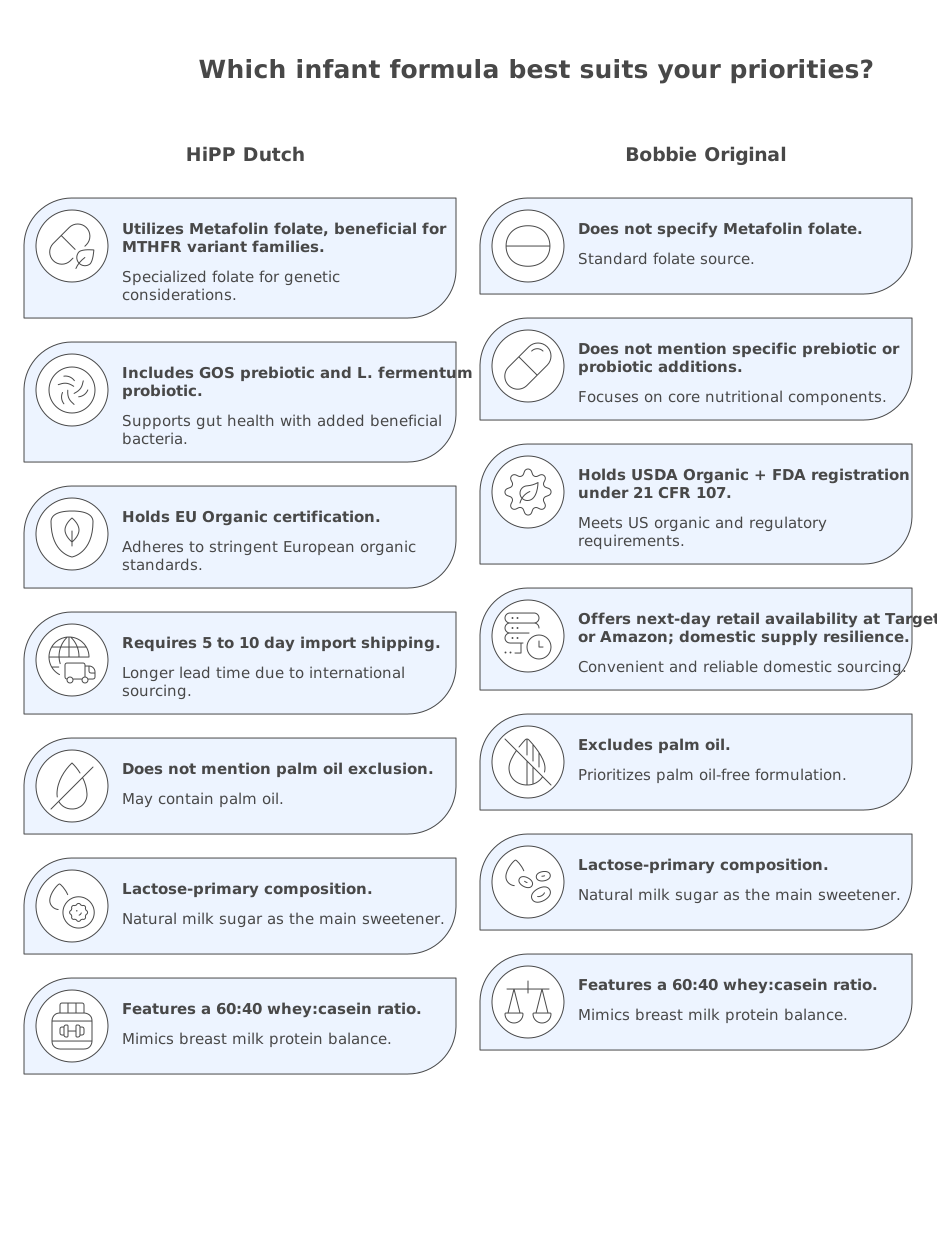
Visual generated with Napkin AI, editorial review by María López Botín. See methodology for our use policy.
Compositional differences that actually matter
Seven dimensions where HiPP Dutch and Bobbie Original diverge in ways parents care about, in descending order of practical relevance.
1. Palm oil presence
Bobbie Original's fat blend excludes palm oil entirely, it uses rapeseed, sunflower, and coconut oils. HiPP Dutch includes palm oil as part of its vegetable-oil blend (along with the same three non-palm oils).
Palm oil is permitted under both FDA, EU rules, and contributes palmitic acid, which is also present in breast milk (~25% of milk fat). The clinical concerns parents raise, calcium soap formation, harder stools, reduced mineral absorption, are real but modest in effect size for most healthy infants.
Parents who specifically want to avoid palm oil on principle (either for sustainability or the calcium-absorption debate) will prefer Bobbie. Parents who don't weight palm oil heavily won't see this as a decision factor. For the full framework see thepalm oil explainer.
2. Metafolin vs folic acid
HiPP Dutch uses Metafolin, the bioactive L-5-methyltetrahydrofolate (L-5-MTHF) calcium salt, as its folate source. Bobbie uses standard folic acid, as do all US-domestic infant formulas.
The distinction matters because roughly 40–60% of the general population carries at least one MTHFR gene variant that reduces the enzyme's ability to convert folic acid into the bioactive methylfolate form. Metafolin is already in the bioactive form, so absorption does not depend on enzyme function.
For infants without known MTHFR status (i.e., most infants), folic acid works fine; the body still processes enough of it. But if you or your partner know you have an MTHFR variant, or if you want to eliminate enzyme conversion as a variable, HiPP's Metafolin is the more conservative choice. Bobbie's stance is that folic acid is the FDA-defined standard and is adequate for the general population, and they are correct about that too. See theMetafolin explainer.
3. Probiotic and prebiotic additions
HiPP Dutch includes GOS (galacto-oligosaccharides, a prebiotic) at EU-regulated levels plus L. fermentum CECT5716, a specific probiotic strain with clinical evidence for supporting Bifidobacterium dominance in the infant gut. Bobbie Original currently contains neither.
Clinically, the effect size of GOS and L. fermentum on infant gut microbiome composition is modest but real, moving the formula-fed microbiome closer to the breast-fed pattern, reducing some markers of GI distress. It does not make HiPP-fed infants microbiome-equivalent to breast-fed infants, and Bobbie-fed infants are not disadvantaged; they simply have a microbiome more typical of formula-fed infants generally.
For parents who weight microbiome-related claims as a decision factor, HiPP has the edge. See themicrobiome evidence review for where the claims hold up and where they are oversold. Bobbie has announced HMO-enriched variants in their roadmap but as of April 2026 the standard Bobbie Original does not include them.
4. DHA source: fish oil vs algal oil
HiPP Dutch sources its DHA from fish oil. Bobbie uses algal oil (typically Schizochytrium sp.). Both deliver DHA as the same molecule, produce equivalent plasma, and tissue DHA levels in infants.
The practical difference is only about sourcing preference: vegetarian families typically prefer algal DHA; sustainability- focused families are split (fish oil raises overfishing concerns; algal DHA raises industrial-monoculture concerns). Neither choice has a superior clinical outcome for infant cognitive or visual development, the DHA target is met either way.
5. Age range: Stage 1 scope
This one catches parents off-guard. HiPP Dutch Stage 1 is the EU 0–6 month formula; at 6 months the manufacturer expects you to transition to Stage 2. Bobbie Original is the US 0–12 month formula; there is no separate Stage 2.
In practice, many parents using HiPP Dutch stay on Stage 1 past 6 months and never switch, which is clinically acceptable (the composition remains adequate for a 7-month-old who is also eating solids). But the manufacturer labeling and per-tin volume math differ: Bobbie is designed to be a 12-month formula; HiPP Dutch is designed for 6 with an implicit follow-on. For the stage-progression framework seewhen to switch formula stages.
6. Manufacturer and supply chain
HiPP is a German-headquartered company with Dutch manufacturing for the Dutch-market SKU. Supply chain: cow milk sourced from HiPP- contracted organic dairy farms in the Netherlands, processed at the HiPP Dutch facility, packaged with SKAL Dutch organic certification. Brand has operated since 1956 in its modern form, with the organic line since the 1950s origin story.
Bobbie is a US company founded in 2018 by a mother-led team. Manufacturing is contracted to Perrigo (the primary US private-label infant formula manufacturer; same facility that produces Parent's Choice, Up&Up, and Mama Bear) with Bobbie-specific formulation oversight. Supply chain: milk from USDA Organic-certified US and European dairy partners, manufactured in Perrigo's Michigan facility.
Both supply chains passed their respective regulatory scrutiny. Both have managed supply reliability during recent US shortage events — HiPP because it's independent of US Abbott/Reckitt supply chains, Bobbie because they maintain Perrigo manufacturing independent of the brands that failed in 2022.
7. Price per ounce and availability
parents typically pay ~$1.80–$1.85 per ounce for either formula, which is closer than the sticker difference ($50/tin vs $26/tin) implies: HiPP's 800g tin just yields more ounces. The real economic difference is in access logistics:
- HiPP Dutch arrives via Organic's Best Shop with 5–10 day shipping from EU warehouses. Subscribe-and-save discounts available. You need to plan ahead; running out requires waiting for the next shipment.
- Bobbie arrives next-day from Target, Amazon, or via Bobbie's own subscription. Out-of-stock events have been rare since Bobbie expanded manufacturing capacity in 2023.
If same-day availability matters, Bobbie wins. If you can maintain 2–4 weeks of stock and are comfortable with occasional shipping delays, HiPP is fine.
Regulatory framework: the claim each brand makes
Both brands claim something legitimate but the claims are about fundamentally different regulatory systems, and understanding the difference clears up a common parent confusion about "which one is actually approved." Short answer: both, but by different authorities, each under different compositional and quality-control rules.
HiPP Dutch Stage 1 complies with EU Regulation 2016/127 (infant formula and follow-on formula) plus EU Regulation 2018/848 (organic). Dutch organic certification (SKAL) verifies the organic claim. EU 2016/127 is somewhat stricter than FDA 21 CFR 107 on several dimensions: lactose must be the predominant carbohydrate, DHA is mandatory, and specific nutrients have upper limits as well as lower.
Bobbie Original complies with FDA 21 CFR Part 107 (US infant formula) plus USDA National Organic Program (NOP) standards. It is fully FDA-registered, meaning it passed pre-market notification with FDA review of composition, labeling, and manufacturing controls. USDA Organic requires ≥95% organic ingredients by weight and strict farming standards.
Neither framework is universally superior. EU 2016/127 is more prescriptive on composition; FDA 21 CFR 107 has somewhat heavier quality control and recall mechanisms. For the full side-by-side seeFDA vs EFSA standards compared andEU Organic vs USDA Organic.
The parent-facing takeaway: HiPP Dutch is not FDA-registered (US parents import under FDA enforcement discretion for personal use), and Bobbie is not EU-certified. Each is legitimate in its home market. See thebuying European formula in the US pillar for the import legality question specifically.
Real-world parent experience
This section is labelled parent-experience per the site methodology: observations from María's own use and from a stable pool of parent-feedback notes, not regulatory claims. Individual variation is large enough that any of these points can reverse for a specific baby, read as context for expectations, not prediction.
Smell and taste. HiPP Dutch has a slightly more noticeable dairy aroma when prepared, not unpleasant, just more assertive than Bobbie. Bobbie prepares with a cleaner, softer smell. Neither formula has added sweetness or flavoring. Most infants accept both without preference; occasional babies prefer one to the other for reasons that are hard to predict.
Mixability. Both dissolve cleanly in the recommended water temperature. Bobbie tends to dissolve slightly faster; HiPP occasionally leaves a few tiny clumps that resolve with 5–10 seconds of extra shaking. Not a daily concern.
Stool consistency. Reasonably similar. Some parents report slightly firmer stools on HiPP (palm oil and fish-oil DHA effect) and slightly softer stools on Bobbie. Neither is concerning in either direction for a term infant without specific GI issues.
Switching between them. Clinically straightforward for most healthy term infants. A gradual transition (25% new, 50% new, 100% new over 4–6 days) is the conservative protocol. Seeswitching between formula brands for the full protocol.
Verdict: when to pick each
Pick HiPP Dutch Stage 1 if:
- You specifically want Metafolin (MTHFR variant, folate-bioavailability priority)
- You want the added prebiotic and probiotic bioactive depth
- EU Organic certification is meaningful to you independent of USDA
- You can maintain 2–4 weeks of stock to absorb shipping timelines
- Organic's Best subscription pricing works for your budget
Pick Bobbie Original if:
- FDA registration matters to you as a baseline assurance
- No palm oil is a personal priority
- You want same-day retail availability at Target or Amazon
- US-domestic supply resilience weighs more than EU bioactive depth
- The Bobbie founding story and transparency resonate with you
Pick either if:
- You're choosing between these and any corn-syrup-primary US formula. Both HiPP Dutch and Bobbie are materially closer to breast milk composition than any reduced-lactose "sensitive" or "gentle" formula and most conventional national brands.
What you can't infer from this comparison
Neither formula is indicated for diagnosed cow milk protein allergy (CMPA); that's where extensively hydrolyzed (Nutramigen, Alimentum) or amino-acid (Neocate, EleCare, Puramino) formulas belong. SeeCMPA explained.
Neither is specifically indicated for reflux; if your pediatrician has diagnosed GERD or significant reflux, a rice-starch-thickened formula (HiPP AR, Enfamil AR, Similac Spit-Up) or partial hydrolysate is the usual clinical path.
Neither is appropriate for preterm infants under 37 weeks gestation or under 2500g birth weight without pediatrician guidance.
Frequently asked questions
Is HiPP Dutch or Bobbie Original better for sensitive babies?
Can I switch from HiPP Dutch to Bobbie (or vice versa)?
Which is cheaper per ounce?
Is HiPP Dutch legal in the US?
Does Bobbie have a European-style Stage 2 follow-on?
Is HiPP Dutch or Bobbie more likely to be recalled?
What about HiPP German vs HiPP Dutch, which matters more here?
If I care about organic certification specifically, which wins?
Related reading
- HiPP brand hub
- Bobbie brand hub
- HiPP Dutch Stage 1, full SKU record
- Bobbie Original, full SKU record
- Buying European formula in the US
- FDA vs EFSA standards compared
- Is European formula safer than US formula?, the safety question behind this comparison
- Lactose-primary formulas filter
Primary sources
- HiPP Netherlands, official Dutch-market product information. hipp.nl
- Bobbie, official US-market product information. hibobbie.com
- EU Regulation 2016/127: Infant formula and follow-on formula compositional requirements. eur-lex.europa.eu
- FDA 21 CFR Part 107. US infant formula regulation. ecfr.gov
- USDA National Organic Program, organic certification framework. ams.usda.gov
This site provides research and comparisons, not medical advice. Consult your pediatrician before changing your baby's formula.