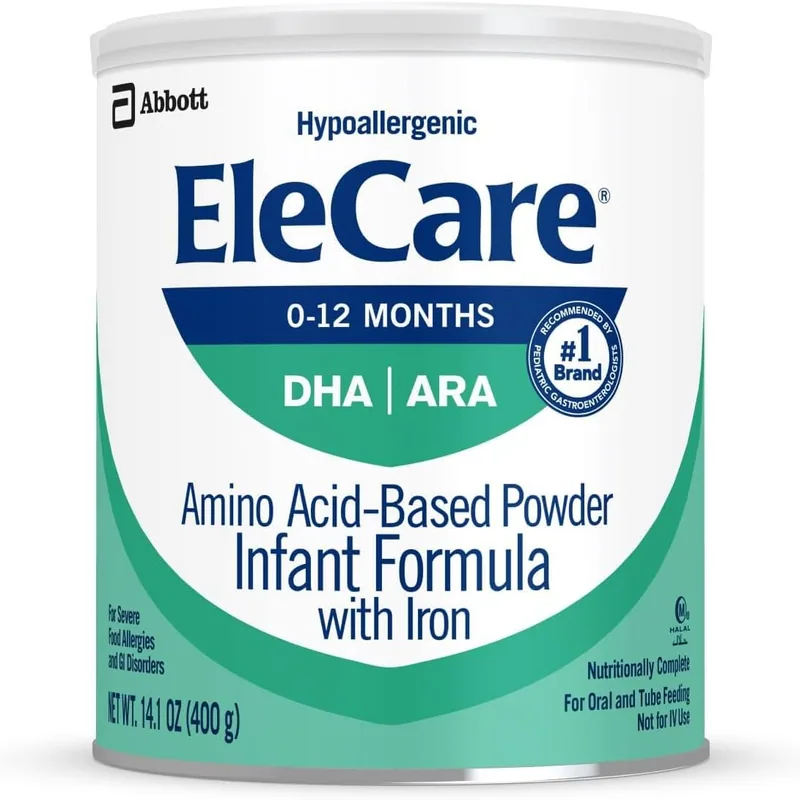
EleCare is Abbott's entry in the amino-acid-based (AAF) specialty formula category. Launched in 2003, it is the second-oldest AAF in the US market after Neocate (1984). Like Neocate and Puramino, EleCare is used for the most severe protein-allergy presentations where even extensively hydrolyzed formulas (eHF) fail to resolve symptoms. EleCare's history is inseparable from the Sturgis, Michigan facility where it is manufactured, the same plant whose 2022 Cronobacter recall triggered the US infant formula shortage and left EleCare-dependent families with particularly acute supply problems, since Sturgis is the sole US EleCare manufacturing site.
EleCare is an amino-acid-based infant formula manufactured by Abbott Nutrition at its Sturgis, Michigan facility. It is used for severe cow milk protein allergy, multiple food allergies, eosinophilic esophagitis, and short gut syndrome. FDA-registered under 21 CFR 107 and typically covered by insurance with medical necessity documentation. The 2022 Sturgis recall caused severe supply disruption for EleCare-dependent families, leading to emergency imports under Operation Fly Formula. Current US distribution is back to normal; the Sturgis plant operates under a consent decree with enhanced FDA oversight.
Company snapshot
| Attribute | Value |
|---|---|
| Parent company | Abbott Laboratories / Abbott Nutrition |
| Founded | 2003 (EleCare launch) |
| Corporate HQ | Abbott Park, Illinois, USA |
| Manufacturing | Sturgis, Michigan, USA (sole US site) |
| Product category | Amino-acid-based infant formula (AAF) |
| FDA registered as infant formula | Yes (21 CFR 107) |
| Sold by Organic's Best Shop | No |
| Insurance coverage | Typically yes with medical necessity docs |
| Cost without insurance | Very high, $60-90+/can; multiple cans/week |
Abbott is the largest US infant formula manufacturer. EleCare is its specialty-allergy SKU in a portfolio that also includes Similac (mass-market) and Similac Alimentum (extensively hydrolyzed specialty). The company's recall history is unusually important for parents evaluating EleCare specifically, see Abbott 2022 recall aftermath and formula recall history USA for the full record.
Where EleCare fits in the CMPA hierarchy
The clinical hierarchy from least to most intervention:
- Partially hydrolyzed formula (pHF), not indicated for diagnosed CMPA
- Extensively hydrolyzed formula (eHF), first-line for CMPA (Nutramigen, Similac Alimentum, Gerber Extensive HA)
- Amino-acid-based formula (AAF), EleCare, Neocate, Puramino
EleCare is used when:
- Extensively hydrolyzed formulas fail to resolve symptoms (approximately 10% of CMPA cases)
- Multiple food protein allergies are present
- Eosinophilic esophagitis is diagnosed
- Severe anaphylactic risk requires zero protein fragment exposure
- Short gut syndrome or severe malabsorption
For the full CMPA framework, see our cow milk protein allergy explained pillar.
EleCare vs Neocate vs Puramino
The three US-available AAFs have meaningful distinctions:
EleCare (Abbott)
- Launched: 2003
- Prebiotic system: No (original EleCare Infant does not include prebiotic synbiotic)
- Probiotic: No
- Distinctive features: Sturgis, MI production; 2022 recall history; simpler formulation than Neocate Syneo
- Common pediatric preference: Clinicians who prefer minimal ingredient lists or have patient-specific tolerability concerns with prebiotic/probiotic additions
Neocate Syneo (Nutricia/Danone)
- Launched: 1984 (original); Syneo mid-2010s
- Prebiotic system: Yes (scGOS/lcFOS)
- Probiotic: Yes (Bifidobacterium breve M-16V)
- Distinctive features: Longest clinical literature; synbiotic system differentiates it from original Neocate and from EleCare
- Common pediatric preference: Specialists who favor the synbiotic premise for gut microbiota restoration in AAF-fed infants
Puramino (Reckitt/Mead Johnson)
- Launched: 2014
- Prebiotic system: Yes (PDX and GOS)
- Probiotic: No
- Distinctive features: Newest of the three; from the same parent company that makes Nutramigen (eHF); prebiotic but not probiotic-fortified
See the Neocate brand hub for the full Neocate profile.
The 2022 Sturgis shutdown impact
The February 2022 Abbott recall, driven by Cronobacter and Salmonella findings at the Sturgis, Michigan facility, shut down US EleCare production for approximately 5 months. Because Sturgis is the sole US EleCare manufacturing site, this created an acute crisis for EleCare-dependent families.
The specialty formula subgroup problem
Standard formula shortages are severe but navigable, parents can switch brands, use RTF, or wait. Specialty-formula shortages are fundamentally different:
- EleCare users have severe, medically diagnosed conditions that make most other formulas unsuitable
- Switching to Neocate or Puramino requires medical reassessment (some infants tolerate one AAF better than another for subtle reasons)
- Emergency formula substitutions risk anaphylactic reactions or severe GI symptoms
Operation Fly Formula response
Federal government response specifically targeted the AAF subgroup:
- Nestlé Alfamino imported from Europe via military aircraft
- EleCare alternatives flown in from Abbott's Ireland facility
- Bubs/Bebelac and other brands airlifted specifically for specialty use
For the full chronology, see our Abbott 2022 recall aftermath pillar.
Current status
Sturgis reopened EleCare production first (July 2022), before resuming standard Similac production. The plant now operates under a consent decree including:
- Enhanced environmental monitoring
- Third-party audit requirements
- Expanded microbiological testing
- FDA oversight frequency increases
US EleCare supply has returned to pre-2022 availability. Whether the consent decree conditions translate to measurably reduced future risk is a reasonable open question.
Product line
EleCare Infant (flagship)
Amino-acid infant formula for 0-12 months, FDA-registered under 21 CFR 107.
See the SKU record: EleCare Infant.
EleCare Jr (12+ months)
Amino-acid formula for toddlers. Not regulated under 21 CFR 107. Available in vanilla and unflavored variants.
Regulatory and insurance
FDA 21 CFR 107 status
EleCare Infant is FDA-registered as infant formula. Full nutritional compliance for the 0-12 month range when used as sole nutrition.
Insurance coverage
As with Neocate:
- Typically covered by US private insurance and Medicaid/CHIP with diagnosis and letter of medical necessity
- Often documented failure of eHF trial required before AAF coverage is approved
- WIC coverage varies by state; typically requires prescription
Out-of-pocket cost
$60-90+ per can; similar order-of-magnitude to Neocate. Annual out-of-pocket without insurance: $7,000-12,000+.
Practical notes for parents
Introducing EleCare
Usually under pediatric GI or allergist supervision. Key points:
- Taste, free amino acids are bitter; many infants resist initially
- Preparation, standard Cronobacter prevention (70°C water) per WHO/CDC/FDA guidance. See how to prepare baby formula safely.
- Growth monitoring, close follow-up every 2-4 weeks initially
- Insurance pre-authorization, handle the paperwork before the first can runs out
EleCare vs Neocate decision
This decision is typically made by the pediatric specialist based on:
- Infant's specific allergic profile
- Response to initial trials
- Tolerability of the prebiotic synbiotic system in Neocate Syneo
- Insurance formulary preferences
- Clinician familiarity
There is no clear clinical winner between the three US AAFs. All three are used successfully; the difference is in specific infant tolerability and clinical experience.
Editorial notes from María
EleCare is not a brand parents choose, it is prescribed. The Atlas includes it as a reference hub for several reasons:
- Parents navigating severe CMPA need to understand all three AAF options and how they compare
- EleCare-specific history (the 2022 Sturgis shutdown) is clinically relevant for families considering or using the product, supply resilience matters
- The AAF category is underserved by consumer-facing resources; most information lives in pediatric GI literature and manufacturer sites
EleCare is not sold by Organic's Best Shop. This hub exists for Atlas completeness. Parents navigating severe allergy diagnoses should work with pediatric gastroenterology or allergy specialists as primary clinical advisors.
For related profiles:
- Neocate: Nutricia AAF peer with synbiotic system
- Nutramigen, eHF from the same parent company as Puramino
- Alimentum: Abbott eHF also Sturgis-produced
Frequently asked questions
The questions below come up most often when families navigate EleCare for the first time — typically after a CMPA, FPIES, or EoE diagnosis where the pediatric specialist recommends an amino-acid formula. The answers reference the FDA 21 CFR 107.30 framework for exempt infant formula and the AAP/NASPGHAN clinical guidance on amino-acid formulas as second-line CMPA management.
Is EleCare available without a prescription?
What's the difference between EleCare and Neocate?
Will my insurance cover EleCare?
How long does it take to see if EleCare is working?
Can I switch from extensively hydrolyzed (eHF) to EleCare without specialist input?
Does EleCare taste different from regular formula?
Was EleCare affected by the 2022 Abbott Sturgis recall?
Primary sources
- Abbott Nutrition: EleCare product information. abbottnutrition.com/elecare
- FDA: Infant Formula Guidance and 21 CFR 107 regulation. fda.gov
- FDA: Abbott Nutrition Consent Decree (May 2022) and Sturgis facility oversight post-recall.
- NASPGHAN: Clinical guidelines on CMPA management. naspghan.org
- AAP: Clinical Report on food allergy prevention and management. aap.org
Related reading
This site provides research and comparisons, not medical advice. Consult your pediatrician before changing your baby's formula.