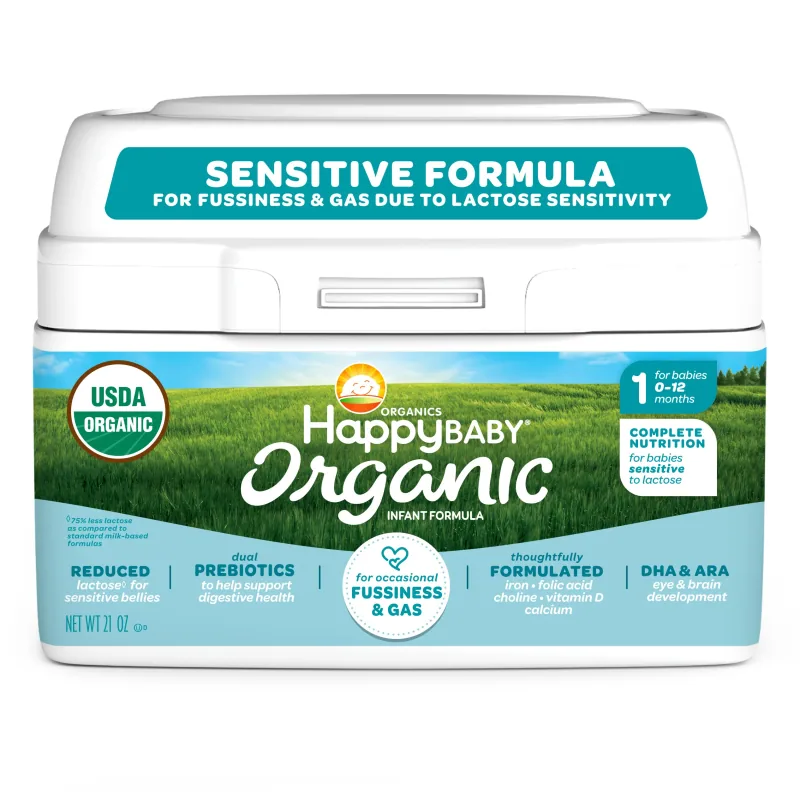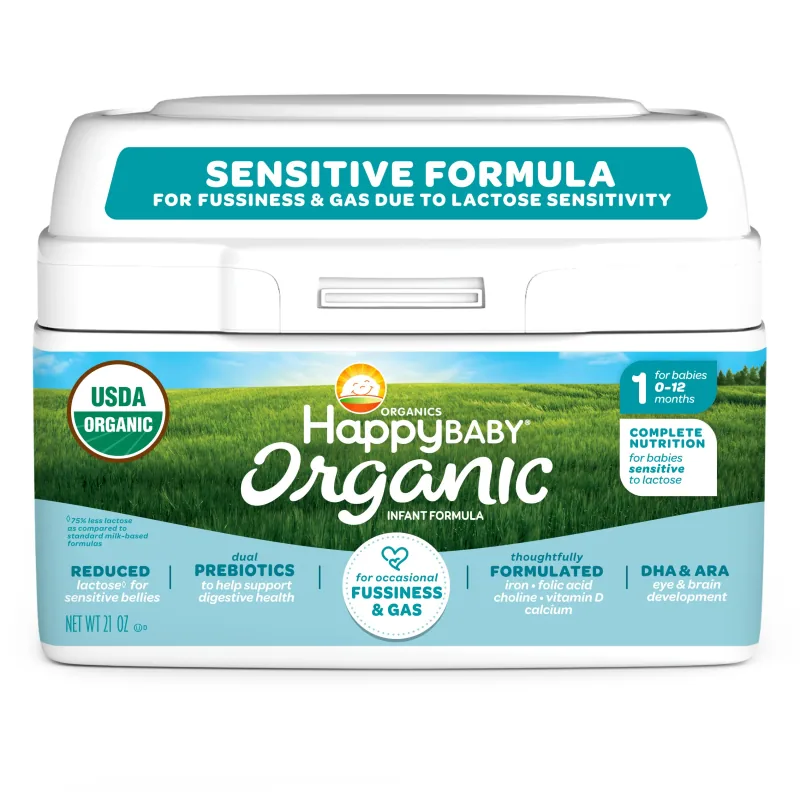
Reference coverage. Happy Baby Organic isn't sold by Organic's Best. We cover it because it's a widely-stocked US organic infant formula that parents frequently encounter at Whole Foods, Target, and specialty baby stores. Honest editorial, no commercial funnel.
Happy Baby Organic is the infant formula arm of Happy Family Organics, a US baby-food brand founded in 2006 and acquired by Danone (through Nurture, Inc.) in 2013. The broader brand is best known for organic baby food pouches at US retail; the infant formula launched more recently as a response to the post-2022 US market demand for cleaner organic US formula options. Happy Baby sits in a similar market position to Earth's Best Organic: US organic entry point, widely retailed, priced below Bobbie.
What defines Happy Baby Organic
- USDA Organic across the infant formula lines. Certified organic milk sources, organic vegetable oils.
- FDA-registered under 21 CFR 107.
- Non-GMO Project Verified. US recognized non-GMO certification.
- Danone-backed manufacturing: Happy Baby uses Danone's Nutricia manufacturing network for some production, which brings Danone's infant-nutrition R&D expertise to US organic market positioning.
- Mixed carbohydrate composition. Despite marketing mentioning "organic lactose," the ingredient list for Happy Baby Stage 1 Organic shows organic maltodextrin and organic glucose syrup solids as the primary added carbohydrates, with lactose coming from the organic nonfat milk component rather than as a standalone ingredient. This is a less clean carbohydrate profile than Bobbie (lactose-first explicit) or Earth's Best Dairy (organic lactose listed first). Parents specifically avoiding added maltodextrin or glucose syrup should cross-reference the actual label against Happy Baby's marketing.
Where Happy Baby fits in the US organic landscape
For parents comparing US organic options:
- vs Bobbie. Bobbie is newer (2020) with explicit EU-style composition. Bobbie includes lactoferrin; Happy Baby does not. Bobbie positions premium; Happy Baby is more mainstream-priced. Both are USDA Organic and FDA-registered.
- vs Earth's Best Organic. Both are long-running US organic. Happy Baby has Danone backing (Nutricia R&D); Earth's Best has Hain Celestial. Similar pricing, similar retail footprint. Earth's Best has broader SKU range (Sensitivity, Soy, Plant-Based); Happy Baby has fewer variants but newer formulations.
- vs European organic (HiPP, Holle, Kendamil). European organics remain stronger on attribute depth (Metafolin, GOS and FOS ratio, Demeter certifications) and regional sourcing. Happy Baby's advantage: US retail convenience and FDA registration.
- vs mainstream US non-organic (Similac, Enfamil). Happy Baby is organic; the mainstream brands are not. For parents whose baseline requirement is organic certification, Happy Baby is a step up from the non-organic US options.
Danone backing: what it means
Happy Baby's acquisition by Danone in 2013 brought Nutricia-style infant nutrition R&D into the Happy Baby product development. That produces a composition that's more "technically thoughtful" than the 1985-era Earth's Best formulation approach, you see evidence of the Danone influence in specific ingredient choices (DHA/ARA dual-source, prebiotic fiber additions, specific amino acid supplementation).
That said, Happy Baby is positioned for the US organic retail market, not premium, so it doesn't go as far into bioactive ingredients as Danone's premium European Aptamil Profutura line does. The positioning is "US organic, Danone backbone, mainstream price point."
Regulatory posture
- FDA-registered under 21 CFR 107.
- USDA Organic across main lines.
- Covered by some state WIC programs with specific contract agreements.
Recall history
- Historical lot-level recalls for packaging issues, routine for any long-running infant formula operation.
- Not implicated in the 2022 Abbott Cronobacter crisis (separate manufacturing network).
No broad active recall affecting Happy Baby as of April 2026.
My take on Happy Baby Organic for parents
Happy Baby Organic is a reasonable choice when the parent wants:
- USDA Organic certification at a mainstream US retail price point.
- US FDA-registered formula (no import/enforcement-discretion framework).
- Availability at typical US retailers (Whole Foods, Target, Amazon).
- Danone/Nutricia manufacturing background (implicit R&D credibility).
The trade-offs:
- Not as composition-optimized as Bobbie for parents who care about lactoferrin, HMO content, or specific bioactive depth.
- Lower SKU variety than Earth's Best (no dedicated soy, plant-based, or toddler-specific lines at equivalent scale).
- Sensitive variant uses glucose syrup solids as secondary carb (typical US pattern).
For parents whose baseline priority is "USDA Organic, US retail, and not European import" without premium-tier requirements, Happy Baby is a credible choice. For parents prioritizing specific bioactive ingredients, Bobbie or European imports remain stronger.
All Happy Baby Organic formulas
Every Happy Baby Organic SKU currently documented in the Atlas appears below. Each entry links to the individual product record with verified nutrition per 100 ml, resolved ingredients, certification status, and retail availability. For a side-by-side comparison against other brands, add any of these SKUs to the compare tool; for one-dimension filters (origin, protein, certifications, red flags) start from the Atlas root.
FAQ
Is Happy Baby Organic actually organic?
Is Happy Baby FDA-approved?
How does Happy Baby compare to Bobbie?
Is Happy Baby made in the US?
Does Happy Baby have DHA and ARA?
Is Happy Baby covered by WIC?
Sources
- Happy Family Organics corporate: https://www.happyfamilyorganics.com/
- Danone corporate: https://www.danone.com/brands/specialized-nutrition-brands.html
- FDA infant formula registration: https://www.fda.gov/food/infant-formula-guidance-documents-regulatory-information
- USDA National Organic Program: https://www.ams.usda.gov/about-ams/programs-offices/national-organic-program
- Non-GMO Project: https://www.nongmoproject.org/
Related reading
- Head-to-head comparisons, Happy Baby Organic Infant vs HiPP Dutch Stage 1 (USDA Organic with maltodextrin vs EU lactose-only Combiotik), Best baby formulas (clean-label lactose-only vs maltodextrin-primary), Best baby formulas (supermarket USDA Organics head-to-head), and Happy Baby Organic Infant vs Similac Organic (Danone vs Abbott USDA Organic)
- EU Organic vs USDA Organic compared
- FDA 21 CFR 107 explained
- FDA vs EFSA standards, the lactose-predominance regulatory divergence
This site provides research and comparisons, not medical advice. Consult your pediatrician before changing your baby's formula.