
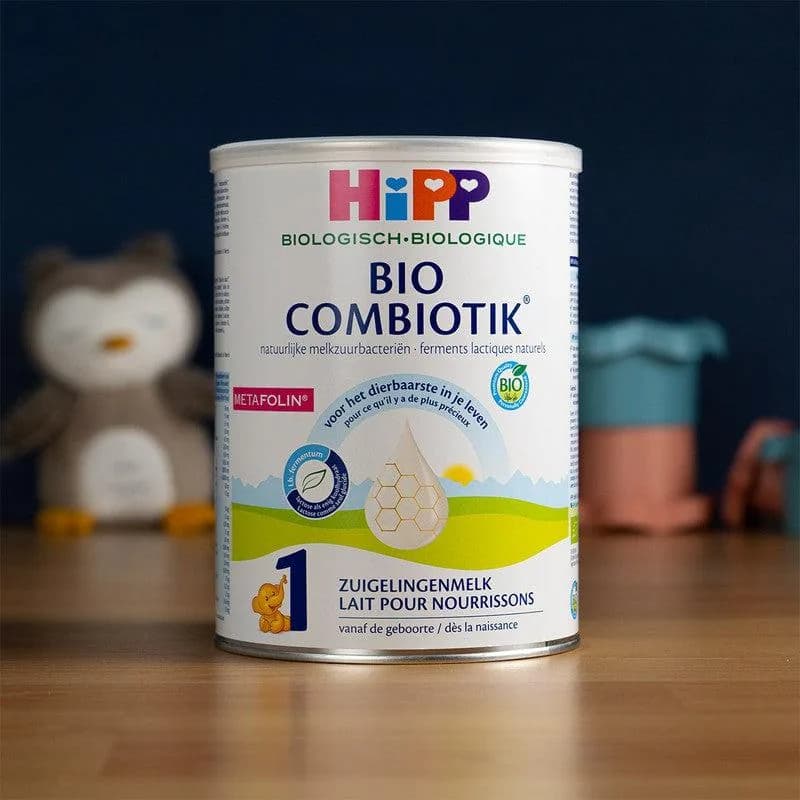
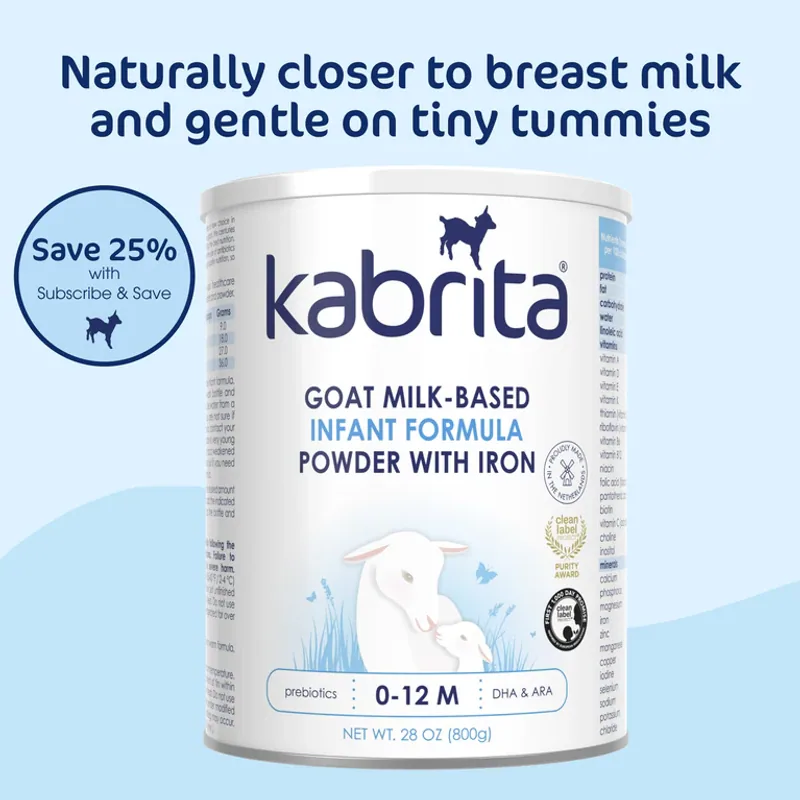
HiPP Dutch Stage 1 and Kabrita Stage 1 represent two structurally distinct premium Stage 1 options — HiPP Dutch is the EU Organic Combiotik cow-milk flagship (probiotic plus Metafolin), Kabrita is the non-organic Dutch goat-milk formula with 2'-FL HMO plus sn-2 palmitate. Both Dutch-origin manufacturing, different protein species, different bioactive layering, different regulatory pathways.
HiPP Dutch Stage 1 is a Dutch EU Organic cow-milk formula with skimmed cow milk, lactose-only carbohydrate, GOS prebiotic plus Limosilactobacillus fermentum hereditum live probiotic, Metafolin bioactive folate, palm oil and rapeseed and sunflower fat blend (no soy), ~$1.77/oz delivered. Kabrita Stage 1 is a Dutch non-organic goat-milk formula with lactose-primary, GOS plus 2'-FL HMO, sn-2 palmitate plus rapeseed and sunflower (no soy), 60:40 whey:casein, ~$2.71/oz at US retail. EU Organic cow with probiotic vs HMO goat at retail.
Why this comparison matters
Both formulas come from the Dutch goat/cow specialty manufacturing ecosystem. HiPP Dutch is the EU-Organic-Combiotik gold standard for US-imported cow-milk. Kabrita is the US-retail goat-milk option with 2'-FL HMO inclusion. Parents typically arrive at this matchup researching protein species while also weighting bioactive depth (probiotic vs HMO) and regulatory pathway (FDA enforcement discretion via personal import vs FDA enforcement discretion direct retail).
At a glance
| Dimension | HiPP Dutch Stage 1 | Kabrita Stage 1 |
|---|---|---|
| Manufacturer | HiPP Group (Dutch operation) | Ausnutria (Netherlands) for Kabrita USA |
| Origin | Netherlands (NL) | Netherlands (NL) |
| Age range | 0-6 months | 0-12 months |
| Regulation | EU 2016/127 (FDA enforcement discretion for US import) | FDA enforcement discretion (US retail) and EU 2016/127 |
| Organic certification | EU Organic (SKAL) | None (Non-GMO Project Verified) |
| Protein source | Skimmed cow milk and whey | Whole goat milk plus goat-milk whey |
| Whey:casein ratio | 60:40 | 60:40 |
| Primary carbohydrate | Lactose only added | Lactose primary |
| Prebiotic | GOS | GOS and 2'-FL HMO |
| Probiotic | Limosilactobacillus fermentum hereditum | None |
| HMO | None | 2'-FL HMO |
| Folate form | Metafolin (bioactive) | Folic acid |
| Fat blend | Palm oil (RSPO), rapeseed, sunflower (no soy) | sn-2 palmitate (structured) plus rapeseed and sunflower (no soy) |
| DHA source | Algal oil, ~13.2 mg/100 ml | Algal oil, ~13.4 mg/100 ml |
| Iron | 0.5 mg/100 ml | 1.1 mg/100 ml |
| Red flags | None | Palm (in sn-2 structured form) |
| Fat-blend notes | Palm oil (RSPO standard form) | None |
| Format | 800 g tin | 800 g tin |
| Typical US price | ||
| US availability | Personal import via Organic's Best Shop, 5-10 day shipping | Target, Amazon, Kabrita US direct |
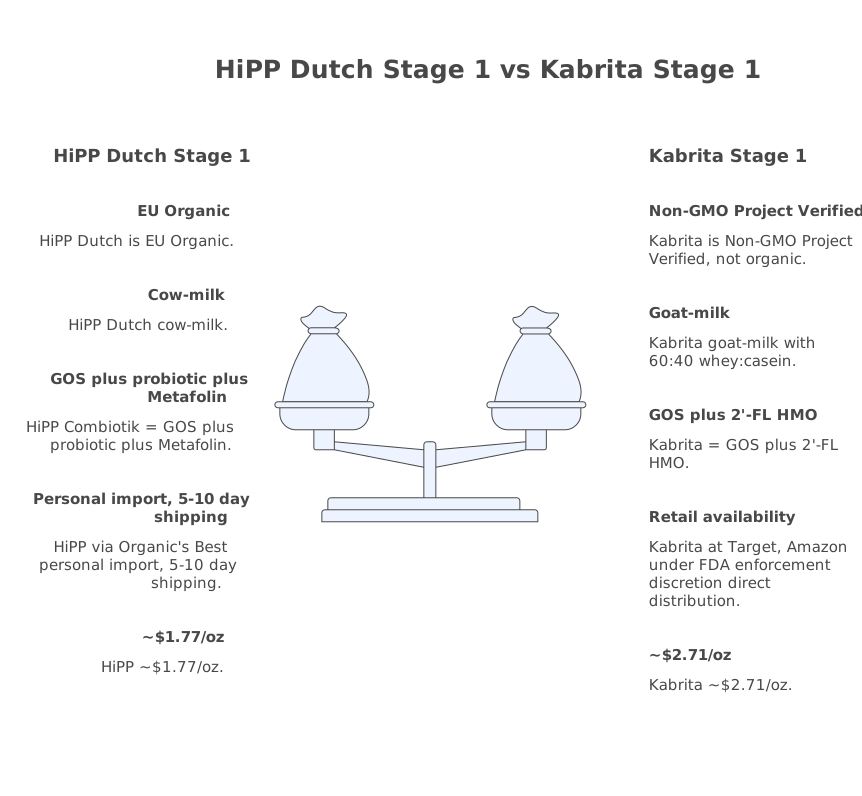
Visual generated with Napkin AI, editorial review by María López Botín. See methodology for our use policy.
Compositional differences that actually matter
Four dimensions where HiPP Dutch and Kabrita diverge.
1. Protein species: skimmed cow vs whole goat
HiPP Dutch uses skimmed cow milk plus whey. Kabrita uses whole goat milk plus goat-milk whey at the breast-milk-matching 60:40 ratio. Goat- milk casein structure differs from cow-milk in ways some families find easier to digest. Goat-milk is not hypoallergenic; cross-reacts with cow-milk proteins in CMPA cases.
2. Bioactive strategy: Combiotik probiotic plus Metafolin vs GOS plus 2'-FL HMO
Different bioactive philosophies. HiPP Dutch's Combiotik = GOS plus live Limosilactobacillus fermentum probiotic plus Metafolin bioactive folate. Kabrita = GOS plus 2'-FL HMO. Probiotic-plus-bioactive-folate vs human-milk-oligosaccharide approach. Neither is clinically superior. See 2'-FL HMO explainer.
For 2'-FL HMO inclusion, only Kabrita carries it among the two. For live probiotic strain plus Metafolin, only HiPP Dutch.
3. Organic certification: EU Organic vs none
HiPP Dutch is EU Organic (SKAL Dutch certifier). Kabrita is not organic (Non-GMO Project Verified). For families weighting EU Organic baseline, HiPP Dutch is the only option between the two. See organic certifications compared.
4. Cost and supply pathway
HiPP Dutch ~$1.77/oz, Kabrita ~$2.71/oz, ~$0.94/oz gap. At typical consumption, ~$94/month difference. Kabrita's premium reflects the goat-milk sourcing plus 2'-FL HMO plus sn-2 palmitate inclusion costs.
Supply: HiPP Dutch via Organic's Best Shop personal-import (5-10 day shipping). Kabrita at Target, Amazon under FDA enforcement discretion direct distribution (next-day-ish). Both available to families, different routes.
Regulatory framework
HiPP Dutch complies with EU Regulation 2016/127, EU Organic Regulation 2018/848, and operates under FDA enforcement discretion for US personal import via Organic's Best Shop.
Kabrita Stage 1 also operates under FDA enforcement discretion but through direct US retail distribution rather than personal import. Kabrita USA is sold at Target and Amazon under this framework.
For the broader regulatory comparison, see FDA vs EFSA standards compared.
Real-world parent experience
Following site methodology, observations come from personal testing plus parent-feedback notes. Read these as context, not prediction. Where my own feeding observations are referenced, they are clearly labeled as parent-experience notes; manufacturer claims and regulatory data are cited separately so the source weight stays explicit.
Smell and taste. HiPP Dutch has a clean, slightly creamier cow- milk profile. Kabrita has a milder goat-milk character (sn-2 palmitate smooths the goat-milk tang). Most infants accept either.
Mixability. Both dissolve cleanly at 70°C. Standard preparation works for both.
Stool consistency. HiPP Dutch families often report softer stools from GOS plus L. fermentum. Kabrita families report softer pattern from GOS plus 2'-FL HMO. Both within normal range.
Switching between them. Use a 4-6 day gradual transition. Protein-species shift plus bioactive shift plus fat-blend shift can produce 7-14 days of adjustment. Most infants tolerate the change.
Verdict: when to pick each
Pick HiPP Dutch Stage 1 if:
- EU Organic certification is your baseline
- Cow-milk protein is fine
- Combiotik probiotic plus Metafolin matters
- Lower per-ounce cost is decisive
- You can absorb personal-import shipping window
Pick Kabrita Stage 1 if:
- Goat-milk protein is the priority
- 2'-FL HMO bioactive in goat-milk format is desired
- US retail next-day-ish availability is required
- Non-organic certification is acceptable
Pick neither if:
- EU Organic goat-milk is the priority (look at Jovie Goat Stage 1 or Holle Goat Stage 1)
- Diagnosed CMPA (look at HiPP HA Stage 1 for HiPP-family hypoallergenic)
What you can't infer from this comparison
Neither is hypoallergenic. HiPP Dutch's Combiotik is HiPP-proprietary; not directly comparable to other probiotic-fortified formulas without clinical evidence specific to L. fermentum hereditum. Kabrita's 2'-FL HMO is identical to the HMO used in Similac Pro-Advance, Kendamil Organic, and other HMO-fortified formulas — the bioactive itself is not species-specific.
Format and supply considerations also matter beyond the per-ounce price. HiPP Dutch's 800 g tin format means roughly two weeks of coverage per tin at typical Stage 1 consumption rates; Kabrita's 800 g tin gives similar coverage. HiPP's import shipping cycle (5-10 days from EU warehouses) means families typically maintain a 2-4 week stock buffer to avoid running out during shipping windows. Kabrita's direct US retail distribution provides next-day-ish replenishment but sometimes faces stock fluctuations at Target and Amazon. Neither formula is WIC-eligible in any state; both are out-of-pocket purchases for families. For supply continuity, HiPP Dutch's established import infrastructure has historically been more reliable than Kabrita's retail-channel availability during demand spikes.
Frequently asked questions
Is HiPP Dutch or Kabrita more bioactive-rich?
Is goat-milk formula safer or healthier than cow-milk for healthy infants?
Does HiPP Dutch have 2'-FL HMO?
Is Kabrita FDA-registered?
Can I switch from HiPP Dutch to Kabrita or vice versa?
Is HiPP Dutch organic and Kabrita not?
Why is Kabrita more expensive than HiPP Dutch?
Related reading
- HiPP brand hub
- Kabrita brand hub
- HiPP Dutch Stage 1, full SKU record
- Kabrita Stage 1, full SKU record
- HiPP Dutch vs Jovie, the EU Organic cow vs goat
- Jovie vs Kabrita, the Dutch goat head-to-head
- Kabrita vs Similac Pro-Advance, the goat vs US cow comparison
- Buying European formula in the USA
- Goat milk protein explainer
- 2'-FL HMO explainer
- sn-2 palmitate explainer
Primary sources
- HiPP, official manufacturer information. hipp.com
- Kabrita USA, manufacturer information for the US-distributed line. kabritausa.com
- EU Regulation 2016/127: Infant formula compositional requirements. eur-lex.europa.eu
- FDA enforcement discretion: Personally-imported and reseller-imported infant formula framework. fda.gov
This site provides research and comparisons, not medical advice. Consult your pediatrician before changing your baby's formula.