
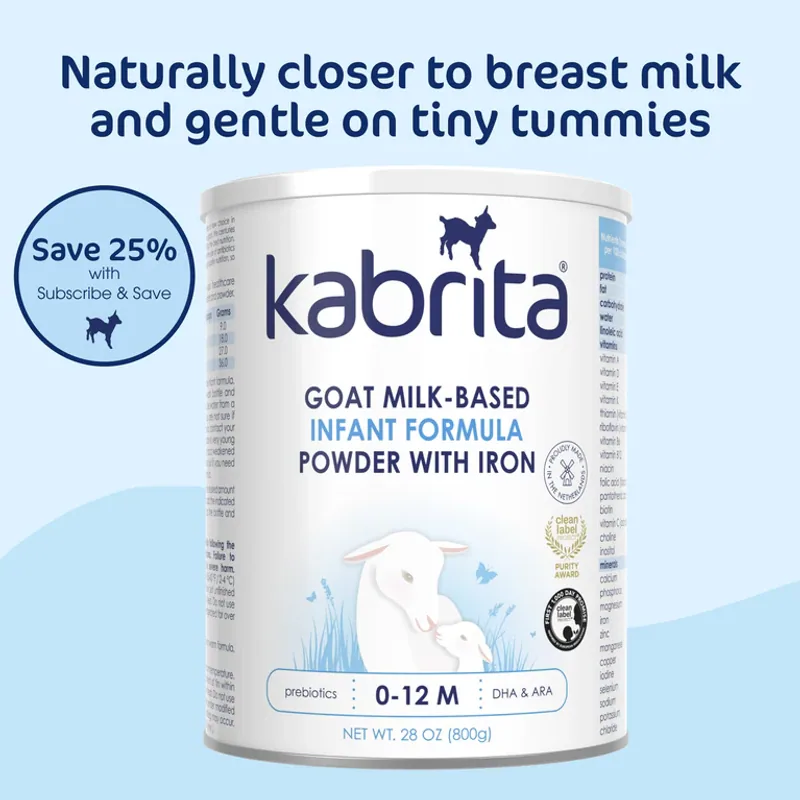
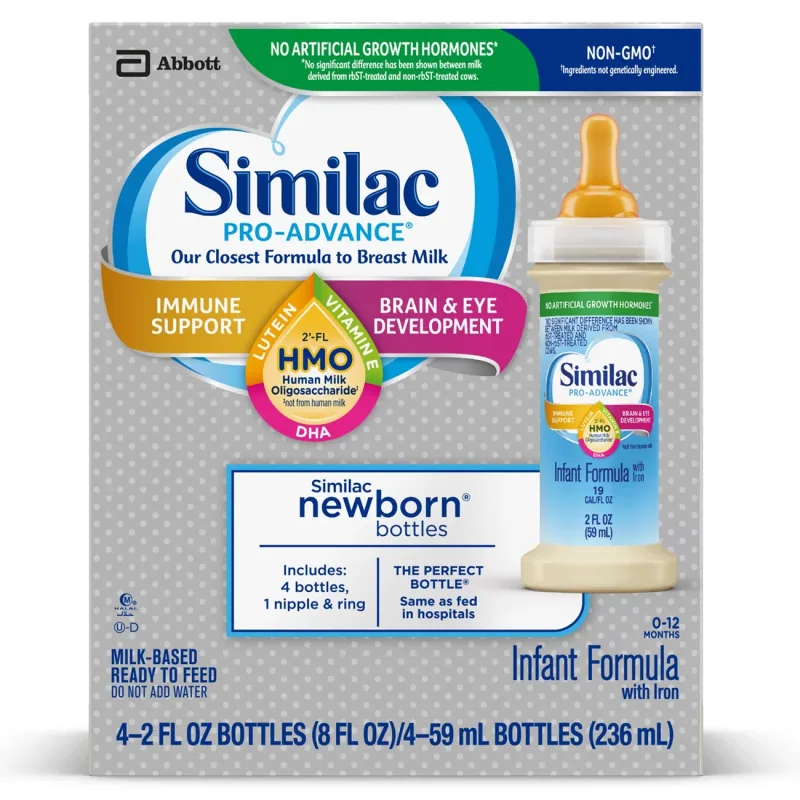
Kabrita Stage 1 and Similac Pro-Advance both include 2'-FL HMO, both include GOS, both arrive without import drama. Beyond that they diverge sharply: Kabrita is Dutch goat-milk with sn-2 palmitate (structured palm oil) and no soy, distributed via FDA enforcement discretion at US retailers including Target and Amazon. Similac Pro-Advance is US cow-milk, FDA-registered, palm-olein-free but soybean-oil-inclusive, WIC-eligible. The decision is the cleanest goat-vs-cow head-to-head available in the US 2'-FL HMO tier.
Kabrita Stage 1 is a Dutch goat-milk Stage 1 formula at 60:40 whey:casein with lactose-primary carbohydrate, sn-2 palmitate structured fat, GOS prebiotic, and 2'-FL HMO, no soy, ~$2.71/oz. Similac Pro-Advance is a US cow-milk formula at 60:40 whey:casein with lactose-primary carbohydrate, GOS, 2'-FL HMO, palm-olein-free but soybean-oil-inclusive fat blend, FDA-registered, ~$1.51/oz at standard retail. Same bioactive headline (2'-FL HMO), different protein species and fat construction.
Why this comparison matters
This is the closest goat-versus-cow comparison parents can make without losing the 2'-FL HMO bioactive. Both formulas carry GOS plus 2'-FL HMO. Both are 60:40 whey:casein. Both are lactose-primary. The remaining differentiators are protein species (goat vs cow), fat-blend philosophy (sn-2 palmitate plus rapeseed plus sunflower vs soy plus coconut plus safflower), and regulatory pathway (FDA enforcement discretion vs FDA registration). Cost differs by ~$1.20/oz at retail, which is the practical anchor for many decisions.
At a glance
| Dimension | Kabrita Stage 1 | Similac Pro-Advance |
|---|---|---|
| Manufacturer | Ausnutria (Netherlands) for Kabrita USA | Abbott Nutrition |
| Origin | Netherlands (NL) | USA (Sturgis MI and Columbus OH) |
| Age range | 0-12 months | 0-12 months |
| Regulation | FDA enforcement discretion (US retail) and EU 2016/127 | FDA 21 CFR 107 |
| Organic certification | None (Non-GMO Project Verified) | None |
| Protein source | Whole goat milk plus goat-milk whey | Skimmed cow milk and whey |
| Whey:casein ratio | 60:40 | 60:40 |
| Primary carbohydrate | Lactose | Lactose |
| Prebiotic | GOS and 2'-FL HMO | GOS and 2'-FL HMO |
| Probiotic | None | None |
| HMO | 2'-FL HMO | 2'-FL HMO |
| Fat blend | sn-2 palmitate (structured) plus rapeseed and sunflower (no soy) | Soy, coconut, safflower/sunflower (no palm olein, contains soy) |
| DHA source | Algal oil, ~13.4 mg/100 ml | Algal oil, ~11.3 mg/100 ml |
| ARA source | Mortierella alpina oil, ~13.4 mg/100 ml | Mortierella alpina oil, ~22.6 mg/100 ml |
| Iron | 0.85 mg/100 ml | 1.2 mg/100 ml |
| Red flags | Palm (in sn-2 structured form, not free palm olein) | Synthetic beta-carotene |
| Fat-blend notes | None | Soy oil and lecithin |
| Format | 800 g tin | ~23.2 oz container |
| Typical US price | ||
| US availability | Target, Amazon, Kabrita US direct | Target, Walmart, Amazon, CVS, WIC, next-day |
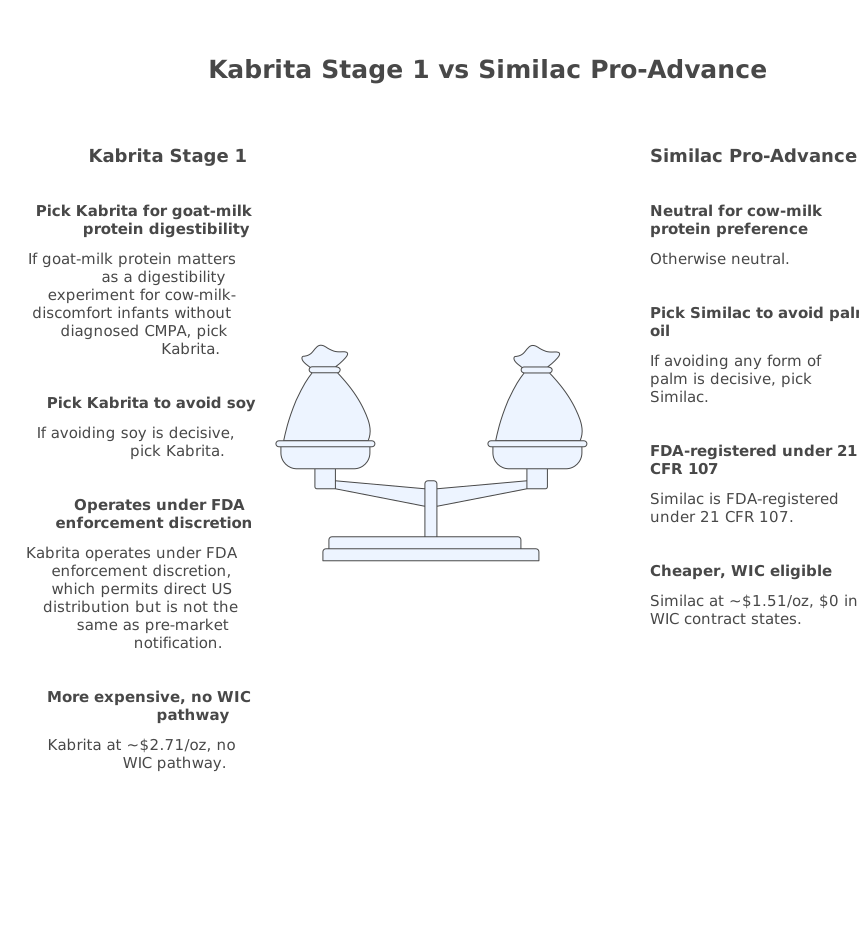
Visual generated with Napkin AI, editorial review by María López Botín. See methodology for our use policy.
Compositional differences that actually matter
Five dimensions where Kabrita and Similac Pro-Advance diverge.
1. Protein species: goat vs cow
The defining difference. Kabrita uses whole goat milk plus goat-milk whey at a 60:40 whey:casein ratio (matching breast-milk ratio). Similac Pro-Advance uses skimmed cow milk plus whey concentrate, also at 60:40. Both ratios match the breast-milk benchmark; the protein species is the divergence. Goat milk has different casein structure (less αs1-casein, more β-casein, smaller native fat globules) and is sometimes easier on infants experiencing generalized cow-milk discomfort (gas, mild fussiness without diagnosis).
Goat milk is not hypoallergenic. Goat and cow milk proteins cross-react in the majority of CMPA cases. See CMPA explained for the clinical distinction. Neither Kabrita nor Similac Pro-Advance is appropriate for diagnosed CMPA.
2. Fat blend: sn-2 palmitate vs vegetable oil construction
Kabrita uses sn-2 palmitate (a structured palm oil fraction with palmitic acid bonded at the sn-2 position rather than the standard sn-1 / sn-3 positions of regular palm olein) plus rapeseed and sunflower oils, no soy. The sn-2 form addresses the calcium-soap and stool-hardening issues associated with regular palm olein. See palm oil explainer and sn-2 palmitate explainer for the mechanism.
Similac Pro-Advance excludes palm olein entirely and uses soybean oil, coconut, safflower or sunflower, and rapeseed instead. Soy oil and soy lecithin are present.
Families avoiding palm in any form pick Similac. Families OK with sn-2-structured palm but avoiding soy pick Kabrita. Both cover the "no free palm olein" baseline, just through different paths.
3. Same bioactive headline: 2'-FL HMO plus GOS
A rare match: both formulas add 2'-FL HMO and GOS. Kabrita is the primary US-available goat formula at this bioactive level; Similac Pro-Advance is the primary US-available cow-milk formula at this bioactive level. See 2'-FL HMO and GOS for the mechanisms.
This neutralizes one of the most-cited US-vs-EU bioactive gaps. The decision shifts to protein species and fat-blend philosophy.
4. DHA, ARA, and iron levels
Kabrita provides ~13.4 mg DHA and ~13.4 mg ARA per 100 ml. Similac Pro-Advance provides ~11.3 mg DHA and ~22.6 mg ARA per 100 ml. Both deliver functional levels for term infants; Kabrita is slightly higher on DHA, lower on ARA. Iron differs: Kabrita ~0.85 mg/100 ml (within EU 2016/127 range), Similac ~1.2 mg/100 ml (US convention). Both are adequate for term infants without iron-deficiency risk; pediatric guidance trumps formula iron level for at-risk infants.
5. Cost, retail availability, and supply
Both formulas are sold at US retail without personal-import logistics. Similac Pro-Advance: ~$1.51/oz at standard retail, $0 in WIC contract states, available next-day at Target, Walmart, Amazon, CVS, Walgreens, and grocery chains. Kabrita Stage 1: ~$2.71/oz, available at Target, Amazon, and Kabrita USA's direct site, no WIC pathway.
The ~$1.20/oz gap is the largest cost differential among US-retail goat-versus-cow Stage 1 options. For families weighting goat-milk protein heavily, Kabrita is the only US-retail goat option with 2'-FL HMO. For families neutral on protein species, Similac is materially cheaper.
Regulatory framework
Kabrita Stage 1 operates under FDA enforcement discretion for infant formula imported to the US. The Kabrita USA distribution operates under this framework rather than FDA pre-market notification, which is why Kabrita is sold directly at Target and Amazon without being characterized as personal import. Kabrita also complies with EU Regulation 2016/127 in its EU markets.
Similac Pro-Advance complies with FDA 21 CFR Part 107 under Abbott Nutrition's pre-market notification, Part 106 quality control, and the FSMA mandatory recall framework. Pro-Advance was not directly affected by the 2022 Sturgis Cronobacter recall — see Abbott 2022 recall aftermath.
For the broader regulatory context, see FDA vs EFSA standards compared.
Real-world parent experience
Following site methodology, the observations below come from my personal testing across both formulas plus a stable pool of parent-feedback notes from families. Read these as context, not prediction.
Smell and taste. Kabrita has a mild goat-milk profile, less tangy than Holle Goat or Jovie due to the sn-2 palmitate fat blend mellowing the protein character. Most infants accept it with no flavor adjustment. Similac Pro-Advance is clean, slightly sweet, typical cow-milk profile.
Mixability. Both dissolve cleanly at 70°C preparation. Similac produces more foam on vigorous shaking from soy oil; swirling reduces it. Kabrita dissolves smoothly with a slightly creamier mouthfeel from the structured fat.
Stool consistency. Both families typically report soft stools, within normal range for healthy term infants on lactose-primary diets with prebiotics. The sn-2 palmitate in Kabrita addresses some of the constipation concerns seen in regular-palm-olein formulas; Similac's palm-free construction sidesteps the issue entirely.
Switching between them. Use a 4-6 day gradual transition. The protein-species shift can produce 5-10 days of stool adjustment; most infants tolerate it without issue.
Verdict: when to pick each
Pick Kabrita Stage 1 if:
- Goat-milk protein is the priority for cow-milk-discomfort experimentation
- Avoiding soy derivatives matters
- sn-2 palmitate structured fat is acceptable (vs strict no-palm)
- You want the goat-milk equivalent of Similac's 2'-FL HMO bioactive
- US retail without import logistics is required
Pick Similac Pro-Advance if:
- Cow-milk protein is fine for your baby
- WIC eligibility makes Similac effectively free in your state
- Strict palm avoidance (in any form) is decisive
- The ~44% lower per-oz cost is decisive
- FDA pre-market registration matters as a baseline assurance
Pick neither if:
- Diagnosed CMPA (goat is not a safe substitute, see hypoallergenic formula explained)
- USDA Organic is required (look at Bobbie Original or Kendamil Organic Stage 1)
What you can't infer from this comparison
Neither is hypoallergenic. Neither is reflux-specific. Kabrita is not USDA Organic and not EU Organic; for organic goat-milk, see Holle Goat Stage 1 (Demeter biodynamic) or Jovie Goat Stage 1 (EU Organic). Similac Pro-Advance is not USDA Organic; for that tier look at Similac Organic or Bobbie Original.
Frequently asked questions
Is Kabrita Stage 1 FDA-registered?
Does Kabrita have 2'-FL HMO?
Why does Kabrita use palm oil if Similac doesn't?
Is Kabrita more expensive than Similac?
Can I switch from Similac Pro-Advance to Kabrita Stage 1?
Is Kabrita organic?
Are Kabrita and Similac Pro-Advance both lactose-primary?
Related reading
- Kabrita brand hub
- Similac brand hub
- Kabrita Stage 1, full SKU record
- Similac Pro-Advance, full SKU record
- Jovie Goat Stage 1 vs Similac Pro-Advance, the EU-Organic goat-milk alternative
- Kabrita vs Jovie, the goat-milk EU comparison
- sn-2 palmitate explainer
- 2'-FL HMO explainer
- Goat milk protein explainer
- HiPP Dutch Stage 1 vs Kabrita Stage 1 - EU Organic Cow Combiotik vs Dutch Goat with 2'-FL HMO
Primary sources
- Kabrita USA, manufacturer information for the US-distributed line. kabritausa.com
- Similac Pro-Advance, official product information. similac.com
- FDA 21 CFR Part 107: US infant formula regulation. ecfr.gov
- FDA enforcement discretion: Personally-imported and reseller-imported infant formula framework. fda.gov
This site provides research and comparisons, not medical advice. Consult your pediatrician before changing your baby's formula.