


HiPP Dutch Stage 2 and Stage 3 are the two follow-on formulas in the HiPP Combiotik line. Stage 2 covers 6-12 months (the classic follow-on formula window); Stage 3 is the "toddler-transition" formula for 10 and months, specifically designed to complement a solids-heavy diet rather than serve as the primary milk. This difference produces the single most counterintuitive stage progression in the HiPP Dutch line: Stage 3 has LOWER energy density than Stage 2 (60 vs 68 kcal/100 ml). Understanding why matters for families making the transition.
Stage 2 (6-12m): energy 68 kcal and protein 1.3 g and iron 1.0 mg and DHA 13.6 mg and carbs 7.2 g, designed as primary milk source alongside solids introduction. Stage 3 (10+m): energy 60 kcal (LOWER) and protein 1.4 g (slightly higher) and iron 0.9 mg and DHA 12.0 mg and carbs 6.0 g (LOWER), designed to complement a solids-heavy diet rather than dominate caloric intake. Same Combiotik, Metafolin, and RSPO palm continuity.
Why this comparison matters
The Stage 2 → Stage 3 transition is less intuitive than Stage 1 → Stage 2. The timing is unclear (HiPP labels Stage 3 for "10+ months" vs Stage 2's "6-12 months", overlap at 10-12 months). The composition differences are subtler but conceptually important: Stage 3 isn't "more" of Stage 2, it's a different formulation philosophy for the toddler window when solids are providing the majority of nutrition. Many families stay on Stage 2 longer or transition to whole cow milk at 12 months instead of moving to Stage 3, both approaches are valid; understanding what Stage 3 actually offers helps the decision.
At a glance
| Dimension | HiPP Dutch Stage 2 | HiPP Dutch Stage 3 |
|---|---|---|
| Age range | 6-12 months | 10+ months (toddler transition) |
| EU classification | Follow-on formula (EU 2016/128) | Young-child / follow-on continuation (EU 2016/128) |
| Energy | 68 kcal / 100 ml | 60 kcal / 100 ml (LOWER) |
| Protein | 1.3 g / 100 ml | 1.4 g / 100 ml (slightly higher) |
| Whey:casein | 60:40 | 60:40 |
| Primary carbohydrate | Lactose | Lactose |
| Carbohydrates | 7.2 g / 100 ml | 6.0 g / 100 ml (LOWER) |
| Fat | 3.7 g / 100 ml | 3.3 g / 100 ml (slightly lower) |
| Iron | 1.0 mg / 100 ml | 0.9 mg / 100 ml |
| DHA | 13.6 mg / 100 ml | 12.0 mg / 100 ml |
| Prebiotic | GOS (Combiotik) | GOS (Combiotik) |
| Probiotic | L. fermentum and L. rhamnosus | L. fermentum and L. rhamnosus |
| HMO | None | None |
| Folate | Metafolin | Metafolin |
| Fat blend | RSPO palm, rapeseed, sunflower, and coconut | RSPO palm, rapeseed, sunflower, and coconut |
| Format | 800 g tin | 800 g tin |
| Typical price (US) | ||
| Primary feeding role | Primary milk source | Complement to solids diet |
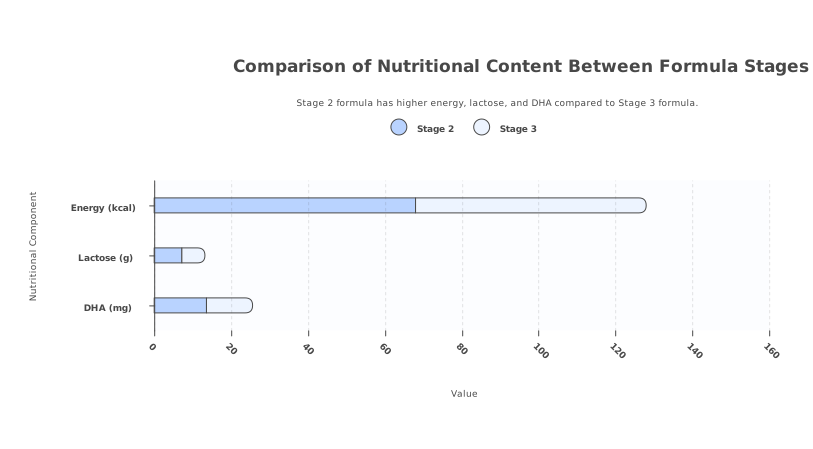
Visual generated with Napkin AI, editorial review by María López Botín. See methodology for our use policy.
Compositional differences: and what they mean
1. Energy density: Stage 3 is LOWER (the counterintuitive change)
Stage 2: 68 kcal / 100 ml. Stage 3: 60 kcal / 100 ml, ~12% lower energy density.
This is the single most unexpected stage transition in the HiPP Dutch line. Most parents expect each subsequent stage to provide more energy. Stage 3 is deliberately less energy-dense because its role has shifted: by 10-12 and months, solid foods should be providing ~50-70% of caloric intake. A toddler-transition formula that matches or exceeds Stage 2's energy density would over-deliver calories when solids are already substantial, potentially displacing solid- food intake.
Stage 3's lower energy is intentional. It's the formula's way of saying: "Your baby should be eating more solids now. I'm here to complement that, not dominate it."
2. Carbohydrate content: Stage 3 LOWER
Stage 2: 7.2 g carbs / 100 ml. Stage 3: 6.0 g carbs / 100 ml, ~17% lower.
Both are lactose-primary, but Stage 3 has less total lactose. The reduction aligns with the energy density reduction, fewer carbohydrate calories in the formula because toddlers get more carbs from their solid-food diet (grains, fruits, vegetables).
3. Protein: Stage 3 slightly higher
Stage 2: 1.3 g protein / 100 ml. Stage 3: 1.4 g protein / 100 ml, ~8% higher.
Protein density rises slightly despite lower total calories. This is a deliberate toddler-transition choice: protein supports growth and development through the 10 and month window, and formula's protein contribution (in a smaller total-volume role) needs to remain robust even as other macros adjust.
4. DHA: Stage 3 slightly lower
Stage 2: 13.6 mg DHA / 100 ml. Stage 3: 12.0 mg DHA / 100 ml, ~12% lower.
DHA reduction aligns with solids contribution. By 10 and months, babies introduced to fish (when appropriate), fortified foods, and diverse solids get additional DHA from their diet. The formula still contributes but in a complementary role.
5. Iron: Stage 3 slightly lower
Stage 2: 1.0 mg iron / 100 ml. Stage 3: 0.9 mg iron / 100 ml.
Very small reduction. Iron demand remains significant in the 10 and month window (growth continues), but solid-food iron sources (meat, iron-fortified cereals, legumes) contribute significantly by this age. Formula iron remains important but in a complementary role.
6. Everything else: Combiotik continuity preserved
Preserved from Stage 2 to Stage 3:
- Lactose-primary carbohydrate
- 60:40 whey:casein ratio
- GOS prebiotic (Combiotik)
- L. fermentum and L. rhamnosus probiotics
- Metafolin folate
- RSPO palm, rapeseed, sunflower, and coconut fat blend
- No HMO (Combiotik remains the bioactive strategy)
- No soy oil
The core composition, bioactive system, fat blend, micronutrient form, continues across the transition.
When to transition from Stage 2 to Stage 3 (or NOT)
HiPP's age labeling: Stage 3 is "10+ months." This creates flexibility, you can transition at 10, 11, 12, or later.
Common US family approaches:
Approach A: Transition at 10-12 months:
- Matches HiPP's label range
- Typical EU family approach
- Keeps formula continuity across 10-12 months when other transitions (solids expansion, cup introduction, potential breastfeeding weaning) are also happening
Approach B: Stay on Stage 2 through 12 months, then transition to whole cow milk:
- Many US pediatric recommendations favor whole cow milk from 12 months (with iron-rich solids as supplement)
- Skips Stage 3 entirely
- Appropriate if solids diet is already substantial and diverse at 12 months
Approach C: Use Stage 3 through 15-18 months as a bridge:
- Some families continue Stage 3 past 12 months before transitioning to whole cow milk
- Appropriate if toddler has picky eating patterns, marginal solids intake, or specific dietary considerations
- Provides ongoing Combiotik system and age-appropriate micronutrient support during an eating-pattern-variable period
Discuss with your pediatrician. No single approach is universally correct, all three are clinically valid depending on family context and toddler's eating patterns.
US vs EU framing on Stage 3
In Europe, Stage 3 (follow-on / "young-child" formulas) is more commonly used through toddlerhood, many European pediatric recommendations continue formula through 18-24 months, especially for children who aren't yet consuming substantial dairy alternatives.
In the US, AAP and WHO guidance generally supports whole cow milk from 12 months for children with adequate iron-rich solids intake; toddler formulas (US equivalent products) are viewed more as an optional supplement for specific nutrition contexts rather than a default.
Both frames are legitimate. Families on HiPP Dutch who value EU- style fortification and Combiotik continuity often choose to keep Stage 3 through 12 and months; families who follow US pediatric norms often transition to whole cow milk at 12 months. See our transition to whole cow milk explainer.
Real-world parent experience
Following site methodology, observations come from US parent feedback on HiPP Combiotik use. Not clinical recommendations. Where my own feeding observations are referenced, they are clearly labeled as parent-experience notes; manufacturer claims and regulatory data are cited separately so the source weight stays explicit.
Smell and taste. Stage 3 tastes marginally less sweet (lower lactose and lower carbs overall) and slightly richer (higher protein). Most toddlers, who have more developed palates than 0-6 month infants, accept the transition without issue. Occasional initial resistance (2-3 feeds) if the taste change is noticed.
Stool consistency. Minimal change. The Combiotik system continuity means gut microbiome support persists. Lower overall lactose may produce slightly firmer stool in the first week.
Feeding volumes. Stage 3 is designed for lower daily volumes than Stage 2, typically 16-20 oz/day vs Stage 2's 20-28 oz/day for 10-12 month infants. This matches the solids-heavy diet goal. If your toddler is drinking >24 oz/day of Stage 3, solids intake may be insufficient; discuss with pediatrician.
Transitioning. The Stage 2 → Stage 3 transition is typically smooth. Use 7-10 day gradual approach (25%/50%/75%/100%). Watch for: (a) toddler rejecting the taste (rare, but more common than the Stage 1 → 2 transition because the taste change is slightly more noticeable), (b) reduced total fluid intake (Stage 3's lower energy density may shift toddler consumption patterns, encourage water between feeds if needed).
Transitioning Stage 3 → whole cow milk later. When you're ready to transition from Stage 3 to whole cow milk (typically 12-18 months in the US), use a 10-14 day gradual transition. Whole cow milk is in their ingredients more different than the formula-to-formula transitions (different protein ratio, much higher iron absorption efficiency but lower iron density, no GOS/probiotics). Expect normal digestive adjustment over 1-2 weeks.
Verdict: which to pick when
Use HiPP Dutch Stage 2 if:
- Your baby is 6-12 months
- Solids are introduced but not yet substantial (formula still provides majority of nutrition)
- You value Stage 2's higher energy density (68 kcal) for growing infants
Use HiPP Dutch Stage 3 if:
- Your baby is 10+ months and eating substantial solids
- You want to maintain Combiotik continuity through toddlerhood
- Your pediatric team supports European-style toddler formula use
- Your toddler has variable solids intake and formula provides nutritional safety net
Transition directly to whole cow milk if:
- Your baby is 12 and months with substantial and diverse solids diet
- Pediatrician supports AAP-style whole cow milk from 12 months
- You want to end formula use at 12 months for logistical or financial reasons
- Skip Stage 3 entirely, valid clinical approach
What you can't infer from this comparison
Both are safe EU-compliant formulas for their respective age ranges. Stage 3 is not "better" than Stage 2 for older babies, it's a different formula for a different feeding role. A 10-month-old with substantial solids and adequate iron intake may do well on either Stage 2 (traditional approach) or Stage 3 (EU toddler-transition approach). The choice depends on family context, solids-diet maturity, pediatric guidance, and whether you plan to use formula through 12 and months or transition to whole cow milk earlier.
Frequently asked questions
Why does HiPP Stage 3 have lower energy than Stage 2?
When should I switch my baby from Stage 2 to Stage 3?
Is HiPP Stage 3 necessary?
Why is the iron lower in Stage 3 than in Stage 2?
Can I use Stage 3 before 10 months?
Does the Combiotik system continue in Stage 3?
Should I skip Stage 3 and go directly to whole cow milk at 12 months?
How much Stage 3 should my toddler drink per day?
Related reading
- HiPP brand hub
- HiPP Dutch Stage 1 vs Stage 2, the 6-month transition
- When to switch formula stages
- Transition to whole cow milk
- EU infant formula regulation
- Introducing solids and formula
- Iron in infant formula
- GOS explainer
- Probiotics in formula
- HiPP German Stage 1 vs Stage 2 - German-Market HiPP Bio Stage Progression
- Holle Cow Stage 3 vs Stage 4 - Demeter Biodynamic Toddler Progression (10-18 to 12-36 Months)
- Kendamil Organic Stage 2 vs Stage 3 - Follow-On to Toddler Transition (Whey:Casein Flips to 40:60)
- Is toddler formula necessary?
- When do babies finish drinking formula?
- Best Baby Formula for 12 Month Old (Stage 3 / Toddler)
Primary sources
- HiPP GmbH, manufacturer product information. hipp.de
- EU Regulation 2016/128. EU compositional requirements for follow-on and young-child formula. eur-lex.europa.eu
- EFSA Scientific Opinion on compositional requirements for infant formula. efsa.europa.eu
- WHO infant and young child feeding guidance. who.int
- American Academy of Pediatrics, whole cow milk from 12 months guidance. aap.org
This site provides research and comparisons, not medical advice. Consult your pediatrician before changing your baby's formula.