
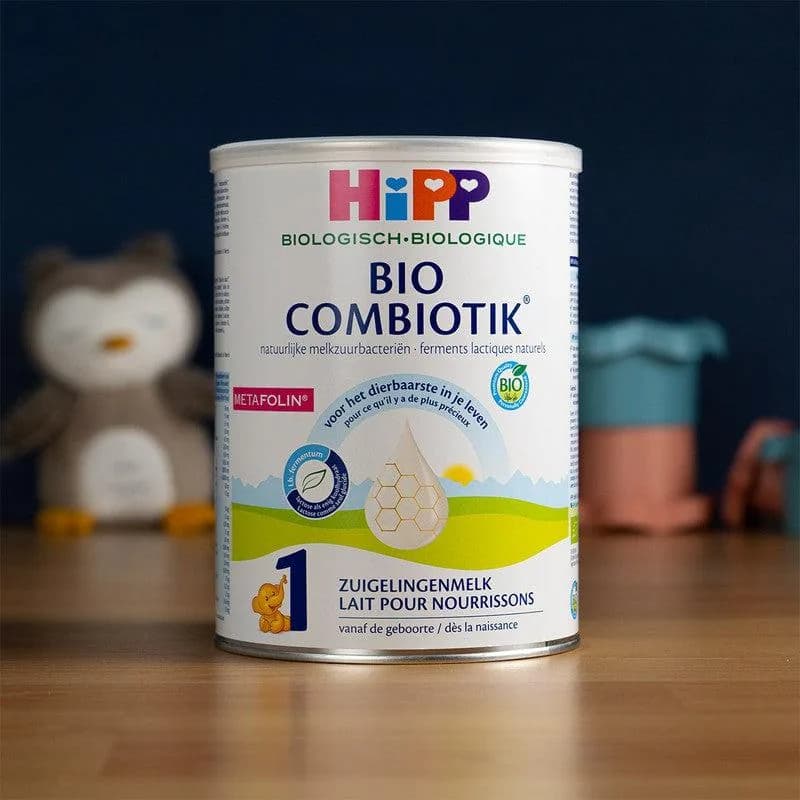
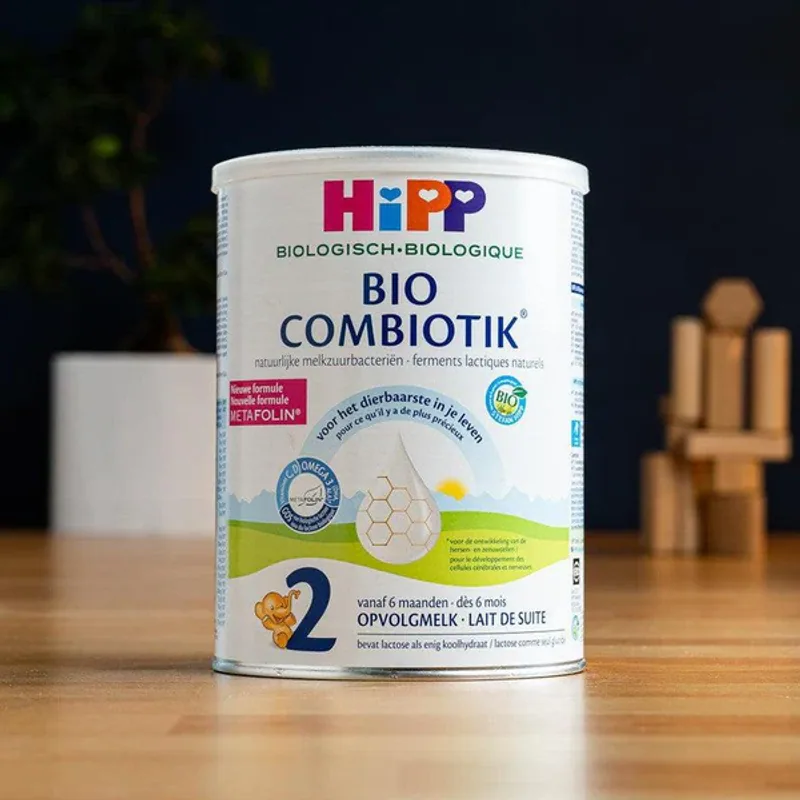
HiPP Dutch Stage 1 and Stage 2 are the two most-purchased HiPP Combiotik SKUs for families importing EU formula. They're the same product line at two different ages: Stage 1 for 0-6 months, Stage 2 for 6-12 months. The compositional differences are modest but meaningful: iron doubles (0.5 → 1.0 mg/100 ml), protein and DHA rise slightly, energy density ticks up a fraction. Everything else (lactose-primary, Combiotik GOS and probiotic system, Metafolin, RSPO palm, no HMO) is preserved across the transition. Understanding when and why to move matters for families on HiPP Combiotik.
HiPP Dutch Stage 1 (0-6 months): protein 1.28 g/100 ml and iron 0.5 mg and DHA 13.2 mg, energy 66 kcal, and lactose-primary and Combiotik, Metafolin, and RSPO palm. HiPP Dutch Stage 2 (6-12 months): protein 1.3 g/100 ml and iron 1.0 mg (doubled) and DHA 13.6 mg, energy 68 kcal, same Combiotik, same Metafolin, and same fat blend. stage transition adjusts iron and protein for the 6-12 month age when solids introduction begins.
Why this comparison matters
Parents on HiPP Combiotik hit the Stage 1 → Stage 2 question around month 5-6, as their baby approaches the 6-month milestone and solids introduction window. The decision isn't primarily about formula composition: Stage 1 and Stage 2 are in their ingredients very similar with minor age-specific adjustments. The decision is about timing the transition and understanding what changes (iron especially) so parents know what to expect.
At a glance
| Dimension | HiPP Dutch Stage 1 | HiPP Dutch Stage 2 |
|---|---|---|
| Age range | 0-6 months | 6-12 months |
| EU regulation | EU 2016/127 (infant formula) | EU 2016/128 (follow-on formula) |
| FDA status | Not FDA-registered (personal import enforcement discretion) | Not FDA-registered (personal import enforcement discretion) |
| Energy | 66 kcal / 100 ml | 68 kcal / 100 ml |
| Protein | 1.28 g / 100 ml | 1.3 g / 100 ml |
| Whey:casein | 60:40 | 60:40 |
| Primary carbohydrate | Lactose | Lactose |
| Fat | 3.6 g / 100 ml | 3.7 g / 100 ml |
| Iron | 0.5 mg / 100 ml (EU standard for 0-6) | 1.0 mg / 100 ml (doubled) |
| DHA | 13.2 mg / 100 ml | 13.6 mg / 100 ml |
| Prebiotic | GOS (Combiotik) | GOS (Combiotik) |
| Probiotic | L. fermentum and L. rhamnosus (Combiotik) | L. fermentum and L. rhamnosus (Combiotik) |
| HMO | None | None |
| Folate | Metafolin | Metafolin |
| Fat blend | RSPO palm, rapeseed, sunflower, and coconut | RSPO palm, rapeseed, sunflower, and coconut |
| Format | 800 g tin | 800 g tin |
| Typical price (US) | ||
| US availability | Personal import (Organic's Best and similar) | Personal import (Organic's Best and similar) |
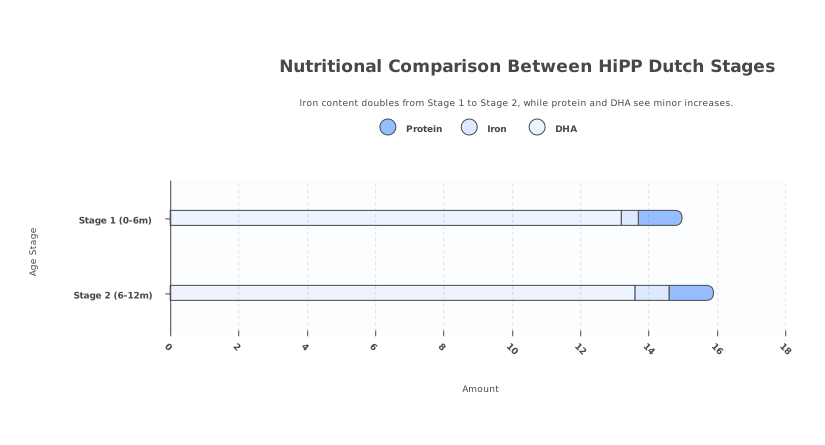
Visual generated with Napkin AI, editorial review by María López Botín. See methodology for our use policy.
What changes from Stage 1 to Stage 2
1. Iron doubles: the biggest compositional change
Stage 1: 0.5 mg iron / 100 ml. Rationale: EU regulatory baseline for 0-6 month infants has explicitly reduced iron vs US standards (US Stage 1 formulas typically ship 1.0-1.2 mg). EU reasoning: excess iron in infant formula may not benefit, some research suggests higher iron can compete with zinc/copper absorption and may affect gut microbiome composition. EU 2016/127 allows 0.3-1.3 mg iron / 100 ml for 0-6 month infant formula; HiPP Dutch Stage 1 sits at the low end.
Stage 2: 1.0 mg iron / 100 ml. Rationale: 6-12 month infants have depleting iron stores (birth-delivered stores run out around 4-6 months) and increased iron demand as they grow. Solids introduction at 6 months provides iron-rich foods (iron-fortified cereals, meat purées), but formula remains a significant iron source through month 12. Doubling iron supports this transition window.
The iron doubling is the single biggest reason HiPP structures Stage 1 vs Stage 2 differently, it matches changing physiological iron needs. Stage 1's lower iron is clinically appropriate for the 0-6 month window; Stage 2's higher iron is clinically appropriate for the 6-12 month window. Using Stage 1 formula beyond 6 months under-delivers iron; using Stage 2 formula before 6 months may be unnecessarily high. See our iron in infant formula explainer.
2. Protein rises slightly
Stage 1: 1.28 g protein / 100 ml. Stage 2: 1.3 g protein / 100 ml.
Modest increase (+1.5%) reflecting slightly elevated protein needs in 6-12 month window. EU 2016/128 follow-on formula allows slightly higher protein than Stage 1 infant formula (EU 2016/127).
3. DHA rises slightly
Stage 1: 13.2 mg DHA / 100 ml. Stage 2: 13.6 mg DHA / 100 ml.
Very small increase. Both sit in the upper range of EU DHA fortification (EU 2016/127 requires minimum 20 mg/100 kcal; HiPP Stage 1 at 13.2 mg/100 ml delivers ~20 mg/100 kcal). The stage difference is marginal.
4. Energy density ticks up
Stage 1: 66 kcal / 100 ml. Stage 2: 68 kcal / 100 ml.
Very small increase. Not clinically significant for the age progression; reflects slight fat and protein adjustments.
5. Everything else: preserved across transition
Preserved from Stage 1 to Stage 2:
- Lactose as primary carbohydrate
- 60:40 whey:casein ratio
- GOS prebiotic (Combiotik)
- L. fermentum and L. rhamnosus probiotics (Combiotik)
- Metafolin folate (EU bioactive L-methylfolate)
- RSPO-certified palm, rapeseed, sunflower, and coconut fat blend
- No HMO (Combiotik takes that role via GOS and probiotic)
- No soy oil
This continuity means the Stage 1 → Stage 2 transition is among the smoothest formula stage transitions available. Your baby experiences minimal taste/smell change and minimal digestive readjustment because the core composition, carbohydrate source, protein ratio, probiotic system, fat blend, is identical.
6. Format and price parity
Both come in 800 g tins at the same retail price (~$47/tin via personal import). Your monthly formula budget doesn't change when you transition.
When to make the transition
HiPP's guidance: Stage 2 is appropriate from 6 months onward when solids introduction has begun. The World Health Organization (WHO) recommends exclusive breastfeeding or formula for 0-6 months and complementary foods from 6 months. HiPP's Stage 2 aligns with this timing.
Practical transition timing for parents on HiPP Dutch:
- Not before 6 months: Stage 2's higher iron is unnecessary for the 0-6 month window and EU Stage 1 composition is appropriate.
- At or slightly after 6 months, typical transition point, matching solids introduction readiness signals (head control, interest in food, ability to sit with support).
- Not later than 8 months, delaying past this point leaves your baby on Stage 1's lower iron during a period of rapidly increasing iron demand. If you've missed the typical window, transition promptly on pediatrician guidance.
Some families on HiPP Dutch choose to start iron-rich solids at 6 months before transitioning formula stages, the combined iron from Stage 1 formula and iron-rich solids can bridge the gap. Discuss with your pediatrician if you want to delay Stage 2 transition for specific reasons.
Stage 1 and Stage 2 transitions
Transitioning Stage 1 → Stage 2
Because composition is very similar, transition is usually straightforward. Typical approach:
- Day 1-3: Mix 25% Stage 2 and 75% Stage 1 in a single bottle or across 2-3 feeds per day
- Day 4-6: Mix 50% Stage 2 and 50% Stage 1
- Day 7-9: Mix 75% Stage 2 and 25% Stage 1
- Day 10+: 100% Stage 2
Most infants experience no noticeable adjustment, the minimal compositional change means no digestive disruption. Some may have very mild stool pattern shift (related to the iron increase) for 5-10 days; this is normal. If significant fussiness or stool changes persist beyond 2 weeks, check with your pediatrician.
Not transitioning: using Stage 1 past 6 months
Some families wonder whether to stay on Stage 1 past 6 months for any reason. Clinical guidance: Stage 2's age-appropriate iron is specifically for the 6-12 month window; continuing Stage 1 past 6 months under-delivers iron during a period of increased demand. This is not life-threatening risk but can contribute to marginal iron status issues. If you must stay on Stage 1 for supply or family reasons, pair with iron-rich solid foods from 6 months onward and monitor with pediatric visits.
Real-world parent experience
Following site methodology, observations come from US parent feedback on HiPP Combiotik use. Not clinical recommendations. Where my own feeding observations are referenced, they are clearly labeled as parent-experience notes; manufacturer claims and regulatory data are cited separately so the source weight stays explicit.
Smell and taste. Very similar between the two, most infants don't detect a difference during transition. Stage 2's slightly higher DHA produces marginally richer smell, but the difference is imperceptible to most adult palates.
Stool consistency. Some families notice slight stool change 5-10 days after transitioning (often slightly darker or firmer) — this is related to the iron increase. Common and temporary. Not concerning unless paired with obvious discomfort or other symptoms.
Feeding volumes. 6-12 month infants are typically taking 20-32 oz/day of formula alongside solids. Stage 2 volumes are typically slightly reduced from pure-formula Stage 1 volumes as solids displace liquid calories.
Combiotik system continuity. The probiotic strains (L. fermentum and L. rhamnosus) and GOS prebiotic continue across the transition, so microbiome-support benefits accumulated on Stage 1 carry forward to Stage 2 without a break. This is one of the reasons families on HiPP Combiotik often stay within the system across both stages rather than switching brands.
Verdict: which to pick when
Use HiPP Dutch Stage 1 if:
- Your baby is 0-6 months
- You value EU-standard lower iron (0.5 mg) and Combiotik and Metafolin composition
- Solids introduction has not begun
Transition to HiPP Dutch Stage 2 if:
- Your baby is 6+ months (typically 6-12)
- Solids introduction has begun
- You want continuity of the HiPP Combiotik system with age- appropriate iron and protein adjustment
Pick neither if:
- You want US-registered follow-on with HMO fortification, consider Similac 360 Total Care or Enfamil NeuroPro
- You want EU and whole-milk-fat composition, consider Kendamil Classic Stage 1 → Stage 2 progression
- You want EU and Demeter biodynamic, consider Holle Cow Stage 1 → Stage 2 progression
What you can't infer from this comparison
Both are safe EU-compliant formulas for their respective age ranges. The Stage 1 → Stage 2 transition is not a major compositional shift — it's age-appropriate fortification adjustment. Stage 1 is not "superior" for younger babies in an absolute sense; Stage 2 is not "superior" for older babies in an absolute sense. Each is specifically formulated for its age window. The transition timing (6 months) is driven by physiological iron needs and typical solids introduction readiness, not arbitrary marketing segmentation.
Frequently asked questions
Should I move my baby from HiPP Stage 1 to Stage 2?
What happens if I keep my baby on HiPP Stage 1 past 6 months?
Can I move to Stage 2 before 6 months?
Is the transition from Stage 1 to Stage 2 difficult for my baby?
Does Stage 2 cost more than Stage 1?
Does HiPP Combiotik continue across both stages?
When does HiPP Dutch Stage 3 start?
Should I buy Stage 2 via Organic's Best or via another EU reseller?
Related reading
- HiPP brand hub
- HiPP Dutch Stage 2 vs Stage 3, follow-on to toddler transition (coming soon)
- HiPP Dutch Stage 1 vs Kendamil Classic Stage 1
- HiPP Dutch Stage 1 vs Holle Cow Stage 1
- EU infant formula regulation
- When to switch formula stages
- Iron in infant formula
- GOS explainer
- Probiotics in formula
- Aptamil UK Stage 1 vs Stage 2 - Danone's UK GOS+FOS Palm-Free Progression
- HiPP German Stage 1 vs Stage 2 - German-Market HiPP Bio Stage Progression
- Can I mix two different baby formulas in the same bottle?
- Is HiPP Combiotik the same as HiPP Bio?
- Best Baby Formula for 6 Month Old (Stage 2)
Primary sources
- HiPP GmbH, manufacturer product information. hipp.de
- EU Regulation 2016/127. EU compositional requirements for infant formula (0-6 months). eur-lex.europa.eu
- EU Regulation 2016/128. EU compositional requirements for follow-on formula (6-12 months). eur-lex.europa.eu
- EFSA Scientific Opinion on compositional requirements for infant formula. efsa.europa.eu
- WHO infant feeding recommendations, complementary feeding from 6 months. who.int
This site provides research and comparisons, not medical advice. Consult your pediatrician before changing your baby's formula.