
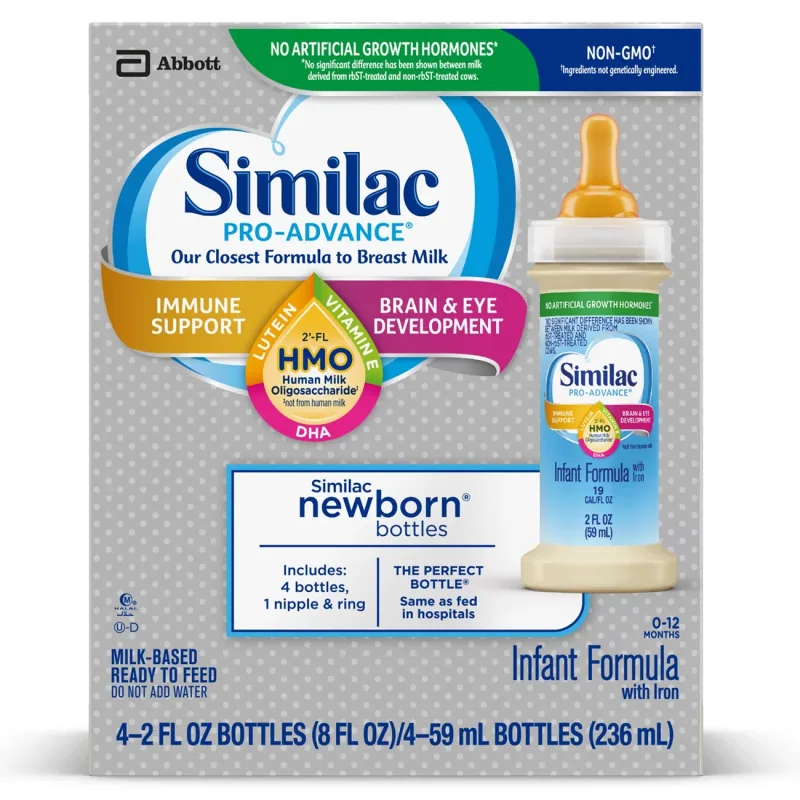
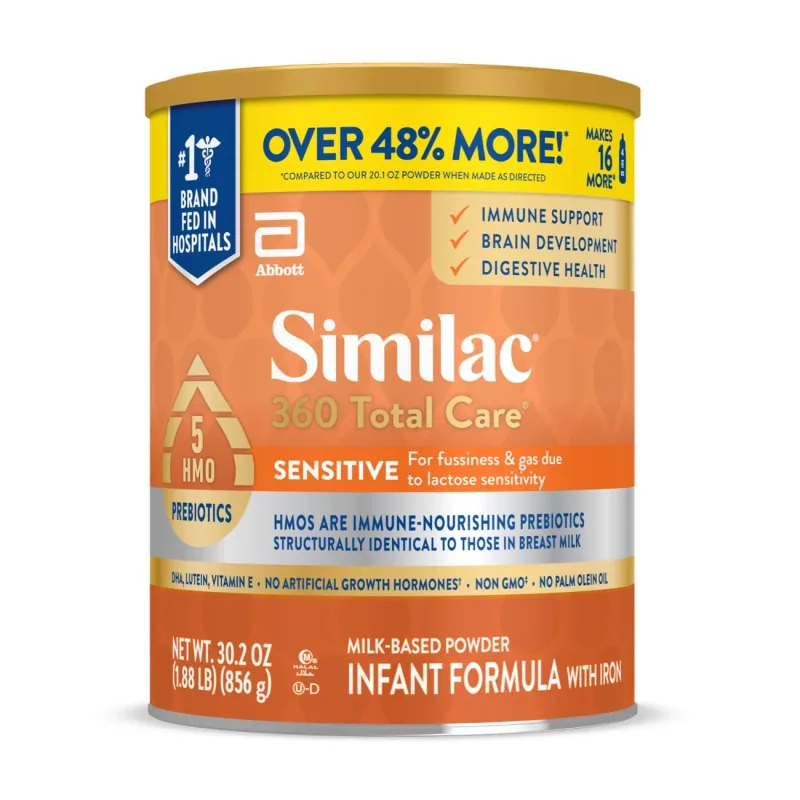
Similac Pro-Advance and Similac 360 Total Care are Abbott's two mainstream flagship SKUs, both lactose-primary, both 2'-FL HMO- containing, both positioned at the premium end of Abbott's retail portfolio. The usual "which Similac should I buy?" question almost always comes down to this head-to-head. They share more than they differ (Abbott, 21 CFR 107 compliance, standard manufacturing), but the differences are meaningful: palm-free fat blend vs 5-HMO breadth, 48:52 vs 60:40 whey:casein, and a ~$0.40/oz price gap.
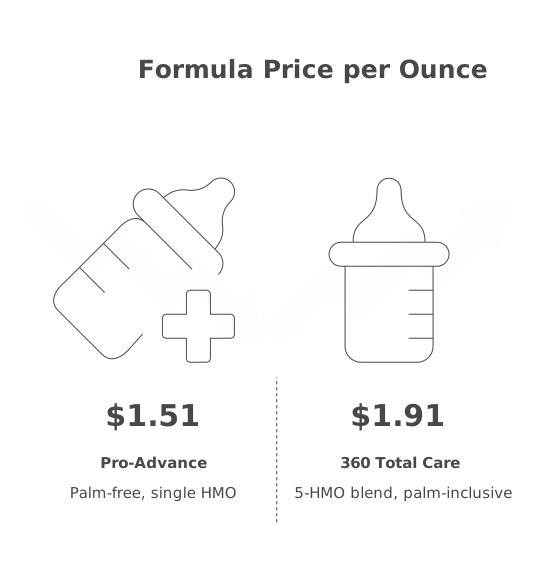
Pro-Advance: palm-free and 2'-FL HMO and GOS and 48:52 whey:casein (casein-majority, unusual) at ~$1.51/oz. 360 Total Care: 5-HMO blend (2'-FL and 3-FL and LNT and 3'-SL and 6'-SL) and palm-inclusive and 60:40 whey:casein at ~$1.91/oz. Pro-Advance optimizes fat blend and single- HMO depth at lower cost; 360 Total Care optimizes HMO breadth at premium price.
Why this comparison matters
Parents buying Similac at US retail typically encounter both SKUs on the same shelf and choose on price and marketing alone. The composition gaps are bigger than most parents realize: Pro-Advance is palm-free (rare in US mainstream); 360 Total Care has the first 5-HMO blend on the US market. The whey:casein ratios also diverge meaningfully, 48:52 for Pro-Advance (casein-majority, atypical for newborn formulation) vs 60:40 for 360 Total Care (standard whey-majority). For a parent deciding "which Similac is right for my family", understanding these trade-offs matters more than the retail marketing copy conveys.
At a glance
| Dimension | Similac Pro-Advance | Similac 360 Total Care |
|---|---|---|
| Manufacturer | Abbott Nutrition | Abbott Nutrition |
| Regulation | FDA 21 CFR 107 | FDA 21 CFR 107 |
| Protein | Skimmed cow milk and whey | Skimmed cow milk and whey |
| Whey:casein | 48:52 (casein-majority, unusual) | 60:40 (standard) |
| Primary carbohydrate | Lactose (primary) | Lactose (primary) |
| Prebiotic | GOS | None |
| HMO | 2'-FL HMO (single) | 5-HMO blend (2'-FL, 3-FL, LNT, 3'-SL, 6'-SL) |
| Lactoferrin | None | None |
| MFGM | None | None |
| DHA | Fish oil, ~11.3 mg/100 ml | Fish oil, ~11 mg/100 ml |
| Fat blend | Palm-FREE (safflower, soy, and coconut) | Palm-inclusive (safflower, soy, coconut, and palm) |
| Red flags | (no palm) | None |
| Fat-blend notes | Soy | Palm oil, soy |
| Format | 23.2 oz can | 30.8 oz can |
| Typical price | ||
| US availability | Broad US retail | Broad US retail |
Visual generated with Napkin AI, editorial review by María López Botín. See methodology for our use policy.
Compositional differences that actually matter
1. Fat blend: palm-free Pro-Advance vs palm-inclusive 360 Total Care
Pro-Advance uses a palm-free vegetable oil blend: high-oleic safflower oil, soy oil, and coconut oil. No palm. This is unusual for US mainstream premium formulas, most US mainstream SKUs (including 360 Total Care, NeuroPro, Enspire) include palm olein.
360 Total Care uses palm olein, safflower, soy, and coconut — standard US premium archetype.
Why does palm matter? Palm oil supplies palmitic acid at the sn-1 / sn-3 positions (vs breast milk's sn-2-dominant structure). Some parents and pediatricians prefer palm-free blends to avoid the hard-stool, calcium-binding effects that sn-1/sn-3 palmitate can produce in some infants. Pro-Advance is one of very few US mainstream palm-free options, this is Pro-Advance's single most distinctive feature. See our palm oil explainer.
2. HMO strategy: single deep vs five wide
Pro-Advance includes 2'-FL HMO, the most-studied and most abundant single HMO (80% of women are "secretors" producing 2'-FL in breast milk). Pro-Advance also adds GOS prebiotic (galacto- oligosaccharide), a synthetic prebiotic with extensive research support as an HMO substitute/supplement.
360 Total Care includes the 5-HMO blend: 2'-FL, 3-FL, LNT (lacto-N-tetraose), 3'-SL (3'-sialyllactose), and 6'-SL (6'-sialyllactose), the first 5-HMO blend on the US market (launched 2022). No GOS.
Trade-off: Pro-Advance has more 2'-FL concentration and GOS prebiotic (the well-studied foundation); 360 Total Care has more HMO diversity (closer to breast-milk HMO complexity). Neither approach is definitively "better", clinical evidence for multi-HMO blends vs well-dosed single-HMO and GOS at equivalent use is still emerging. The 5-HMO blend is a meaningful differentiation from the single-HMO-plus-GOS approach; which matters more depends on parent priority.
3. Protein ratio: 48:52 casein-majority vs 60:40 whey-majority
Pro-Advance: 48:52 whey:casein, casein-majority. Unusual for US mainstream formulas; closer to mature breast-milk composition (which shifts toward 50:50 around 6 months) but further from early-lactation ~80:20 (whey-majority). Pro-Advance is marketed as appropriate for 0-12 months but the casein-majority ratio is atypical for newborn formulation.
360 Total Care: 60:40 whey:casein, standard US whey- majority ratio.
This is a meaningful composition difference that's often underplayed in retail marketing. 360 Total Care's 60:40 matches what most pediatricians expect for newborn formulation. Pro-Advance's 48:52 sits closer to older-infant breast-milk composition. Neither is "wrong", both are FDA-approved and produce adequate protein nutrition, but the difference is real and worth knowing.
4. Neither has MFGM or lactoferrin
Neither Pro-Advance nor 360 Total Care includes MFGM or bovine lactoferrin. Abbott's Similac premium lines do not combine these bioactives, for that feature set in a US SKU, Enfamil Enspire is the primary option. Abbott's thesis: HMO fortification (single or multi) and GOS prebiotic. Reckitt's thesis (at Enspire level): MFGM, lactoferrin, and HMO.
5. Both lactose-primary: shared strength
Both use lactose as primary carbohydrate, no corn syrup solids, no maltodextrin. This is a shared strength of both SKUs compared with Similac Sensitive / Pro-Total Comfort (both corn-syrup-solids primary) and Enfamil Gentlease. Parents wanting lactose-primary at US mainstream premium tier get it with either of these two.
6. Price per ounce: Pro-Advance ~21% cheaper
Pro-Advance ~$1.51/oz. 360 Total Care ~$1.91/oz. ~26% price difference favoring Pro-Advance. On 100-oz/week feeding, that's ~$40/week or ~$174/month. The 360 Total Care premium reflects the 5-HMO ingredient cost (five distinct HMOs is expensive sourcing) + larger 30.8 oz can format and newer flagship positioning.
7. Recall history: both affected by 2022 Abbott event
Both Pro-Advance and 360 Total Care were among the Sturgis, Michigan-produced SKUs affected by the 2022 Cronobacter recall. Abbott has since remediated Sturgis and resumed production; current stock carries no active recall. Both sit in the same post-2022 manufacturing context: FDA-inspected, FSMA-compliant, and with Abbott having invested heavily in Sturgis remediation. See our Abbott 2022 recall aftermath for depth on what changed and what didn't.
Regulatory framework
Both comply with FDA 21 CFR Part 107. Both are Abbott-manufactured in the US. Both subject to FDA enforcement and FSMA recall authority. Neither is USDA Organic.
Real-world parent experience
Following site methodology, the observations below come from my own feeding experience and a stable pool of US parent feedback. They carry the parent-experience label rather than being claimed as regulatory or clinical facts.
Stool consistency. Pro-Advance's palm-free and GOS combination tends to produce softer, more breast-milk-like stools (GOS is fermentative; palm-free removes the stool-firming palmitate component). 360 Total Care's palm-inclusive and 5-HMO produces moderate-consistency stools with the 3'-SL/6'-SL HMO contribution softening slightly. Neither is concerning without other symptoms.
Smell and taste. 360 Total Care has a slightly sweeter, richer profile (5-HMO blend is sweeter; palm contributes richness). Pro-Advance is cleaner, slightly drier (palm-free blends typically register this way). Most infants accept either; infants who reject one typically accept the other.
Mixability. Both dissolve cleanly at 70°C. Pro-Advance's 23.2 oz can is the mid-size format; 360 Total Care's 30.8 oz is the larger bulk format preferred by families buying fewer units per month.
Switching between them. Multiple simultaneous changes: fat blend (palm-free ↔ palm-inclusive), whey:casein (48:52 ↔ 60:40), HMO profile (2'-FL and GOS ↔ 5-HMO blend). Use a 4-6 day gradual transition. Expect 1-2 weeks of adjustment. Going Pro-Advance → 360 Total Care: slightly firmer stool (added palm and removed GOS), richer smell. Going 360 Total Care → Pro-Advance: slightly softer stool (palm removed and GOS added), cleaner smell.
Verdict: when to pick each
Pick Similac Pro-Advance if:
- Palm-free fat blend matters: Pro-Advance is one of very few US mainstream palm-free options
- GOS prebiotic combined with single 2'-FL HMO feels like sufficient bioactive depth
- 48:52 casein-majority protein ratio is acceptable or preferred
- ~21-26% lower per-oz price is appealing
- Smaller 23.2 oz can format is preferred
Pick Similac 360 Total Care if:
- 5-HMO blend matters, first US market SKU with this diversity
- Standard 60:40 whey:casein is preferred (matches typical newborn formulation expectation)
- Palm-inclusive fat blend is acceptable
- Larger 30.8 oz can reduces purchase frequency
- Premium positioning and multi-HMO breadth justifies ~26% premium
Pick neither if:
- You want MFGM and lactoferrin combined, consider Enfamil Enspire (MFGM and lactoferrin and 2'-FL and highest US DHA)
- You want USDA Organic, palm-free, and no soy, consider Bobbie Original
- You want EU Combiotik (GOS, probiotics, and Metafolin), consider HiPP Dutch Stage 1
- You want EU Organic, whole-milk fat, and palm-free, consider Kendamil Organic Stage 1
What you can't infer from this comparison
Both are safe, FDA-registered Abbott flagships with substantial bioactive fortification. "5-HMO blend is better than single-HMO and GOS" is not a settled clinical claim, no head-to-head trial has proven this superior on infant outcomes at equivalent use. Pro-Advance's 48:52 casein-majority protein ratio is unusual but not established as inferior (or superior) clinically. The 2022 Abbott recall affected both SKUs; Abbott's subsequent remediation does not guarantee zero future manufacturing incidents at Sturgis, it reflects current FDA compliance status.
Frequently asked questions
Is Similac Pro-Advance or 360 Total Care better?
Why does Similac Pro-Advance have a different whey:casein ratio?
Is Similac 360 Total Care palm-free?
How meaningful is the 5-HMO blend vs single 2'-FL HMO?
Were both formulas affected by the 2022 Abbott recall?
Can I switch between Pro-Advance and 360 Total Care?
Which has more DHA?
Is one WIC-covered better than the other?
Related reading
- Similac brand hub
- Enfamil Enspire vs Similac 360 Total Care, two biggest companies top-tier flagship comparison
- Similac Pro-Advance vs Enfamil NeuroPro, classic mid-tier two biggest companies comparison
- Enfamil Enspire vs Similac Pro-Advance, premium bioactive vs palm-free
- 2'-FL HMO explainer
- GOS explainer
- Palm oil explainer
- Abbott 2022 recall aftermath
Primary sources
- Similac / Abbott Nutrition, manufacturer product information. similac.com
- FDA 21 CFR Part 107. US infant formula regulation. ecfr.gov
- EFSA Scientific Opinion on compositional requirements for infant formula. efsa.europa.eu
- FDA Abbott recall investigation summary (2022). fda.gov
This site provides research and comparisons, not medical advice. Consult your pediatrician before changing your baby's formula.