
Palm oil has been the most-criticized infant formula ingredient in US parenting communities for the last decade. Some of that criticism is well-founded; some of it is not. The current nutritional literature positions saturated fats (palm, coconut, whole-milk-fat) as breast-milk-similar and infant-appropriate, while questioning the high omega-6 polyunsaturated fatty acid (PUFA) loads of seed-oil-heavy constructions. "Palm-free" is not categorically "better"; in fact, when palm-free formulas substitute additional sunflower, safflower, soybean, or rapeseed oil, the result is sometimes a less-breast-milk-similar fatty-acid profile.
This explainer walks through what the current evidence actually says and where palm oil sits in the hierarchy of infant fat-blend choices.
What palm oil is and why formulas use it
Palm oil is extracted from the fruit of the oil palm Elaeis guineensis. In infant formula it appears as palm oil, palm olein (the more liquid fraction), or as sn-2 palmitate (also called OPO — oleic-palmitic-oleic, a structured form discussed below). The nutritional reason it is used: human breast milk contains roughly 20-25% palmitic acid among its fatty acids, and palm oil is the cheapest plant source of palmitic acid at the concentrations needed. Without palm oil (or whole-milk fat) in the blend, the formula's fat profile becomes palmitic-acid-poor relative to breast milk.
Palmitic acid is not a nutritional villain. It is a major component of breast-milk fat, contributes to infant brain and nervous-system development, provides stable saturated calories, and is naturally abundant in animal-derived fats including whole-cow-milk fat, goat-milk fat, and coconut oil (which has a related saturated profile with shorter-chain fatty acids).
The three legitimate concerns about palm oil — and which one matters
The criticism of palm oil bundles three distinct issues that should be unbundled. The detail below applies to the typical preparation environment most US households operate in; specific pediatric situations may warrant additional precautions per your physician.
1. Position on the triglyceride (sn-1/sn-3 vs sn-2). This is the real nutritional concern. Triglycerides have three fatty acids on a glycerol backbone at positions sn-1, sn-2, and sn-3. In breast-milk fat, ~70% of palmitic acid sits at the sn-2 position. In standard palm oil, palmitic acid sits mostly at sn-1 and sn-3. This matters for digestion:
- Pancreatic lipase cleaves fatty acids from the sn-1 and sn-3 positions, leaving a 2-monoglyceride that is well absorbed.
- Free sn-1/sn-3 palmitic acid can bind calcium in the gut, forming insoluble calcium soaps that are excreted rather than absorbed.
- sn-2 palmitic acid stays attached to the 2-monoglyceride and is absorbed efficiently without the calcium-binding step.
Documented consequences in studies of standard palm olein vs sn-2 palmitate or palm-free: modestly firmer stools, slightly reduced calcium absorption, and a measurable reduction in stool frequency. Effect sizes are real but modest; no evidence of clinical harm in healthy term infants. See Koletzko 2019 for the systematic review.
The fix is sn-2 palmitate (structured palm) or whole-milk fat (which naturally has palmitic acid at sn-2). See the sn-2 palmitate explainer.
2. Sustainability and sourcing. Large-scale palm cultivation in Southeast Asia has driven deforestation and biodiversity loss. The Roundtable on Sustainable Palm Oil (RSPO) certifies producers against environmental and labor standards, and most EU organic infant formula brands source RSPO-certified or organic-certified palm oil (HiPP, Holle, Lebenswert, and others document this on their corporate sustainability pages). Sustainability is a legitimate concern but it is not a nutritional concern about the infant. RSPO-certified palm in formula does not affect the baby's nutrition relative to non-certified palm.
3. The framing that "palm = bad." This is the misleading part. "Palm oil avoidance" became a parenting heuristic because palm oil critique was simpler to communicate than "sn-1/sn-3 palmitic acid plus calcium-soap formation." The result: many "palm-free" formulas substitute additional seed oils (sunflower, safflower, soybean, rapeseed/canola) to deliver fat calories. Those seed oils introduce their own concerns:
- High omega-6 polyunsaturated fatty acid (PUFA) loads
- Industrial extraction processes (often hexane-solvent for refined versions; organic-certified versions use mechanical pressing)
- Oxidation susceptibility during processing and storage
- Less palmitic acid in the final fat profile (further from breast milk on this axis)
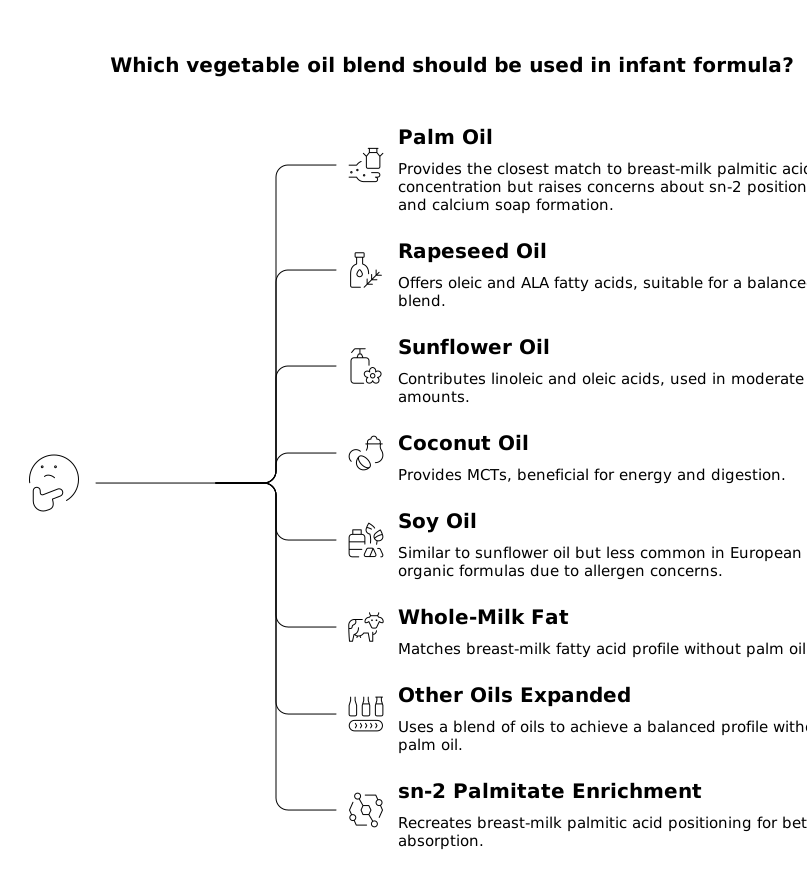
The current nutrition-science perspective on excessive linoleic acid (omega-6 PUFA) and the omega-6:omega-3 ratio is questioning whether seed-oil-heavy constructions are categorically preferable to saturated-fat-anchored ones. EU 2016/127 mandates specific PUFA ranges (linoleic acid 300-1200 mg/100 kcal; α-linolenic acid 50+ mg/100 kcal), so all compliant formulas deliver some seed-oil contribution; the question is the balance between saturated breast-milk-similar fats and PUFA-heavy seed oils.
Visual generated with Napkin AI, editorial review by María López Botín. See methodology for our use policy.
The actual fat-blend hierarchy for infant formula
Putting the evidence together, the practical hierarchy from most to least breast-milk-similar:
-
Whole-milk fat (cow or goat) preserved through processing. Whole milk naturally contains palmitic acid at the sn-2 position, plus the native milk fat globule membrane (MFGM) with sphingomyelin, cholesterol, gangliosides, and glycoproteins. Used by Kendamil Classic, Kendamil Organic, Kendamil Goat, and ByHeart Whole Nutrition.
-
Coconut oil as a major fat-blend component. Provides medium-chain triglycerides (MCT) that are easily absorbed by infants, plus saturated stability. Coconut oil is universally a positive in infant formula. Most EU and US formulas include some coconut oil; the question is the proportion.
-
sn-2 palmitate (structured palm). The OPO form delivers palmitic acid at the breast-milk-equivalent position. Used by Kabrita and a few US-mainstream variants. See the sn-2 palmitate explainer.
-
Standard palm (RSPO-certified) plus supplementary oils. The conventional EU-organic approach. Provides palmitic acid in non-ideal sn-1/sn-3 position. Modest documented effects on stool consistency and calcium absorption. Not a red flag for healthy term infants; just not optimal positioning.
-
All-seed-oil constructions (no palm, no whole-milk fat). Soybean, sunflower, safflower, rapeseed/canola only. Lacks palmitic acid entirely. High omega-6 PUFA load. The conventional "palm-free" path before whole-milk-fat preservation became more widely adopted. Often paired with maltodextrin or corn-syrup-solids carbohydrate base in some US-mainstream formulas.
-
Soy-protein formulas (separate concern). Distinct from the palm-vs-seed-oil discussion; soy protein introduces phytoestrogen exposure considerations that are clinically relevant for some infant populations. See the soy explainer.
Reading the label correctly
When evaluating a formula's fat blend, the questions in order:
-
Is it whole-milk-fat preserved? If yes, you have native sn-2 palmitate plus MFGM plus a breast-milk-similar fat profile. This is the cleanest answer regardless of the palm-oil debate.
-
If not whole-milk-fat, what's the palmitic acid source? Standard palm (sn-1/sn-3), sn-2 palmitate (structured), or none-at-all (all-seed-oil)? sn-2 palmitate or RSPO standard palm are both legitimate; all-seed-oil leaves the formula palmitic-acid-poor.
-
What's the seed-oil load and balance? Coconut oil is universally positive. Sunflower, safflower, rapeseed/canola, and soybean oils are PUFA-heavy and extracted industrially in conventional versions; organic versions use mechanical pressing but the PUFA composition is the same.
-
Does the formula contain soy protein (not just soy oil)? Different concern entirely; see soy explainer.
Which formulas use which approach
In our Infant Formula Atlas:
- Whole-milk-fat preserved (closest-to-breast-milk fat profile): Kendamil Classic, Kendamil Organic, Kendamil Goat, ByHeart Whole Nutrition.
- sn-2 palmitate (structured palm): Kabrita.
- Standard palm RSPO + supplementary oils (conventional EU-organic): HiPP Dutch, HiPP German, Holle Cow, Lebenswert, Earth's Best Dairy, Happy Baby Organic Infant.
- Palm-free with significant seed-oil load: Bobbie (palm-free, no soy, but coconut + sunflower + rapeseed dominant), Loulouka (similar profile), Aptamil UK (palm-free with soy), Holle Goat (whole-goat-milk-fat partial + rapeseed + sunflower), Jovie Goat (similar to Holle Goat profile).
- Mostly seed oils plus palm (US-mainstream conventional): Similac variants, Enfamil variants, store brands.
The framing for parents
The pragmatic reading of current evidence:
- There is no infant-nutrition reason to categorically avoid palm oil. Standard palm in RSPO-certified form is safe; the modest stool-consistency and calcium-absorption effects are not clinically significant for healthy term infants.
- Whole-milk-fat preservation is the cleanest answer for families weighting breast-milk-similar fat profile. Kendamil's whole-milk-fat approach across Classic, Organic, and Goat is structurally distinct from any vegetable-oil-blend construction.
- sn-2 palmitate is a legitimate alternative for families wanting the breast-milk position-matching without the whole-milk-fat approach. Kabrita is the principal example among US-accessible goat-milk Stage 1 formulas.
- "Palm-free" is not synonymous with "better." When palm-free means "more seed oils," the trade-off is not categorically positive. When palm-free means "whole-milk fat" (Kendamil) or "sn-2 palmitate elsewhere" (some US-mainstream variants), it is meaningfully positive.
- Sustainability is a real concern but separable from infant nutrition. Families weighting palm-oil-related deforestation and biodiversity concerns can pick whole-milk-fat or sn-2-palmitate alternatives without conceding nutritional adequacy.
The short version: if your baby tolerates a palm-containing formula well (soft stools, no constipation), there is no clinical reason to switch. If you want the closest possible fat-blend match to breast milk, prioritize whole-milk-fat preservation (Kendamil, ByHeart) or sn-2 palmitate (Kabrita) — not "palm-free" as a generic heuristic.
Frequently asked questions
Why do most infant formulas contain palm oil?
Is palm oil bad for babies?
What's the difference between palm oil and sn-2 palmitate?
Which formulas avoid palm oil entirely?
Is palm oil in formula linked to constipation?
Is palm oil sustainable?
Primary sources
- Koletzko B et al. Palm oil and palmitic acid supply in infant formula: a systematic review. European Journal of Nutrition, 2019. pubmed.ncbi.nlm.nih.gov/30545042
- Kennedy K et al. Double-blind, randomized trial of a synthetic triacylglycerol (sn-2 palmitate) in infant formula. American Journal of Clinical Nutrition, 2003. pubmed.ncbi.nlm.nih.gov/12586971
- Linoleic acid intake in infants and the omega-6:omega-3 ratio in infant formulas. Recent literature questioning seed-oil-heavy constructions. pubmed.ncbi.nlm.nih.gov/35684140
- EU Commission Delegated Regulation 2016/127, permits vegetable oils including palm oil, mandates PUFA ranges in infant formula. eur-lex.europa.eu
- EFSA Panel on Dietetic Products. Scientific opinion on the essential composition of infant and follow-on formulae, EFSA Journal, 2014. efsa.europa.eu
Related reading
- sn-2 palmitate explainer, the structural-palm form that addresses the position issue
- MFGM explainer, why whole-milk-fat preservation matters beyond palmitic acid position
- DHA explainer, the long-chain omega-3 mandated in EU formulas
- ARA explainer, the long-chain omega-6 paired with DHA
- Bobbie Original vs Kendamil Classic Stage 1, palm-free seed-oil-heavy vs whole-milk-fat
- Holle Cow Stage 1 vs Kendamil Classic Stage 1, RSPO palm vs whole-milk-fat
- Kabrita vs Kendamil Goat, sn-2 palmitate goat vs whole-goat-milk-fat
- HiPP brand hub, Kendamil brand hub, Kabrita brand hub
- EU Regulation 2016/127 overview
This site provides research and comparisons, not medical advice. Consult your pediatrician before changing your baby's formula.
- Aptamil UK Stage 1 vs Enfamil NeuroPro - Palm-Free EU Import vs US Bioactive Stack with Palm
- ByHeart Whole Nutrition vs Earth's Best Organic Dairy - Premium Bioactive Whole-Milk (Recalled) vs Budget Supermarket Organic
- Happy Baby Organic Infant vs Similac Organic - Danone US vs Abbott USDA Organic
- Holle Cow Stage 1 vs Earth's Best Dairy - Demeter Biodynamic EU Organic vs USDA Organic Budget
- Jovie Goat Stage 1 vs Similac Pro-Advance - EU Organic Goat-Milk vs US 2'-FL HMO Cow-Milk
- Kabrita Stage 1 vs Similac Pro-Advance - Dutch Goat-Milk with sn-2 Palmitate vs US Cow-Milk Mainstream
- Kendamil Classic Stage 1 vs Lebenswert Stage 1 - UK Whole-Milk Fat vs German Bioland Organic
- Kendamil Organic Stage 1 vs Earth's Best Dairy - UK Organic Whole-Milk-Fat with HMO vs USDA Organic Budget
- Lebenswert Stage 1 vs Similac Pro-Advance - Bioland Minimalist EU Organic vs US 2'-FL HMO
- Loulouka Stage 1 vs Similac Pro-Advance - Swiss EU Organic No-Palm No-Soy vs US 2'-FL HMO Mainstream
- Similac Alimentum vs Gerber Extensive HA - Casein eHF vs Whey eHF (Both with 2'-FL HMO and MCT)
- Similac Pro-Advance vs Similac 360 Total Care - Abbott's Two Mainstream Flagships Compared
- Is Kendamil really palm-oil-free?
- Is whole-milk-fat formula better than vegetable-oil-based formula?
- Best Baby Formulas Closest to Breast Milk (2026 Buying Guide)
- Rapeseed Oil (Canola)
- Whole Milk Fat