
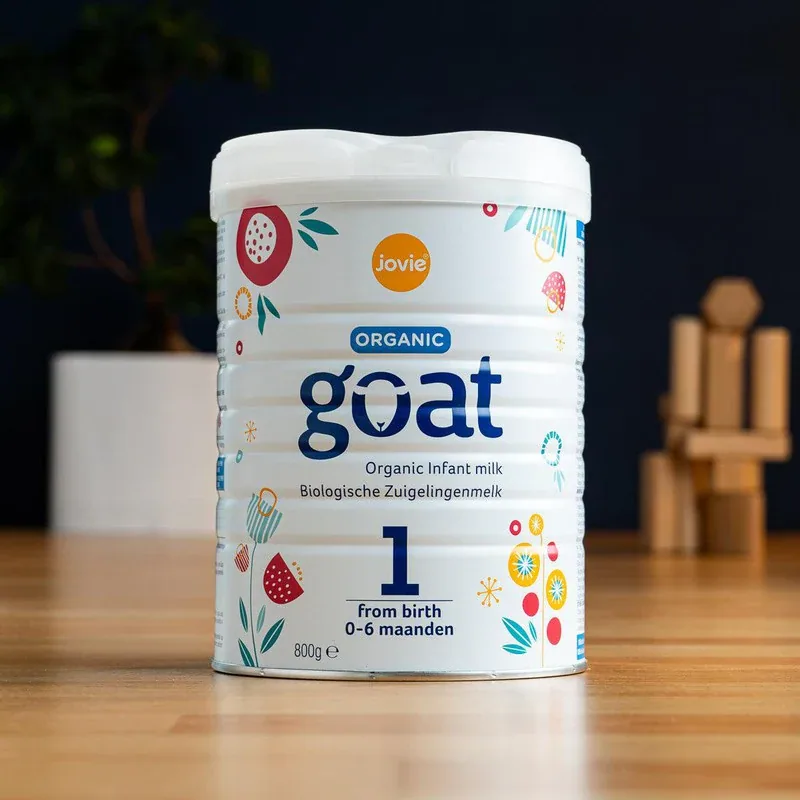
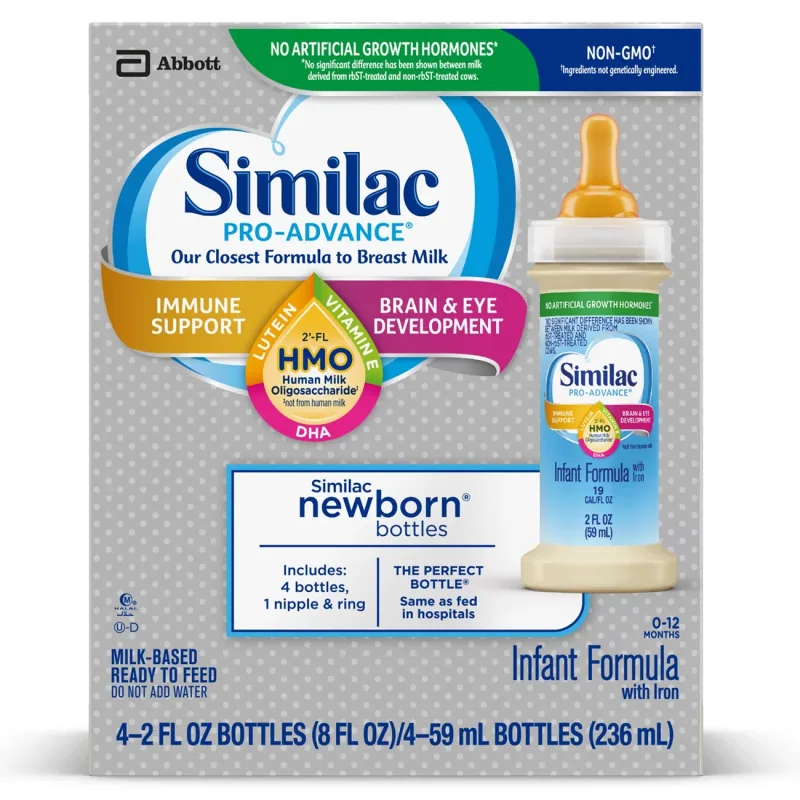
Jovie Goat Stage 1 and Similac Pro-Advance sit at opposite ends of the Stage 1 spectrum parents shop. Jovie is a Dutch EU Organic goat-milk formula imported via Organic's Best Shop, lactose-only carbohydrate, no palm, no soy, GOS prebiotic, ~$2.30/oz once landed. Similac Pro-Advance is the US mainstream cow-milk formula with 2'-FL HMO at ~$1.51/oz, FDA-registered, WIC-eligible in contract states, available next-day at Target and Walmart. The decision is rarely close on any single dimension — it's a structural choice between European-organic goat-milk import and US-retail cow-milk HMO.
Jovie Goat Stage 1 is a Dutch EU Organic formula with whole organic goat-milk powder as the first ingredient, lactose-only added carb, GOS prebiotic, no palm, no soy, ~$2.30/oz via personal import. Similac Pro-Advance is a US FDA-registered cow-milk formula with skimmed cow milk plus vegetable oils, GOS plus 2'-FL HMO, palm-olein-free but soybean-oil-inclusive, ~$1.51/oz at standard retail. Different protein species, different regulatory pathway, different bioactive strategy.
Why this comparison matters
Parents typically arrive at this comparison from one of two directions. Either Similac Pro-Advance is the existing default (pediatrician recommendation, WIC contract, retail convenience) and goat milk is the upgrade path being researched, or Jovie is the target (organic, goat, EU import) and Similac is the US-retail backup considered for travel, emergency, or budget feeds. Both directions are valid and both formulas serve healthy term infants adequately — the question is which structural trade-offs match your family's priorities. Goat protein and EU Organic labeling cost time (5-10 day import shipping) and money (~52% premium per ounce). The 2'-FL HMO bioactive and WIC eligibility are exclusive to Similac.
At a glance
| Dimension | Jovie Goat Stage 1 | Similac Pro-Advance |
|---|---|---|
| Manufacturer | Ausnutria-affiliated Dutch operation | Abbott Nutrition |
| Origin | Netherlands (NL) | USA (Sturgis MI and Columbus OH) |
| Age range | 0-6 months (Stage 1) | 0-12 months |
| Regulation | EU 2016/127 (FDA enforcement discretion for US personal import) | FDA 21 CFR 107 |
| Organic certification | EU Organic | None |
| Protein source | Whole organic goat milk | Skimmed cow milk and whey |
| Primary carbohydrate | Lactose only added | Lactose |
| Prebiotic | GOS | GOS and 2'-FL HMO |
| Probiotic | None | None |
| HMO | None | 2'-FL HMO |
| Folate form | Folic acid | Folic acid |
| Fat blend | Goat-milk fat plus sunflower and rapeseed (no palm, no soy) | Soy, coconut, safflower/sunflower (no palm olein, contains soy) |
| DHA source | Fish oil, ~14 mg/100 ml | Algal oil, ~11.3 mg/100 ml |
| Iron | 0.6 mg/100 ml | 1.2 mg/100 ml |
| Red flags | None | Synthetic beta-carotene |
| Fat-blend notes | None | Soy oil and lecithin |
| Format | 800 g tin | ~23.2 oz container |
| Typical US price | ||
| US availability | Personal import via Organic's Best Shop, 5-10 day shipping | Target, Walmart, Amazon, CVS, WIC, next-day |
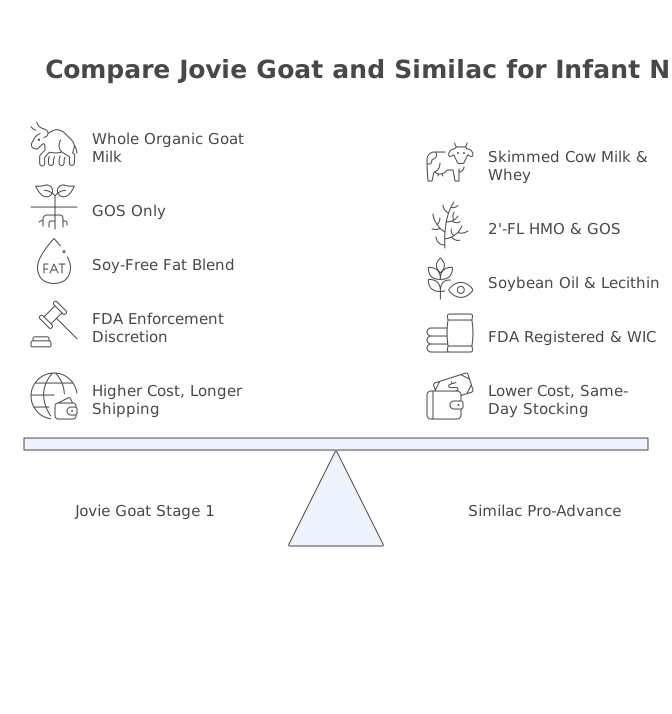
Visual generated with Napkin AI, editorial review by María López Botín. See methodology for our use policy.
Compositional differences that actually matter
Six dimensions where Jovie and Similac Pro-Advance diverge in ways parents care about.
1. Protein species: goat vs cow milk
The defining difference. Jovie uses whole organic goat milk powder as the first ingredient. Similac Pro-Advance uses skimmed cow milk plus whey protein concentrate at a 60:40 whey:casein ratio. Goat milk proteins differ from cow milk in casein structure (less αs1-casein, more β-casein, smaller fat globules) and lactose-handling enzymes parents sometimes seek when a baby seems uncomfortable on cow-milk formulas. Goat milk is not hypoallergenic and is not indicated for diagnosed cow milk protein allergy — see CMPA explained for the clinical distinction.
For families researching goat milk because of generalized cow-milk discomfort (gas, fussiness, mild reflux without diagnosis), Jovie is a reasonable trial. For families with diagnosed CMPA, neither Jovie nor Similac Pro-Advance is appropriate; an extensively hydrolyzed or amino-acid formula is the indicated path.
2. Bioactive strategy: GOS-only vs GOS plus 2'-FL HMO
Similac Pro-Advance includes 2'-FL HMO (the most-studied human milk oligosaccharide) alongside GOS. Jovie includes GOS only, no HMO. 2'-FL HMO has direct structural analogy to breast milk oligosaccharides and is the bioactive Similac is known for in this US tier. See 2'-FL HMO and GOS for the mechanism details.
Families weighting the HMO evidence base pick Similac. Families weighting goat-milk protein and EU Organic certification accept the GOS-only prebiotic profile in Jovie.
3. Carbohydrate composition: lactose-only vs lactose-primary
Jovie uses lactose as the only added carbohydrate alongside the lactose naturally present in goat milk. Similac Pro-Advance is also lactose-primary, no maltodextrin or corn syrup solids. On this axis the two formulas are equivalent and both are aligned with the breast-milk carbohydrate profile. Neither is a budget-tier formula with corn-derived fillers.
4. Fat blend: no palm in either, soy in Similac only
Both formulas exclude palm olein, a meaningful match. Jovie's fat blend is goat-milk fat plus rapeseed and sunflower oils — no soy oil, no soy lecithin. Similac Pro-Advance excludes palm olein but uses soybean oil and soy lecithin in its vegetable oil construction.
For families avoiding soy derivatives, this is the deciding axis: only Jovie clears both palm and soy. See the palm oil explainer for why palm exclusion matters in formula fat blends.
5. DHA, ARA, and iron levels
Jovie provides ~14 mg DHA per 100 ml from fish oil, with 14 mg ARA from Mortierella alpina oil. Similac Pro-Advance provides ~11.3 mg DHA (algal oil) and ~22.6 mg ARA. Both exceed FDA baseline; Jovie's higher DHA reflects EU 2016/127 minimums.
Iron differs more sharply: Jovie at ~0.6 mg/100 ml (EU 2016/127 minimum), Similac at ~1.2 mg/100 ml (US convention). Both are adequate for term infants without iron-deficiency risk; the EU lower range reflects different population-level iron-stores assumptions. Pediatric advice trumps formula iron level for infants flagged for iron screening.
6. Cost, retail availability, and supply continuity
Similac Pro-Advance: ~$1.51/oz at standard US retail, $0 in WIC contract states, available next-day at Target, Amazon, Walmart, CVS, Walgreens, and most grocery chains. Supply is essentially never an issue post-2022.
Jovie Goat Stage 1: ~$2.30/oz delivered via Organic's Best Shop, 5-10 day import shipping from EU warehouses, no WIC pathway, no US brick-and-mortar retail. Subscription pricing through OB reduces cost modestly. For families, a 2-4 week stock buffer is the practical recommendation. See buying European formula in the USA for the full import logistics.
Regulatory framework
Jovie Goat Stage 1 complies with EU Regulation 2016/127 (mandatory EU infant formula composition) and EU Organic Regulation 2018/848. Its US presence operates under FDA enforcement discretion for personally-imported infant formula, the same framework that permits HiPP, Holle, Kendamil, and other European brands to be sold to families via authorized resellers. Jovie is not FDA-registered and not WIC-eligible.
Similac Pro-Advance complies with FDA 21 CFR Part 107 under Abbott Nutrition's pre-market notification, Part 106 quality control, and the FSMA mandatory recall framework. Pro-Advance was not directly affected by the 2022 Sturgis Cronobacter recall — see Abbott 2022 recall aftermath.
For the broader regulatory comparison, see FDA vs EFSA standards compared.
Real-world parent experience
Following site methodology, the observations below come from my personal testing across both formulas plus a stable pool of parent-feedback notes from families using each. They carry the parent-experience label rather than being claimed as regulatory or clinical facts, because individual infant variation on stool consistency, smell preference, and mixability is large enough that any specific point can reverse for a specific baby. Read these as context, not prediction.
Smell and taste. Jovie has the characteristic goat-milk profile: slightly stronger, mildly tangy, denser-smelling than cow-milk formulas. Most infants accept it without complaint, though families switching from a sweeter cow-milk formula sometimes report 2-4 days of adjustment. Similac Pro-Advance has a clean, slightly sweet profile typical of the lactose-plus-vegetable-oil construction.
Mixability. Both dissolve cleanly at the EU 70°C / FDA-recommended preparation temperatures. Similac produces more foam on vigorous shaking (soy oil contribution); swirling reduces this. Jovie occasionally leaves trace residue from the goat-milk-fat character, resolves with extra swirling.
Stool consistency. Jovie families often report soft, slightly yellower stools (the goat-milk-fat plus GOS prebiotic contribution). Similac families report soft stools (the GOS plus 2'-FL HMO load) with occasional softer transition during the first 7-10 days. Both are within normal range for healthy term infants on a lactose-primary diet.
Switching between them. Clinically straightforward for healthy term infants. Use a 4-6 day gradual transition. The protein-species shift (goat to cow or cow to goat) plus fat-blend shift (whole-goat-milk-fat to vegetable oils, or reverse) can produce 5-10 days of stool adjustment. Most infants tolerate the change without issue; some develop a clear preference for one or the other.
Verdict: when to pick each
Pick Jovie Goat Stage 1 if:
- Goat-milk protein matters as a digestibility experiment for a cow-milk-discomfort infant (without diagnosed CMPA)
- EU Organic certification is your baseline
- Lactose-only added carbohydrate (no soy, no palm) is the priority
- You can absorb the ~52% per-ounce premium and the import shipping window
- Higher DHA at the EU mandatory level matters
Pick Similac Pro-Advance if:
- 2'-FL HMO bioactive is your priority
- WIC eligibility makes it effectively free in your state
- FDA registration and US retail next-day availability matter
- Pediatrician familiarity is part of your decision frame
- The ~34% lower per-ounce cost is decisive
Pick neither if:
- Diagnosed cow milk protein allergy. Goat milk is not an allergy- safe substitute. See hypoallergenic formula explained.
- You want the cleanest possible cow-milk option at US retail. Look at Bobbie Original (USDA Organic, palm-free, no soy, US-domestic).
What you can't infer from this comparison
Jovie is not a hypoallergenic formula. Goat milk proteins cross-react with cow milk proteins in the majority of CMPA cases. Similac Pro-Advance is also not hypoallergenic. Neither is reflux-specific (for reflux, see Enfamil AR or discuss thickened-feeding protocols with a pediatrician). Neither is a soy-protein formula (Similac uses soybean oil and soy lecithin in fat construction but not soy-protein isolate).
Frequently asked questions
Is goat milk formula safer or healthier than cow milk formula for healthy infants?
Is Jovie available in the United States?
Does Similac Pro-Advance have palm oil?
Is Jovie or Similac Pro-Advance cheaper?
Can I switch from Similac Pro-Advance to Jovie Goat Stage 1?
Does Jovie have HMOs like 2'-FL?
Is Jovie Goat Stage 1 WIC-eligible?
Related reading
- Jovie brand hub
- Similac brand hub
- Jovie Goat Stage 1, full SKU record
- Similac Pro-Advance, full SKU record
- Jovie vs Kabrita, the goat-milk EU comparison
- Holle Goat Stage 1 vs Jovie Goat Stage 1 for Demeter goat alternative
- Buying European formula in the USA for the import logistics
- 2'-FL HMO explainer
- Goat milk protein explainer
- Kabrita Stage 1 vs Similac Pro-Advance - Dutch Goat-Milk with sn-2 Palmitate vs US Cow-Milk Mainstream
Primary sources
- Jovie, official Dutch manufacturer information. jovie.com
- Similac Pro-Advance, official product information. similac.com
- FDA 21 CFR Part 107: US infant formula regulation. ecfr.gov
- EU Regulation 2016/127: Infant formula compositional requirements. eur-lex.europa.eu
- FDA enforcement discretion: Personally-imported infant formula framework. fda.gov
This site provides research and comparisons, not medical advice. Consult your pediatrician before changing your baby's formula.