Parent's Choice is Walmart's private-label infant formula brand, launched in 1993. Despite its invisibility in premium parenting discourse, Parent's Choice serves an enormous share of US infant formula-fed families, it is among the top-selling brands in the US by unit volume, particularly in lower-income households, rural areas, and WIC-contract markets. The brand is produced primarily by Perrigo, the same FDA-registered US manufacturer that makes most other private-label store brands (Target's Up&Up, Amazon's Mama Bear, and others). Understanding Parent's Choice requires understanding how private-label infant formula manufacturing actually works in the US, a topic more parents should engage with than they do.
Parent's Choice is Walmart's exclusive private-label infant formula, manufactured primarily by Perrigo at the same FDA-registered US facilities that produce most US private-label formulas. Parent's Choice meets FDA 21 CFR 107 requirements identically to major brands. Product line includes Advantage (standard), Advantage Premium (with added prebiotics/HMO), Sensitivity (reduced lactose), Gentle (partially hydrolyzed), and Soy. Prices are typically 30-50% lower than equivalent Similac or Enfamil variants. WIC-contracted in many states. Not sold by Organic's Best Shop. This is a high-utility reference tier for families making cost-conscious decisions.
Company snapshot
| Attribute | Value |
|---|---|
| Retailer/brand owner | Walmart Inc. |
| Primary manufacturer | Perrigo Company plc |
| Founded | 1993 |
| Manufacturing location | Perrigo facilities, Allegan, Michigan (primary) |
| Product category | Full range (standard, sensitive, gentle, soy) |
| FDA registered as infant formula | Yes (21 CFR 107), as with all major US brands |
| WIC contract coverage | Yes, in many state-level contracts |
| Sold by Organic's Best Shop | No |
| Typical price vs Similac/Enfamil | 30-50% lower |
Understanding private-label infant formula
The US infant formula market has an unusual structure: the products parents see on the shelf fall into two major groups.
Major brands (consumer-facing)
- Similac (Abbott Nutrition)
- Enfamil (Reckitt/Mead Johnson)
- Gerber (Nestlé USA)
- Bobbie (Bobbie direct-to-consumer)
- ByHeart (ByHeart direct-to-consumer)
Store brands / private labels (retailer-branded)
- Parent's Choice (Walmart)
- Up&Up (Target)
- Mama Bear (Amazon)
- Kirkland Signature (Costco)
- Berkley Jensen (BJ's Wholesale)
- Multiple regional pharmacy chain store brands
Most store-brand formulas in the US are manufactured by Perrigo at a single major facility in Allegan, Michigan. The Walmart Parent's Choice, Target Up&Up, Amazon Mama Bear, and many other private-label products come out of that same plant. The formulas are nutritionally equivalent to the brand tier they're positioned against, because FDA 21 CFR 107 requires specific nutrient content that all registered infant formulas must meet.
Why are store brands so much cheaper?
The 30-50% price difference is not because the formula is worse. It reflects:
- No direct-to-consumer marketing budget (private labels sell through retailer advertising, not brand campaigns)
- Lower R&D and regulatory affairs overhead
- Economies of scale at the Perrigo contract manufacturer level
- Lower retail markup vs consumer brand expectations
- Standard packaging (no premium can design)
FDA requirements are the same. Manufacturing quality systems are the same. The difference is primarily in marketing and retail strategy.
Perrigo's role
Perrigo is the largest US contract manufacturer of private-label consumer health products, including infant formula. The Allegan, Michigan facility is FDA-registered under 21 CFR 107 with regular inspections. Perrigo has had its own occasional recalls and quality issues, see formula recall history USA for the documented record, but the facility is not distinct from the one producing store brands for parents who rely on them.
Parent's Choice product line
Each Parent's Choice variant is positioned as the price-competitive alternative to a specific major-brand product:
Advantage (standard)
Positioned against Similac Advance. Basic milk-based, iron-fortified, with DHA/ARA. The most basic Parent's Choice offering.
Advantage Premium
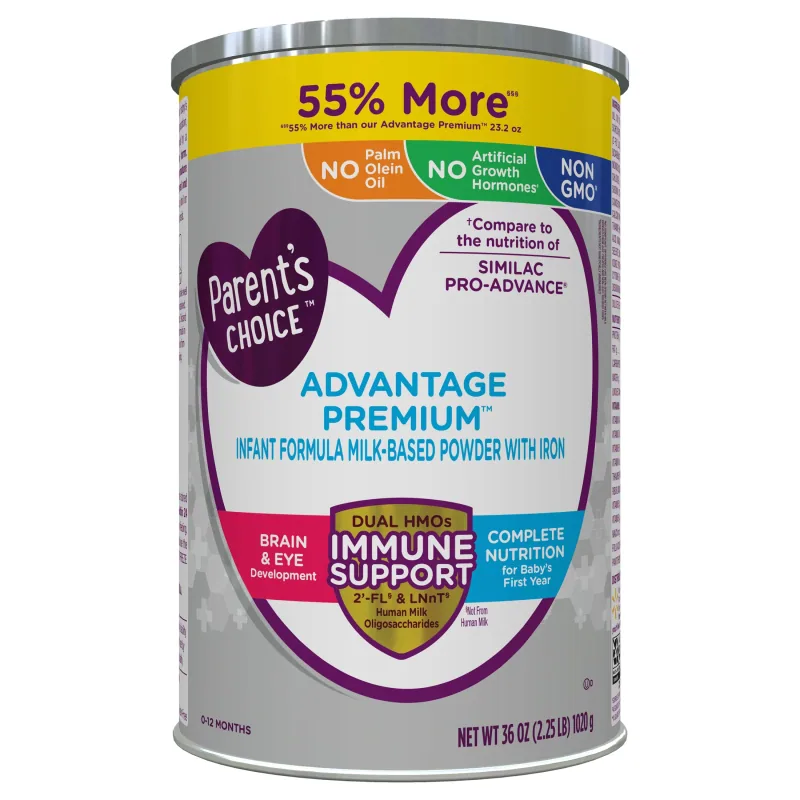
Positioned against Similac Pro-Advance. Adds GOS prebiotics, 2'-FL HMO, and full micronutrient fortification. The premium Parent's Choice variant with current-generation additives.
See the SKU record: Parent's Choice Advantage Premium.
Sensitivity
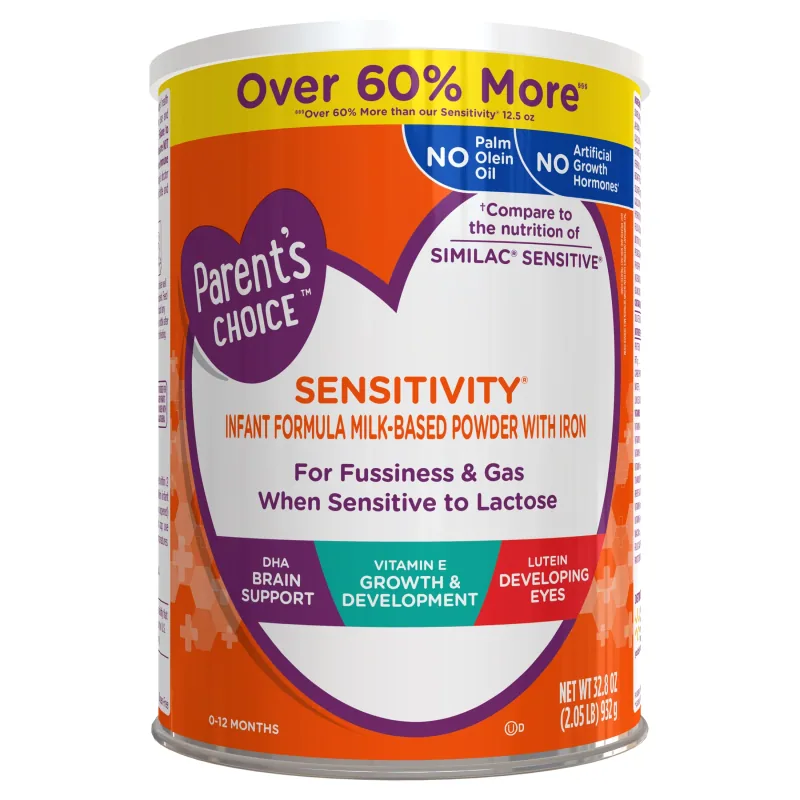
Positioned against Similac Sensitive. Reduced-lactose formula for "sensitive tummies" positioning. See infant lactose intolerance for the clinical context, reduced-lactose formulas are not clinically indicated for most healthy infants; the category exists primarily for commercial rather than medical reasons.
Gentle
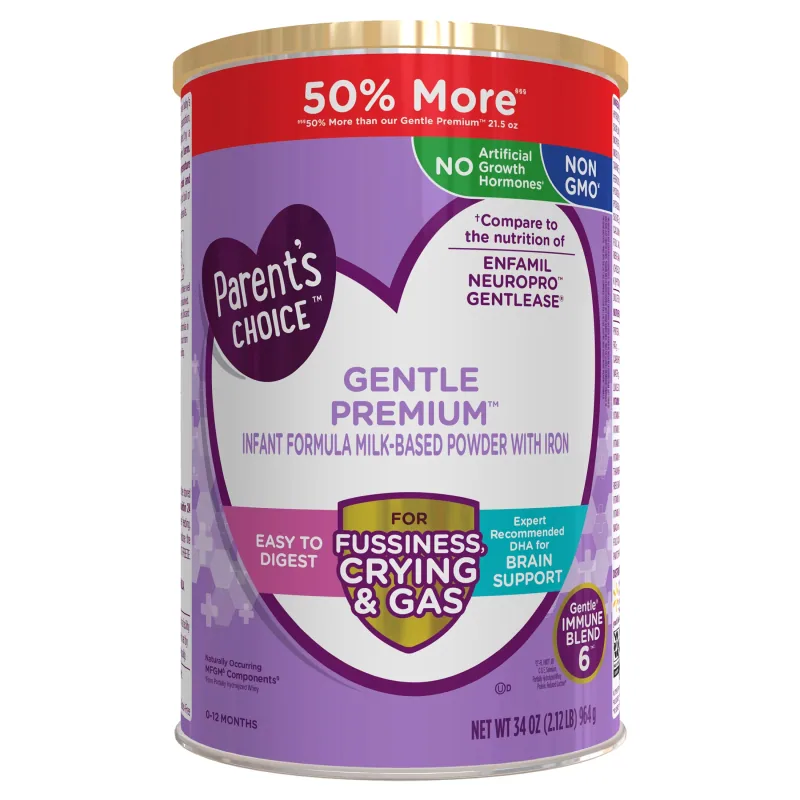
Positioned against Enfamil Gentlease. Partially hydrolyzed whey formula for atopic-risk families or "fussiness and gas" positioning. See colic and formula choice.
Soy
Soy-protein-based formula. Used for galactosemia, parental preference for plant-based, or as alternative to cow-milk formulas for families with specific clinical indications.
The cost math
For a typical US family formula-feeding from birth to 12 months:
| Brand | Approx monthly cost (exclusive formula) | Annual cost |
|---|---|---|
| Similac Pro-Advance | $240-320 | $2,900-3,850 |
| Enfamil NeuroPro | $240-320 | $2,900-3,850 |
| Parent's Choice Advantage Premium | $140-190 | $1,700-2,300 |
| Up&Up Premium (Target) | $140-190 | $1,700-2,300 |
The ~$1,200-$1,500 annual difference between major brand and store brand is significant for most families. FDA 21 CFR 107 compliance means both tiers meet identical nutritional thresholds.
WIC context
The USDA's WIC (Women, Infants, and Children) program serves approximately 6 million infants and children annually. WIC contracts for infant formula are negotiated state-by-state through competitive bidding. Store-brand formulas, including Parent's Choice, compete for these contracts alongside major brands.
Parent's Choice is covered by WIC in many state-level contracts. This means:
- Low-income families receive Parent's Choice under WIC at no cost
- The brand's overall market share is larger than retail sales alone would suggest
- Children receiving WIC are often raised on Parent's Choice (or equivalent store brands) as their primary infant formula
- The perception of "cheap formula is inferior formula" creates unfounded stigma for WIC-dependent families
Regulatory standing
Parent's Choice, like all US-sold infant formulas, must meet FDA 21 CFR 107 requirements:
- Specific nutrient content thresholds
- Pre-market notification
- Annual facility inspection
- Recall authority
See our FDA infant formula regulation pillar for the full regulatory framework.
How Parent's Choice compares to major brands
Nutritional equivalence is regulatory-mandated. Differences:
What's usually the same
- Core nutrient content (protein, fat, carb, vitamins, minerals)
- FDA compliance
- Facility inspection requirements
- Recall authority
- Basic safety framework
What sometimes differs
- Specific micronutrient levels within FDA acceptable ranges
- Presence of optional additives (HMO, MFGM, specific probiotic strains)
- Ingredient sourcing details
- Packaging convenience features
- Manufacturer relationship (store brand is Perrigo-focused; major brands have their own in-house facilities)
What's consistently different
- Price, significantly lower for store brands
- Marketing presence, minimal for store brands
- Pediatric familiarity, clinicians sometimes less familiar with store-brand product names
Editorial notes from María
Parent's Choice is a brand that most premium-parenting discourse ignores, which is a disservice to the majority of parents who use it. The perception that store-brand formula is inferior is not supported by FDA regulatory reality, both tiers meet identical standards. The actual nutritional difference between Parent's Choice Advantage Premium and Similac Pro-Advance is modest, and for most healthy term infants the clinical outcome is equivalent.
The decision between major-brand and store-brand formula typically comes down to:
- Budget, store brands save $1,200-1,500/year
- Pediatric familiarity, if your pediatrician recommends a specific brand, that may outweigh cost savings
- WIC coverage, if you're eligible, WIC formula is free and often a store brand anyway
- Specific features, if you specifically want a feature a major brand has that the store brand doesn't (a specific probiotic strain, HMO concentration, or organic certification), major brand is the only option
For families who want organic infant formula, store brands typically do not offer certified-organic variants, this is one of the consistent gaps. Bobbie, Happy Baby, Baby's Only, Earth's Best, and European imports (HiPP, Holle, Kendamil, Lebenswert, Löwenzahn) remain the organic routes.
Parent's Choice is not sold by Organic's Best Shop. This hub exists for Atlas completeness and to serve the substantial population of parents using this brand.
For related profiles:
- Up&Up: Target private label equivalent
- Similac, major brand reference (Abbott)
- Enfamil, major brand reference (Reckitt)
Frequently asked questions
Who manufactures Walmart's Parent's Choice formula?
Is Parent's Choice WIC-eligible?
Is Parent's Choice nutritionally equivalent to Similac Pro-Advance?
Are there organic options in the Parent's Choice line?
Can I switch between Parent's Choice and brand-name formulas?
Is Parent's Choice safe? Why is it so much cheaper?
Primary sources
- Walmart Inc.: Parent's Choice retail information. walmart.com
- Perrigo Company plc: Primary contract manufacturer for US private-label infant formulas. perrigo.com
- FDA: Infant Formula Guidance and 21 CFR 107 regulation. fda.gov
- USDA Food and Nutrition Service: WIC program infant formula contract information. fns.usda.gov
- AAP: HealthyChildren.org guidance on nutritional equivalence of FDA-registered infant formulas. aap.org
Related reading
This site provides research and comparisons, not medical advice. Consult your pediatrician before changing your baby's formula.