
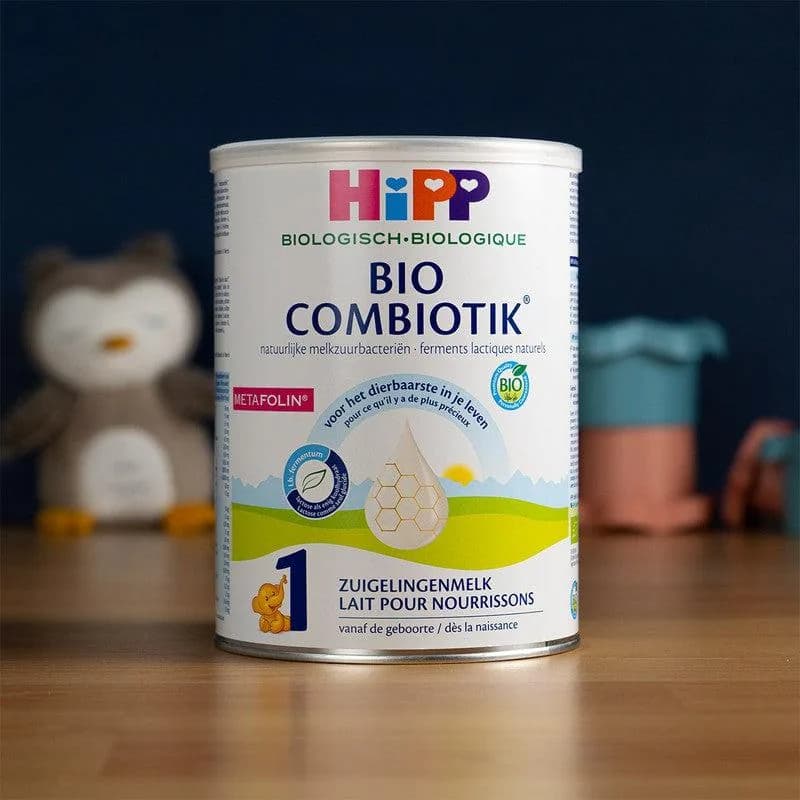
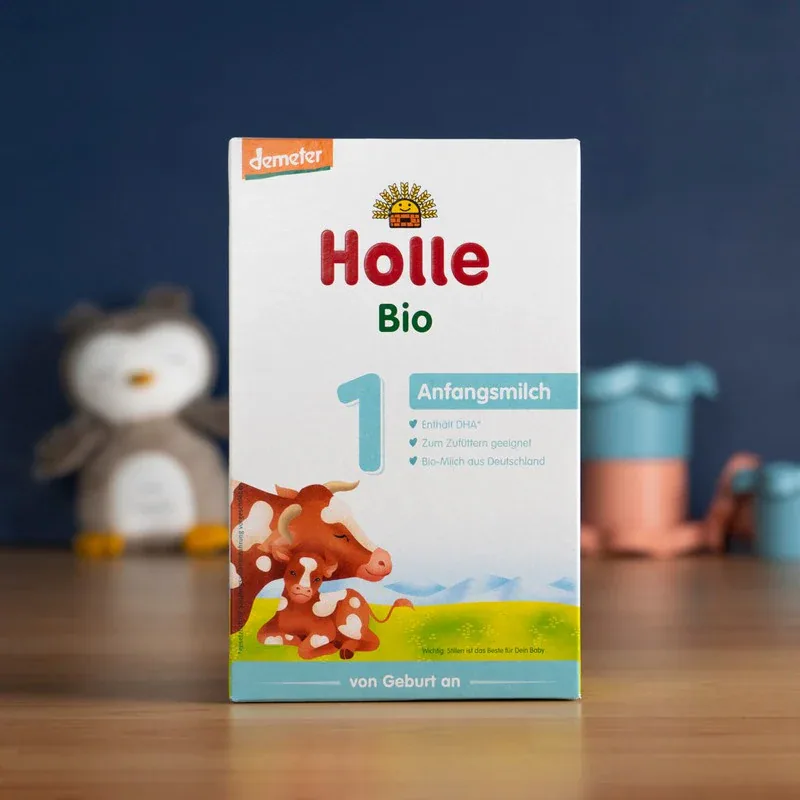
HiPP Dutch Stage 1 and Holle Cow Stage 1 are the two most-asked-about EU organic Stage 1 formulas for US-importing families. They overlap on almost every foundational axis. EU 2016/127 compliance, lactose-only added carbohydrate, 60:40 whey:casein, organic milk base, palm-inclusive vegetable oil blend, and diverge on the two choices parents weight most when picking between them: bioactive depth (HiPP wins) and certification tier (Holle wins).
HiPP Dutch Stage 1 and Holle Cow Stage 1 are both EU Organic Stage 1 cow-milk formulas, both lactose-primary, both palm-inclusive, both via Organic's Best Shop with 5-10 day US import shipping. HiPP adds the Combiotik stack, Limosilactobacillus fermentum hereditum live probiotic and GOS prebiotic, and uses Metafolin (bioavailable folate). Holle Cow Stage 1 is Demeter biodynamic certified (stricter than EU Organic baseline) and uses a traditional minimal-additive composition without probiotic, prebiotic, or Metafolin. HiPP $1.77/oz, Holle $1.95/oz.
Why this comparison matters
If you've narrowed your shortlist to EU organic imports, HiPP and Holle are almost always the final two. Both are manufacturer-owned brands (HiPP produces in Germany and Holland; Holle produces in Switzerland and Germany) with decades of infant-formula track record, clean recall histories, and broad US-parent communities discussing them. The bioactive-vs-biodynamic split is the decision frame that resolves most shortlists.
At a glance
| Dimension | HiPP Dutch Stage 1 | Holle Cow Stage 1 |
|---|---|---|
| Manufacturer | HiPP (Germany, Dutch-market SKU) | Holle AG (Switzerland/Germany) |
| Age range | 0-6 months | 0-6 months |
| Regulation | EU 2016/127 and 2018/848 organic | EU 2016/127 and 2018/848 organic |
| Organic certification | EU Organic (SKAL) | EU Organic and Demeter biodynamic |
| Protein | Skimmed cow milk and whey | Skimmed cow milk and whey |
| Whey:casein | 60:40 | 60:40 |
| Primary carbohydrate | Lactose (only added) | Lactose (only added) |
| Prebiotic | GOS | None |
| Probiotic | L. fermentum hereditum (Combiotik) | None |
| Folate form | Metafolin (L-methylfolate) | Folic acid |
| DHA source | Fish oil, ~13.2 mg/100 ml | Fish oil, ~15 mg/100 ml |
| Fat blend | Palm, rapeseed, sunflower | Palm, rapeseed, coconut, sunflower |
| Fat-blend notes | Palm oil | Palm oil |
| Tin size / format | 800 g metal tin | 400 g cardboard box and foil pouch |
| Typical price | ||
| US availability | Organic's Best, 5-10 day shipping | Organic's Best, 5-10 day shipping |
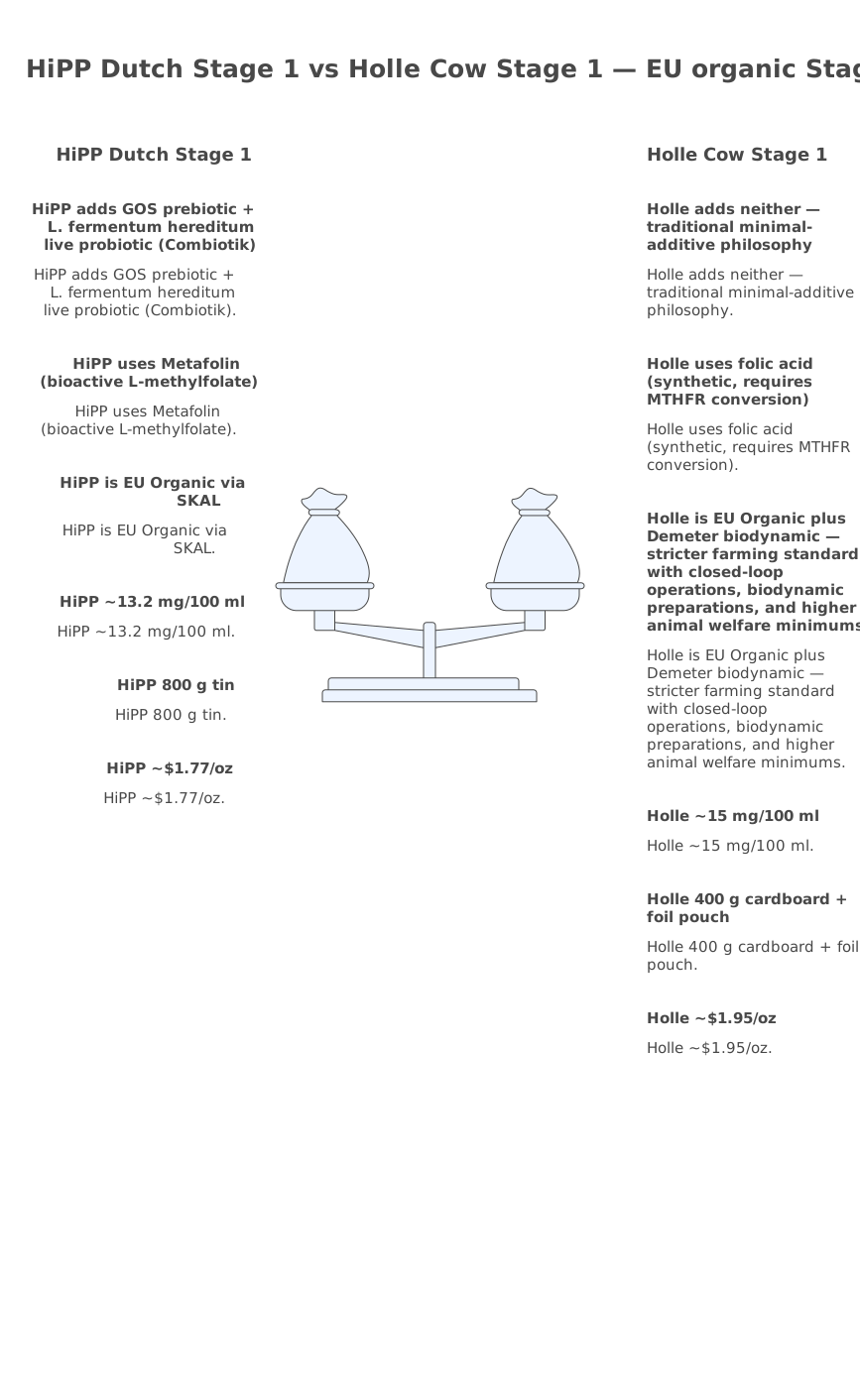
Visual generated with Napkin AI, editorial review by María López Botín. See methodology for our use policy.
Compositional differences that actually matter
1. Bioactive stack: Combiotik vs traditional minimal-additive
HiPP Dutch is the flagship Combiotik SKU: GOS prebiotic + Limosilactobacillus fermentum hereditum® live probiotic. The GOS feeds the L. fermentum strain; the L. fermentum is documented in EU clinical trials on gut colonization and reduced infection incidence vs formula-only controls.
Holle Cow Stage 1 includes neither. Holle's philosophy is traditional minimal-additive composition, whole-food Demeter-certified organic milk and the mandatory EU vitamin/mineral fortification, nothing else. No prebiotic fiber, no probiotic strain, no HMO, no MFGM, no lactoferrin. The implicit claim: you don't need to engineer bioactives into infant formula if the milk source is high-enough quality.
Both philosophies are defensible. Parents who weight "replicate breast- milk bioactive breadth as closely as possible" pick HiPP. Parents who weight "minimize additives, maximize source-milk quality" pick Holle. See the GOS explainer.
2. Certification tier: EU Organic vs Demeter biodynamic
HiPP Dutch is EU Organic certified (Regulation 2018/848) via SKAL (the Netherlands organic certifier). Holle Cow Stage 1 is EU Organic plus Demeter biodynamic, a stricter standard that sits above EU Organic baseline.
Demeter biodynamic means: 100% organic feed, closed-loop farm operation (on-farm nutrient cycling), biodynamic preparations applied to soil, cosmological planting calendars, stricter herd-composition rules, and higher minimum pasture hours for dairy cows. It's not a composition difference in the finished formula, the milk's nutritional profile isn't noticeably different, but it's a real difference in farming methodology, animal welfare, and environmental footprint. See our organic certifications ladder.
For parents who care about biodynamic practice and verifiable-above-EU certification, Holle is the answer. HiPP Dutch is not Demeter.
3. Folate form: Metafolin vs folic acid
HiPP Dutch uses Metafolin (calcium L-methylfolate), the bioactive reduced form that the body uses directly without MTHFR enzyme conversion. Holle Cow Stage 1 uses folic acid, the synthetic oxidized form that requires MTHFR-dependent conversion.
For MTHFR-sensitive families, Metafolin is metabolically more efficient. For families without MTHFR concerns, either form supplies adequate folate for normal infant metabolism. See our Metafolin vs folic acid explainer for the clinical nuance.
4. DHA level: both from fish oil, Holle slightly higher
HiPP Dutch supplies ~13.2 mg DHA / 100 ml; Holle Cow Stage 1 supplies ~15 mg / 100 ml. Both from fish oil sources. Both meet the EU 2016/127 minimum. The ~14% difference is meaningful on paper but sits well within the range of normal breast-milk DHA variability (which ranges 0.1-1.0% of total fat across populations). Neither value is a red flag; neither meaningfully changes infant outcome.
5. Fat blend: both palm-inclusive
Both include organic palm oil within the vegetable oil blend. For palm-free EU organic options, look at Kendamil Organic Stage 1 (whole-milk fat base). See the palm oil explainer.
6. Price per ounce: HiPP cheaper
HiPP Dutch runs ~$1.77/oz via OB subscription; Holle Cow Stage 1 runs ~$1.95/oz. The ~10% premium on Holle reflects the Demeter certification premium and smaller 400 g format (higher per-gram packaging overhead). Both are in the mid-tier of premium EU organic pricing, below Kendamil Organic, above Lebenswert.
7. Format: 800 g tin vs 400 g box
HiPP Dutch comes in an 800 g metal tin with plastic scoop, larger format, fewer repurchases, more storage stability after opening. Holle Cow comes in a 400 g cardboard box with inner foil pouch — smaller format, more frequent repurchases, slightly shorter opened- pouch shelf life. For families committing to one formula long-term, HiPP's format is logistically friendlier.
Regulatory framework
Both formulas comply with EU Regulation 2016/127 (infant formula composition, lactose predominance, mandatory DHA, vitamin/mineral ranges per Annex I) and EU Regulation 2018/848 (organic). Neither is FDA-registered; families import under FDA enforcement discretion. See the buying European formula pillar for the full import framework.
Holle adds Demeter International biodynamic certification, a private, above-EU standard verified through the Demeter registry.
Real-world parent experience
Following site methodology, the observations below come from my personal use across both kids plus a stable pool of parent-feedback notes from families on both formulas. They carry the parent-experience label rather than being claimed as regulatory or clinical facts, because individual infant variation on stool consistency, smell preference, and mixability is large enough that any specific point can reverse for a specific baby. Read these as context, not prediction.
Smell and taste. HiPP has a slightly sweeter, milkier character consistent with Dutch-market dairy. Holle has a deeper, more cereal- like dairy note typical of Swiss-German biodynamic dairy. Both are "European" in profile vs US mainstream formulas. Most infants accept either; transitioning babies sometimes take 3-5 days to adapt.
Mixability. HiPP's 800 g tin with scoop dissolves cleanly at 70°C. Holle's 400 g pouch is more prone to clumping at colder-than-optimal preparation temperatures, stick to 70°C water and stir promptly.
Stool consistency. HiPP families commonly report softer, more yogurt-like stools (L. fermentum probiotic contribution). Holle families report moderate-firm stools with typical palm oil patterns. Neither is concerning for term infants without other symptoms.
Gas and fussiness. Both produce similar gas patterns. A small fraction of families report switching from HiPP to Holle or vice versa and seeing symptom shifts, usually attributable to the probiotic strain change (HiPP has, Holle doesn't) rather than any fundamental composition difference.
Switching between them. Use a 4-6 day gradual transition. Since both are lactose-only added carbohydrate, the transition is usually smooth, the main observable change is stool character from the probiotic add/remove.
Verdict: when to pick each
Pick HiPP Dutch Stage 1 if:
- You want a documented probiotic strain (L. fermentum hereditum) in your infant's formula
- Metafolin folate matters (MTHFR or general optimization)
- You prefer the 800 g tin format (fewer repurchases, better long-term storage)
- Lower per-ounce price matters
Pick Holle Cow Stage 1 if:
- Demeter biodynamic certification matters (above EU Organic baseline)
- You prefer traditional minimal-additive composition (no probiotic, no prebiotic, no added bioactives beyond the mandatory vitamin/mineral stack)
- Swiss/German biodynamic dairy heritage (since 1933) resonates
- Higher DHA level (~15 mg/100 ml) is a target
Pick either if:
- You want EU Organic, lactose-primary, and cow-milk Stage 1 and neither bioactive depth nor Demeter is a strong preference. Both deliver fundamentally similar nutrition with different optimization axes.
Pick neither if:
- You need palm-free, consider Kendamil Organic Stage 1 (whole-milk fat, EU Organic, palm-free)
- You need USDA Organic and FDA registration, consider Bobbie Original
What you can't infer from this comparison
Neither is indicated for diagnosed cow milk protein allergy, see the CMPA pillar. Neither is reflux-specific. Neither is appropriate for preterm infants without pediatrician guidance. The Combiotik probiotic in HiPP is documented-safe but not clinically required; Demeter certification is a farming standard, not a direct nutritional claim.
Frequently asked questions
Which is better: HiPP Dutch or Holle Cow Stage 1?
Is Demeter better than EU Organic?
Does HiPP Dutch have Demeter certification?
Does Holle Cow Stage 1 have a probiotic?
Is HiPP Dutch or Holle cheaper?
Can I switch from HiPP Dutch to Holle Cow or vice versa?
Do HiPP Dutch and Holle have palm oil?
Related reading
- HiPP brand hub
- Holle brand hub
- HiPP vs Holle vs Kendamil compared side-by-side, three-way European flagship comparison
- HiPP Dutch Stage 1 vs Kendamil Classic Stage 1, palm vs palm-free EU decision
- Holle Cow Stage 1 vs Lebenswert Stage 1: Holle's Demeter vs sibling Bioland line
- Organic certifications compared
- Metafolin vs folic acid explainer
- Buying European formula in the USA
- HiPP Dutch Stage 1 vs Jovie Goat Stage 1 - EU Organic Cow with Combiotik vs EU Organic Goat
- Holle Cow Stage 1 vs Earth's Best Dairy - Demeter Biodynamic EU Organic vs USDA Organic Budget
- Are probiotics in baby formula actually effective?
- Best Baby Formulas Closest to Breast Milk (2026 Buying Guide)
Primary sources
- HiPP, manufacturer product information. hipp.com
- Holle AG, manufacturer product information. holle.ch
- Demeter International, biodynamic certification registry. demeter.net
- EU Regulation 2016/127, infant formula compositional requirements. eur-lex.europa.eu
- EU Regulation 2018/848, organic production. eur-lex.europa.eu
This site provides research and comparisons, not medical advice. Consult your pediatrician before changing your baby's formula.