
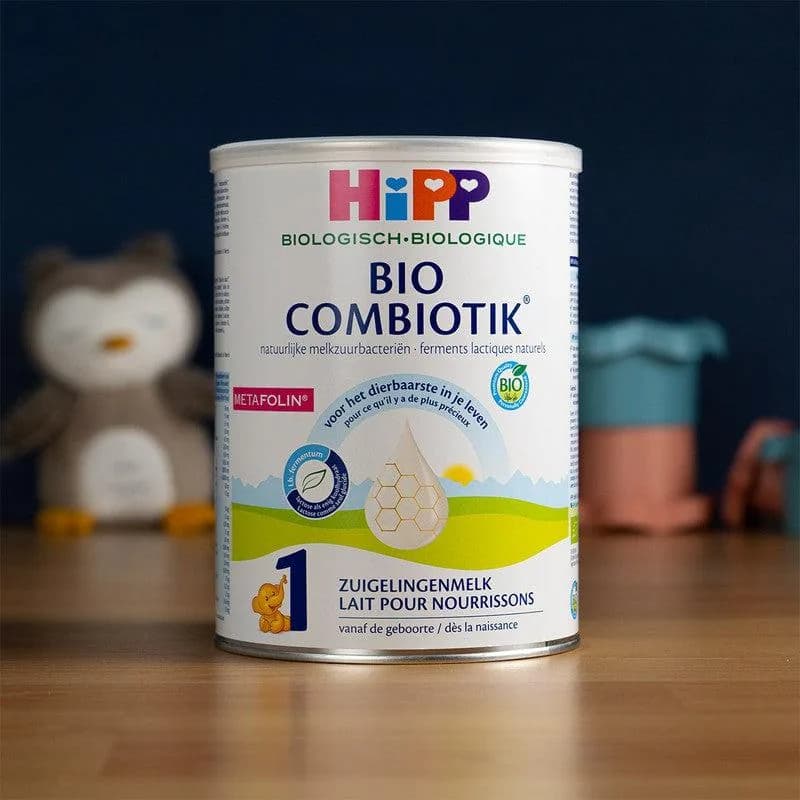
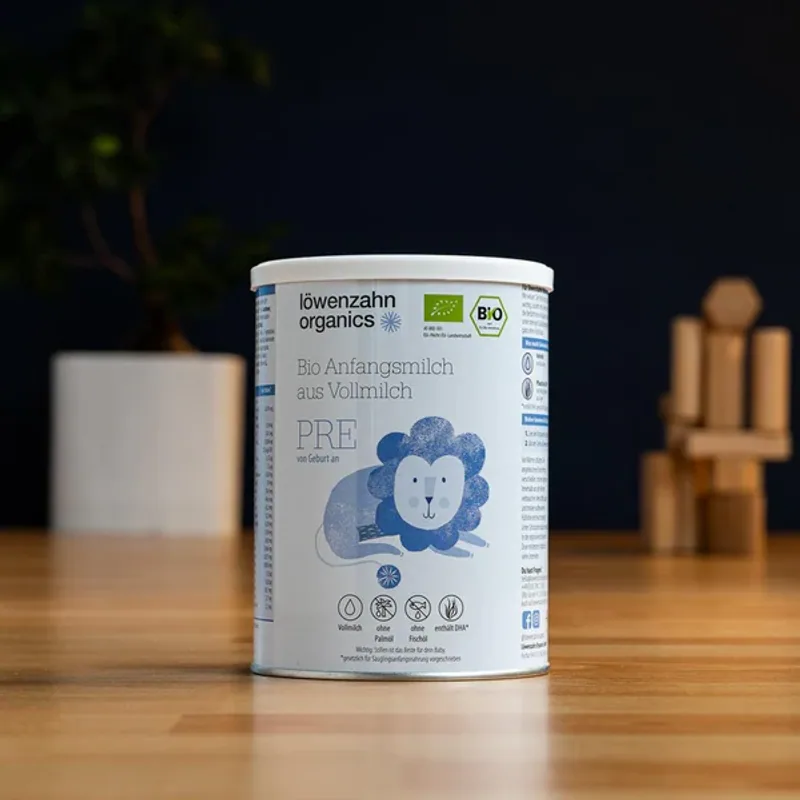
HiPP Dutch Stage 1 and Löwenzahn Stage 1 are both EU Organic Stage 1 cow-milk formulas but they come from opposite ends of the scale spectrum. HiPP is the largest EU organic infant nutrition brand — massive distribution, Combiotik bioactive stack, Metafolin. Löwenzahn Organics is a small premium Bavarian brand founded in 2017 with distinctive Allgäu alpine dairy sourcing, a vegetarian fish-oil-free algal-DHA formulation, and a clean-label minimal-additive approach. Both EU Organic. Both via Organic's Best. Different ethos.
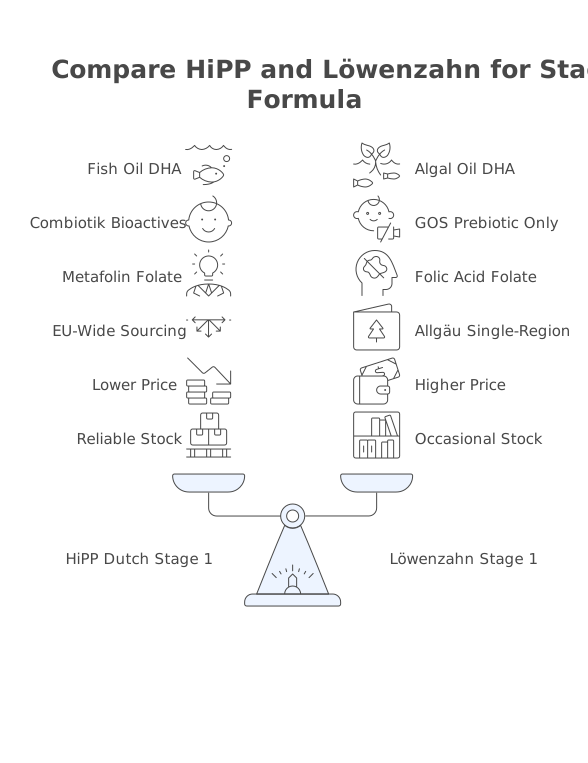
HiPP Dutch Stage 1 is EU Organic and Combiotik (L. fermentum probiotic and GOS prebiotic) and Metafolin folate with fish-oil DHA at ~$1.77/oz. Löwenzahn Stage 1 is EU Organic and Allgäu alpine regional dairy sourcing with algal-only DHA (no fish oil, vegetarian), GOS prebiotic, no probiotic, folic acid, at ~$1.87/oz via Organic's Best. Both lactose- only, both palm-inclusive. HiPP leads on bioactive depth and Metafolin; Löwenzahn leads on fish-oil-free formulation and small-scale Bavarian sourcing.
Why this comparison matters
Löwenzahn has a small but dedicated US parent community, families specifically seeking: (a) vegetarian DHA (algal, no fish oil), (b) tighter regional sourcing than the big EU brands offer, or (c) a cleaner-label formulation with fewer secondary ingredients. HiPP is the default big-scale EU Organic choice with Combiotik. Comparing them resolves the question: do I want HiPP's bioactive depth, or Löwenzahn's fish-oil-free clean-label niche?
Important framing: Löwenzahn is EU Organic, not Demeter
Some secondary sources erroneously list Löwenzahn as Demeter biodynamic certified. Löwenzahn is EU Organic certified only, not Demeter. For Demeter biodynamic Stage 1 cow-milk formula, Holle Cow Stage 1 is the primary option. Löwenzahn's positioning is "EU Organic and small- scale Allgäu sourcing and algal DHA" rather than Demeter biodynamic.
At a glance
| Dimension | HiPP Dutch Stage 1 | Löwenzahn Stage 1 |
|---|---|---|
| Manufacturer | HiPP (Germany, Dutch-market SKU) | Löwenzahn Organics (Germany, Allgäu) |
| Scale | Large: EU's biggest organic infant nutrition brand | Small, founded 2017, premium niche |
| Age range | 0-6 months | 0-6 months |
| Regulation | EU 2016/127 and 2018/848 organic | EU 2016/127 and 2018/848 organic |
| Organic certification | EU Organic (SKAL) | EU Organic |
| Protein | Skimmed cow milk and whey | Skimmed cow milk and whey |
| Whey:casein | 60:40 | 60:40 |
| Primary carbohydrate | Lactose (only added) | Lactose (only added) |
| Prebiotic | GOS | GOS |
| Probiotic | L. fermentum hereditum (Combiotik) | None |
| Folate form | Metafolin (L-methylfolate) | Folic acid |
| DHA source | Fish oil, ~13.2 mg/100 ml | Algal oil only (fish-oil-free), ~14 mg/100 ml |
| Fat blend | Palm, rapeseed, sunflower | Palm, rapeseed, sunflower |
| Fat-blend notes | Palm oil | Palm oil |
| Format | 800 g metal tin | 500 g cardboard box and foil pouch |
| Typical price | ||
| US availability | Organic's Best, 5-10 day shipping | Organic's Best (intermittent stock), 5-10 day shipping |
Visual generated with Napkin AI, editorial review by María López Botín. See methodology for our use policy.
Compositional differences that actually matter
1. DHA source: fish oil vs algal (the signature Löwenzahn differentiator)
This is Löwenzahn's most distinctive feature among EU Organic Stage 1 formulas.
HiPP Dutch uses fish oil as the DHA source (typical EU organic approach, all of HiPP, Holle, Kendamil, Lebenswert, Bebivita use fish-oil DHA).
Löwenzahn uses algal oil only, a plant-derived DHA source grown from microalgae (Schizochytrium). No fish oil in the formulation. Löwenzahn also pairs equal DHA:ARA ratios, using Mortierella alpina oil as the ARA source (fungal, vegetarian- compatible).
For families with fish-allergy concerns in siblings, vegetarian philosophy, or sensory aversion to fish-oil-derived formulas, Löwenzahn's algal-only DHA is essentially unique at the EU Organic Stage 1 level. In the US organic market, Earth's Best Dairy uses algal DHA but adds soy: Löwenzahn delivers algal DHA, no soy, and EU Organic certification.
2. Bioactive depth: Combiotik vs GOS-only clean label
HiPP Dutch: Combiotik: GOS prebiotic and L. fermentum hereditum live probiotic strain. Documented EU clinical trials on the strain.
Löwenzahn: GOS prebiotic only. No probiotic strain. Löwenzahn's positioning is deliberately clean-label minimal, fewer secondary ingredients, no synthetic additions beyond mandatory vitamin/mineral fortification.
For bioactive depth, HiPP wins. For clean-label minimalism, Löwenzahn wins. See the GOS explainer.
3. Folate form: Metafolin vs folic acid
HiPP: Metafolin (L-methylfolate), bioactive. Löwenzahn: folic acid, synthetic oxidized. For MTHFR-sensitive families, HiPP's Metafolin is metabolically more efficient. See Metafolin vs folic acid.
4. Sourcing: broad EU dairy vs Allgäu alpine
HiPP sources from EU-wide organic dairy networks including Germany, Netherlands, Austria. Löwenzahn sources exclusively from Allgäu region (Bavarian Alps foothills, southern Germany), smaller farmer network, single regional terroir. For parents who value traceable single-region sourcing (analogous to wine-terroir thinking) Löwenzahn's Allgäu focus is distinctive.
5. DHA level: Löwenzahn slightly higher
Löwenzahn ~14 mg DHA / 100 ml; HiPP ~13.2 mg. Both above EU minimum. Comparable in practice.
6. Fat blend: both palm-inclusive
Both use organic palm oil in vegetable oil blends. For palm-free EU Organic, Kendamil Organic Stage 1 is the primary option. See palm oil explainer.
7. Price per ounce: similar
Löwenzahn ~$1.87/oz; HiPP Dutch ~$1.77/oz. Löwenzahn's small-scale sourcing premium is modest (~6%). Both are mid-tier EU Organic pricing — Löwenzahn priced slightly above HiPP reflecting its niche positioning, but still below Kendamil Organic and Holle Cow ($1.95/oz).
Regulatory framework
Both comply with EU Regulation 2016/127 (infant formula composition) and EU Regulation 2018/848 (organic). Neither is FDA-registered. Löwenzahn's US import stock at Organic's Best can be intermittent given smaller production scale, verify availability before planning long-term supply. See the buying European formula pillar.
Real-world parent experience
Following site methodology, the observations below come from my personal use across both kids plus a stable pool of parent-feedback notes from families on both formulas. They carry the parent-experience label rather than being claimed as regulatory or clinical facts, because individual infant variation on stool consistency, smell preference, and mixability is large enough that any specific point can reverse for a specific baby. Read these as context, not prediction.
Smell and taste. Löwenzahn has a distinctively clean, neutral dairy profile, no fish-oil notes (which some parents detect faintly in fish-oil DHA formulas). HiPP Dutch has the mild, slightly sweet Dutch profile. Infants generally don't detect fish-oil notes at DHA concentrations used in infant formula, but some sensitive parents do.
Mixability. HiPP's metal tin and scoop dissolves cleanly. Löwenzahn's foil pouch format benefits from 70°C water and prompt stirring.
Stool consistency. HiPP families commonly report softer, more yogurt-like stools (L. fermentum probiotic contribution). Löwenzahn families report moderate stools with no probiotic-driven character shift.
Stock availability. Löwenzahn's small production scale means Organic's Best stock can fluctuate, occasional short-term unavailability has been reported. HiPP Dutch is effectively always in stock. For families committed to Löwenzahn long-term, buffer-stock ordering is advisable.
Switching between them. Use a 4-6 day gradual transition. Both EU Organic and lactose-only and 60:40 whey:casein, macro transition smooth. Main observable change is stool pattern from L. fermentum add/remove plus the fish-oil ↔ algal DHA source shift (usually imperceptible at infant formula concentrations).
Verdict: when to pick each
Pick HiPP Dutch Stage 1 if:
- Combiotik bioactive depth (L. fermentum and GOS) matters
- Metafolin bioavailable folate matters
- Reliable large-scale supply and subscribe-and-save continuity matter
- Fish-oil DHA source is acceptable (or positive)
Pick Löwenzahn Stage 1 if:
- Fish-oil-free DHA is a must-have (vegetarian philosophy, fish allergy considerations, or sensory preference)
- Small-scale Allgäu alpine regional sourcing resonates
- Clean-label minimal-additive composition appeals (vs HiPP's bioactive-heavy approach)
- You can tolerate occasional stock fluctuations
Pick either if:
- You want EU Organic, lactose-only, and cow-milk Stage 1 and neither bioactive depth nor fish-oil-free DHA is a dominant criterion.
Pick neither if:
- Demeter biodynamic certification is required, consider Holle Cow Stage 1
- Palm-free required, consider Kendamil Organic Stage 1
What you can't infer from this comparison
Neither is indicated for diagnosed cow milk protein allergy, see the CMPA pillar. Neither is reflux-specific. Algal DHA vs fish-oil DHA doesn't carry documented clinical-outcome differences at infant-formula concentrations; the choice is preference-driven (vegetarian philosophy, allergen avoidance, sensory) not clinically superior either way.
Frequently asked questions
Is Löwenzahn Demeter biodynamic certified?
Does Löwenzahn use fish oil?
Is Löwenzahn better than HiPP?
Where does Löwenzahn source its milk?
Is Löwenzahn more expensive than HiPP?
Is Löwenzahn always in stock at Organic's Best?
Can I switch from HiPP Dutch to Löwenzahn?
Related reading
- HiPP brand hub
- Löwenzahn Organics brand hub
- HiPP Dutch Stage 1 vs Holle Cow Stage 1: Combiotik vs Demeter biodynamic
- Holle Cow Stage 1 vs Löwenzahn Stage 1: Demeter vs EU Organic Allgäu (coming soon)
- HiPP Dutch Stage 1 vs Kendamil Organic Stage 1
- Organic certifications compared
Primary sources
- HiPP, manufacturer product information. hipp.com
- Löwenzahn Organics, manufacturer product information. loewenzahn-organics.com
- EU Regulation 2016/127, infant formula compositional requirements. eur-lex.europa.eu
- EU Regulation 2018/848, organic production. eur-lex.europa.eu
- EFSA Scientific Opinion on compositional requirements for infant formula. efsa.europa.eu
This site provides research and comparisons, not medical advice. Consult your pediatrician before changing your baby's formula.