
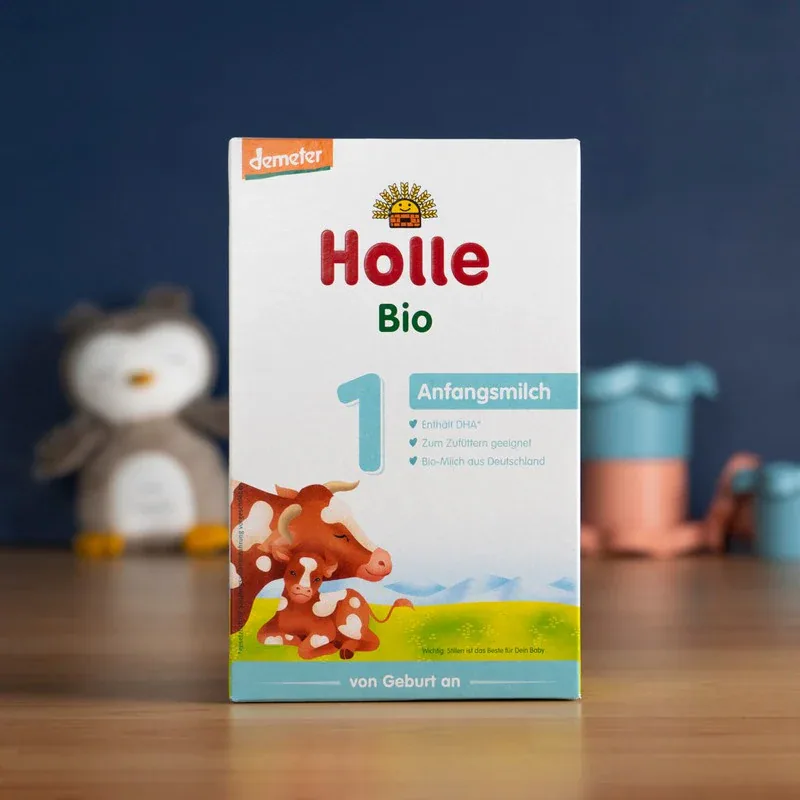
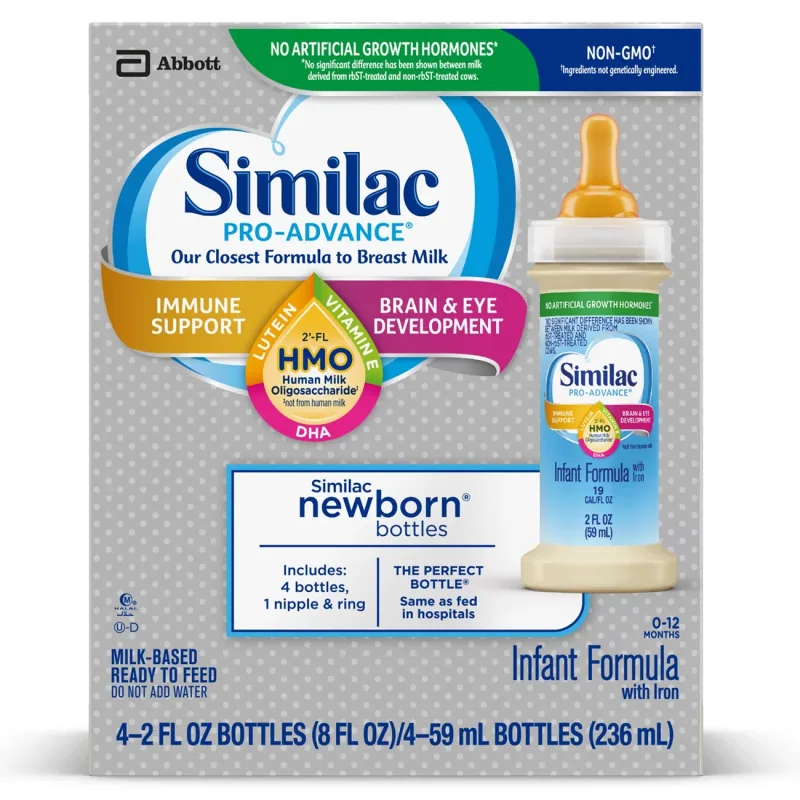
Holle Cow Stage 1 and Similac Pro-Advance illustrate the two dominant philosophies of modern Stage 1 formula design. Holle is the traditional Demeter biodynamic flagship, strictest organic agricultural standard, minimal added ingredients, EU Organic certified, imported from Europe. Similac Pro-Advance is Abbott's bioactive-enriched US flagship, 2'-FL HMO added, no palm olein, FDA-registered, WIC-contracted in many states, next-day retail. They diverge on essentially every non-mandatory dimension, which makes the decision clarifying rather than confusing.
Holle Cow Stage 1 and Similac Pro-Advance are both lactose-primary cow- milk Stage 1 formulas but take opposite compositional approaches. Holle uses traditional Demeter biodynamic composition with palm-inclusive fat blend and no added bioactives, EU Organic certified, ~$1.95/oz via OB. Similac adds 2'-FL HMO and GOS, excludes palm olein (uses soy oil and others), FDA-registered, WIC-eligible, ~$1.51/oz at US retail. Pick by organic tradition vs US bioactive layering.
Why this comparison matters
This comparison addresses two distinct parent decisions. For families weighing Similac as the default US mainstream option but curious about European alternatives, Holle is often the first Demeter biodynamic name that comes up. For families already drawn to EU organic formula, Similac represents "what am I giving up by importing?", particularly the 2'-FL HMO and no-palm-olein features Abbott markets heavily. Both products are legitimate; the decision frame is philosophy, logistics, and cost.
At a glance
| Dimension | Holle Cow Stage 1 | Similac Pro-Advance |
|---|---|---|
| Manufacturer | Holle AG (Swiss and German farms) | Abbott Nutrition |
| Origin | Germany / Switzerland | USA (Sturgis MI and Columbus OH) |
| Age range | 0-6 months (Stage 1) | 0-12 months |
| Regulation | EU 2016/127 and 2018/848 organic | FDA 21 CFR 107 |
| Organic certification | Demeter biodynamic and EU Organic | None |
| Protein | Skimmed cow milk | Skimmed cow milk, 60:40 whey:casein |
| Primary carbohydrate | Lactose | Lactose |
| Prebiotic | None | GOS and 2'-FL HMO |
| Probiotic | None | None |
| Folate form | Folic acid | Folic acid |
| Fat blend | Palm, rapeseed, coconut, sunflower | Soy, coconut, safflower/sunflower, rapeseed (no palm olein) |
| DHA source | Fish oil, ~15 mg/100 ml | Algal oil, ~11.3 mg/100 ml |
| ARA | ~15 mg/100 ml | ~22.6 mg/100 ml |
| Fat-blend notes | Palm oil | Soy oil, synthetic beta-carotene |
| Typical US price | ||
| US availability | Organic's Best, 5-10 day shipping | Target, Amazon, Walmart, WIC, next-day |
| Affiliate commission | Yes (Organic's Best) | No |
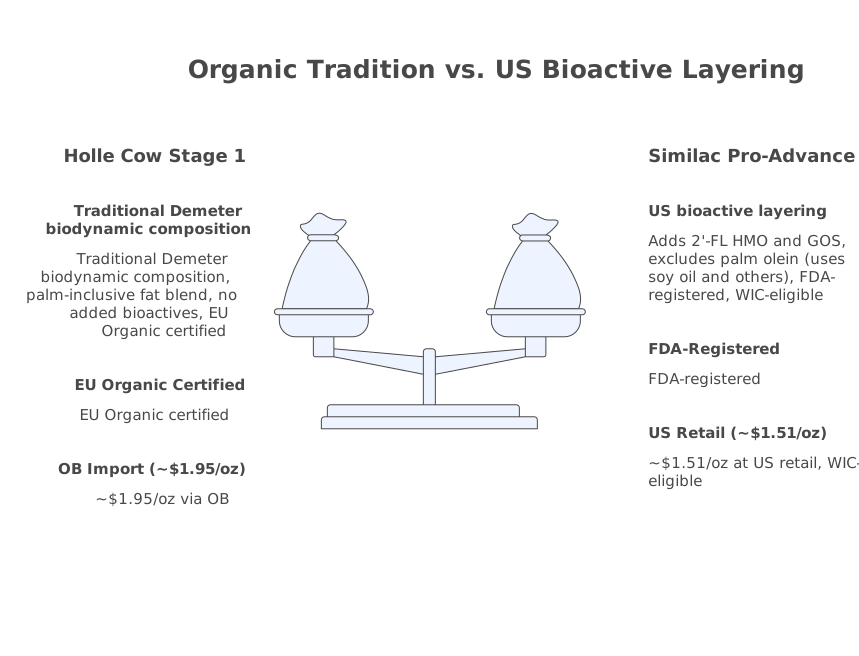
Visual generated with Napkin AI, editorial review by María López Botín. See methodology for our use policy.
Compositional differences that actually matter
Six dimensions that distinguish these two Stage 1 options.
1. Compositional philosophy: traditional vs bioactive-layered
The headline difference. Similac Pro-Advance augments the FDA baseline with 2'-FL HMO plus GOS prebiotic, adds soy oil for fatty-acid profile, includes an extensive vitamin premix. Holle Cow Stage 1 operates on the opposite principle: add as little beyond EU 2016/127 mandatory baseline as possible, trust the Demeter biodynamic farming to provide the rest. No HMO, no prebiotic, no probiotic.
This is not a nutrition-gap argument. Holle meets all EU 2016/127 requirements (which mandate lactose predominance and DHA minimum, so nothing essential is missing). Similac similarly meets all FDA 21 CFR 107 requirements. The difference is strategy: bioactive layering vs traditional simplicity.
2. Organic certification: Demeter biodynamic vs none
Similac Pro-Advance is not organic. Holle Cow Stage 1 carries Demeter biodynamic certification (the strictest organic agricultural standard globally, whole-farm ecosystem management, 100% organic feed, lunar planting cycles, biodynamic preparations) plus EU Organic (Regulation 2018/848) as a baseline certification. See organic certifications compared for the strictness ladder.
For parents weighting organic certification, especially Demeter tier specifically: Holle wins this dimension unambiguously.
3. HMO strategy: 2'-FL vs none
Similac Pro-Advance includes 2'-FL HMO (2'-fucosyllactose), the most- studied commercially-available human milk oligosaccharide. Holle Cow Stage 1 does not include 2'-FL or other HMOs. See the 2'-FL HMO explainer for the mechanism and evidence.
Families weighting 2'-FL as a bioactive priority pick Similac. Families who view Demeter biodynamic farming as providing the trust signal they want, independent of additive layering, pick Holle.
4. Fat blend: palm oil vs palm-free (with soy)
Holle includes palm oil in its vegetable-oil blend, an attribute some parents avoid. Similac Pro-Advance notably excludes palm olein: Abbott markets this as a differentiator, but uses soy oil as part of its blend. Neither adds sn-2 palmitate enrichment.
For parents avoiding palm oil specifically, Similac wins. For parents avoiding soy derivatives, Holle wins. For parents avoiding both, look at Bobbie or Kendamil.
5. DHA provision: Holle higher, Similac lower but HMO-compensated
Holle provides ~15 mg DHA per 100 ml (fish oil source, meeting EU mandatory minimum with margin). Similac provides ~11.3 mg per 100 ml (algal oil, above FDA baseline). Both adequate for term infants; Holle benefits from EU 2016/127 mandatory DHA minimum driving higher delivery. ARA profile flips: Similac higher (~22.6 mg), Holle balanced (~15 mg).
6. Cost and supply chain
Similac Pro-Advance runs meaningfully cheaper per ounce at US retail
($1.51/oz) than Holle ($1.95/oz via OB subscription). WIC eligibility
can reduce Similac to $0. Supply chain resilience flipped during the
2022 Abbott Sturgis shortage, see Abbott 2022 recall aftermath
for context. Holle's EU supply is independent of US single-
manufacturer risk.
Regulatory framework
Holle Cow Stage 1 complies with EU Regulation 2016/127 (infant formula, mandatory lactose predominance, mandatory DHA 20-50 mg/100 kcal) plus EU Regulation 2018/848 (organic) plus Demeter International biodynamic standards. Not FDA-registered; families import under enforcement discretion.
Similac Pro-Advance complies with FDA 21 CFR Part 107 (pre-market notification, nutrient minimums and some maximums, Part 106 quality control, FSMA mandatory recall authority). Abbott's 2022 Sturgis Cronobacter recall did not directly affect Pro-Advance but disrupted the broader Abbott portfolio; Sturgis has since reopened under FDA consent decree with enhanced monitoring.
See FDA vs EFSA standards compared for the full regulatory context.
Real-world parent experience
Following site methodology, the observations below come from my personal use across both kids plus a stable pool of parent-feedback notes from families on both formulas. They carry the parent-experience label rather than being claimed as regulatory or clinical facts, because individual infant variation on stool consistency, smell preference, and mixability is large enough that any specific point can reverse for a specific baby. Read these as context, not prediction.
Smell and taste. Holle has a distinctive traditional European dairy character, noticeably stronger dairy aroma than Similac's cleaner, slightly sweet smell. Most infants adapt to either.
Mixability. Both dissolve cleanly at 70°C. Similac produces slightly more foam on shaking (soy oil in blend); swirling preparation reduces this. Holle mixes uniformly with 5-10 seconds of extra shaking for the 400 g tin format.
Stool consistency. Similac families report softer stools on average (the GOS and 2'-FL HMO combined prebiotic load). Holle families report moderate consistency, occasionally firmer (palm oil contribution without prebiotic softening).
Switching between them. Clinically straightforward for healthy term infants. Use a 4-6 day gradual transition protocol. Expect 7-10 days of stool adjustment during the prebiotic- inclusive to prebiotic-free transition.
Verdict: when to pick each
Pick Holle Cow Stage 1 if:
- Demeter biodynamic certification matters (strictest organic tier)
- Traditional minimal-additive composition fits your philosophy
- European farming heritage is important to you
- You can tolerate 5-10 day import shipping from Organic's Best
- Palm oil inclusion is acceptable (you're not specifically avoiding)
Pick Similac Pro-Advance if:
- 2'-FL HMO breadth is your bioactive priority
- No palm olein is a compositional must-have
- FDA registration is a baseline assurance
- You're WIC-eligible and Similac is your state's contracted brand
- Cost per ounce matters: Pro-Advance runs cheaper at standard retail
- Next-day US retail is essential
Pick either if:
- You're choosing against reduced-lactose or corn-syrup-primary US formulas. Both are materially closer to breast-milk composition than any sensitive variant.
What you can't infer from this comparison
Neither is indicated for diagnosed cow milk protein allergy, see CMPA explained. Neither is a reflux-specific formula (Similac Spit-Up exists for that). Neither is appropriate for preterm infants without pediatrician guidance.
If both Demeter certification AND 2'-FL HMO matter to you, neither formula delivers both. The closest compromise is HiPP Dutch Stage 1 (EU Organic, Metafolin, GOS, and L. fermentum probiotic, but no 2'-FL HMO or Demeter) or Kendamil Organic (EU Organic and 2'-FL HMO in some variants, GOS, FOS, and whole-milk fat, but not Demeter).
Frequently asked questions
Is Holle Cow Stage 1 better than Similac Pro-Advance?
Does Holle Cow Stage 1 have HMOs?
Can I switch from Similac Pro-Advance to Holle Cow Stage 1?
Which is cheaper per ounce?
Is Holle Cow Stage 1 FDA-registered?
Does Holle have palm oil and Similac does not?
Was Similac Pro-Advance affected by the 2022 Abbott recall?
Related reading
- Holle brand hub
- Similac brand hub
- Holle Cow Stage 1, full SKU record
- Similac Pro-Advance, full SKU record
- HiPP Dutch Stage 1 vs Similac Pro-Advance, the HiPP alternative EU flagship
- Bobbie Original vs Holle Cow Stage 1, the US organic comparison to Holle
- HiPP vs Holle vs Kendamil, three-way European organic
- Organic certifications compared
- Abbott 2022 recall aftermath
Primary sources
- Holle, official manufacturer information. holle.ch
- Similac Pro-Advance, official product information. similac.com
- Demeter International, biodynamic certification standards. demeter.net
- EU Regulation 2016/127: Infant formula compositional requirements. eur-lex.europa.eu
- FDA 21 CFR Part 107. US infant formula regulation. ecfr.gov
This site provides research and comparisons, not medical advice. Consult your pediatrician before changing your baby's formula.