
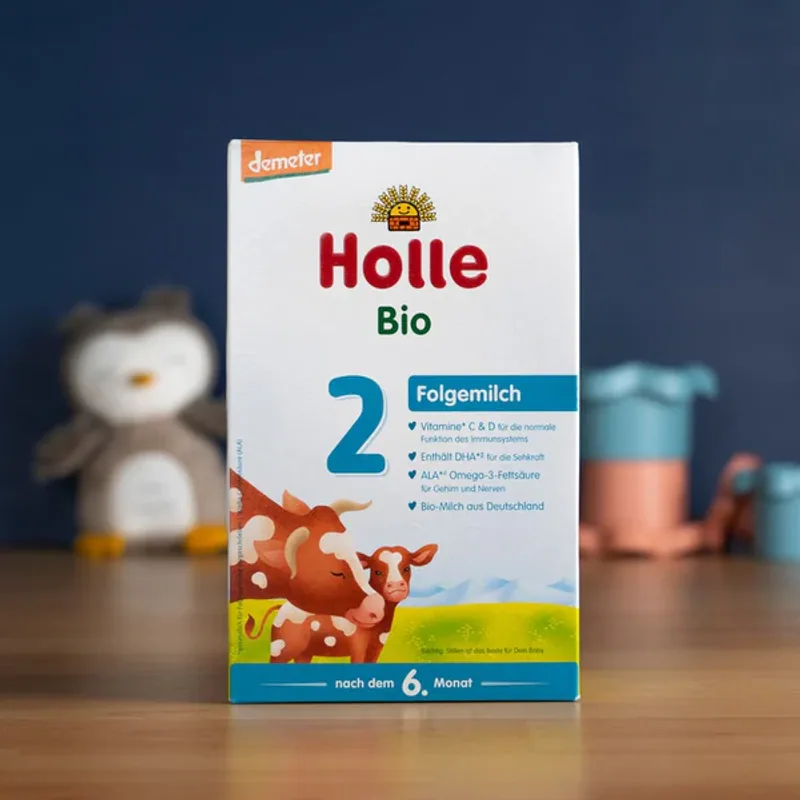
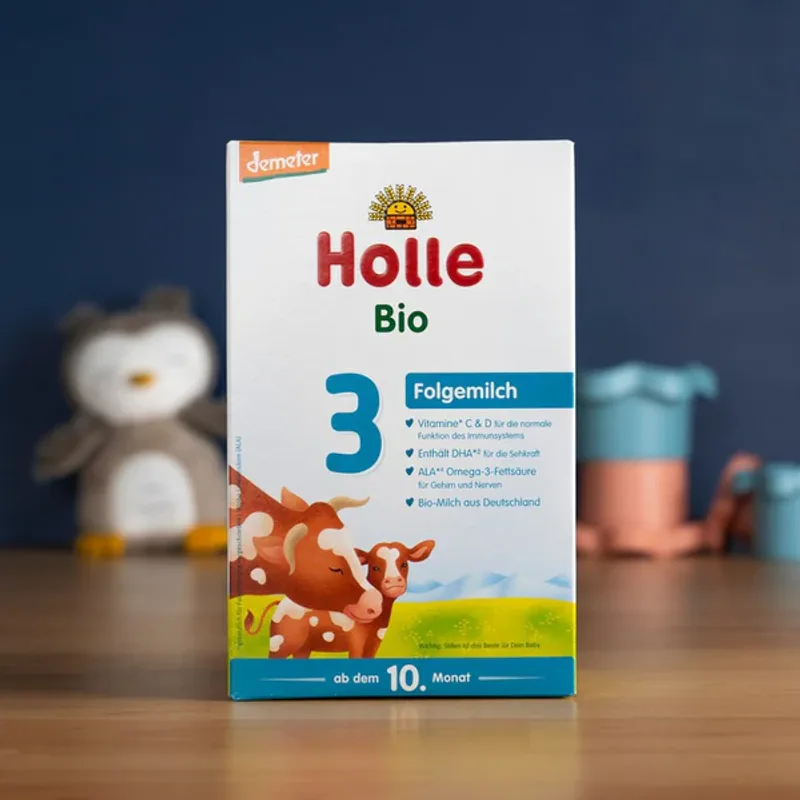
Holle Cow Stage 2 and Stage 3 are Holle's follow-on (6-12 months) and toddler-transition (10-18 months) Demeter biodynamic formulas. The Stage 2 → Stage 3 transition is less commonly asked about than Stage 1 → Stage 2, partly because many families transition to whole cow milk at 12 months rather than continuing with toddler formula. For families who choose to continue Holle through toddlerhood, Stage 3 adjusts macronutrients for the 10-18 month window while keeping the Demeter biodynamic and no-prebiotic philosophy intact.
Stage 2 (6-12m): Demeter biodynamic and protein 1.4 g/100 ml and iron 1.0 mg, DHA 14 mg, and carbs 7.7 g and energy 68 kcal, follow-on formula. Stage 3 (10-18m): Demeter biodynamic and protein 1.5 g + iron 1.2 mg and DHA 14 mg and carbs 8.4 g and energy 68 kcal — toddler-transition. Holle maintains energy density (unlike HiPP Stage 3 which lowers energy). No prebiotic / no probiotic philosophy continues.
Why this comparison matters
Kendamil Classic doesn't have a Stage 3; HiPP Dutch Stage 3 deliberately lowers energy density (toddler-transition philosophy). Holle takes a third approach: Stage 3 preserves Stage 2's energy density while adjusting iron, protein, and carbs upward for continued growth through toddlerhood. For families on Holle who want to continue biodynamic formula past 12 months, understanding this approach matters: Holle Stage 3 isn't a "less dense" toddler formula; it's a continuation follow-on with age-appropriate fortification.
At a glance
| Dimension | Holle Cow Stage 2 | Holle Cow Stage 3 |
|---|---|---|
| Age range | 6-12 months | 10-18 months |
| EU regulation | EU 2016/128 (follow-on) | EU 2016/128 (young-child) |
| Demeter biodynamic | Yes | Yes |
| EU Organic | Yes | Yes |
| Energy | 68 kcal / 100 ml | 68 kcal / 100 ml (SAME) |
| Protein | 1.4 g / 100 ml | 1.5 g / 100 ml |
| Whey:casein | 60:40 | 60:40 |
| Primary carbohydrate | Lactose | Lactose |
| Carbohydrates | 7.7 g / 100 ml | 8.4 g / 100 ml (higher) |
| Fat | 3.6 g / 100 ml | 3.3 g / 100 ml (slight decrease) |
| Iron | 1.0 mg / 100 ml | 1.2 mg / 100 ml (+20%) |
| DHA | 14 mg / 100 ml | 14 mg / 100 ml (same) |
| Prebiotic | None | None |
| Probiotic | None | None |
| HMO | None | None |
| Folate | Folic acid | Folic acid |
| Fat blend | Organic palm, rapeseed, sunflower, and coconut | Organic palm, rapeseed, sunflower, and coconut |
| Format | 600 g tin | 600 g tin |
| Typical price (US) |
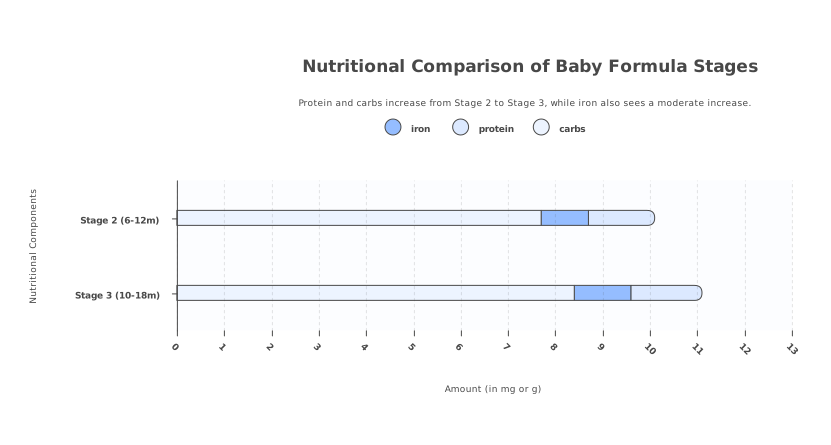
Visual generated with Napkin AI, editorial review by María López Botín. See methodology for our use policy.
What changes from Stage 2 to Stage 3
1. Iron rises 20%
Stage 2: 1.0 mg iron / 100 ml. Stage 3: 1.2 mg iron / 100 ml.
Moderate increase. Note this is opposite direction from HiPP Dutch Stage 3 (which drops iron slightly from 1.0 to 0.9 mg): HiPP assumes solids provide more iron in toddler years; Holle continues formula iron fortification at higher level to support toddler requirements when dietary iron intake from solids is variable.
2. Protein rises to 1.5 g
Stage 2: 1.4 g / 100 ml. Stage 3: 1.5 g / 100 ml (+7%).
Modest increase reflecting toddler protein needs.
3. Carbohydrates rise ~9%
Stage 2: 7.7 g / 100 ml. Stage 3: 8.4 g / 100 ml.
Higher lactose content in Stage 3. Supports sustained energy delivery for toddler growth.
4. Fat decreases slightly
Stage 2: 3.6 g / 100 ml. Stage 3: 3.3 g / 100 ml (-8%).
Slight reduction balancing the carb increase.
5. Energy density HOLDS CONSTANT
Stage 2: 68 kcal / 100 ml. Stage 3: 68 kcal / 100 ml (same).
This is a meaningful philosophical choice by Holle. HiPP Dutch Stage 3 lowers energy to 60 kcal, positioning as a complementary toddler formula for a solids-heavy diet. Holle Stage 3 preserves 68 kcal, positioning as continued growth support through toddlerhood.
Why does this matter? Families picking between HiPP and Holle for toddler-transition formulas face different design philosophies:
- HiPP Dutch Stage 3: complements solids, assumes solids-dominant diet, lower energy.
- Holle Cow Stage 3: continues growth support, maintains energy for toddlers with variable solids intake.
Neither is universally superior. For a toddler with robust solids intake, HiPP's approach matches the clinical goal. For a toddler with variable or picky eating, Holle's continued energy density may provide better nutritional safety net.
6. DHA stays at 14 mg
No change in DHA across Stage 2 and Stage 3. Both at same level.
7. Everything else: preserved across transition
Preserved from Stage 2 to Stage 3:
- Demeter biodynamic milk base
- EU Organic certification
- Lactose-primary carbohydrate
- 60:40 whey:casein ratio
- No GOS, no FOS, no probiotic, no HMO (Holle's minimalist philosophy continues)
- Folic acid folate
- Organic palm, rapeseed, sunflower, and coconut fat blend
- 600 g tin format
- Same pricing
The Holle philosophy of pure biodynamic milk, essential fortification, and minimal additions extends through Stage 3.
When to make the transition (if at all)
Holle's guidance: Stage 3 from 10 months onward, covering 10-18 months. Unlike Stage 1/2 transition (which is clearly age-indicated at 6 months), Stage 2 → Stage 3 has flexibility.
Common approaches for families on Holle:
Approach A: Transition Stage 2 → Stage 3 at 10-12 months:
- Preserves Demeter biodynamic formula continuity through toddlerhood
- Higher iron (1.2 mg) supports ongoing growth
- Maintains energy density for solids-variable eaters
Approach B: Stay on Stage 2 through 12 months, then transition directly to whole cow milk:
- Aligns with AAP guidance for US infants
- Skips Stage 3 entirely
- Appropriate if solids diet is robust and iron-rich by 12 months
Approach C: Use Stage 3 through full 18 months before transition to whole cow milk:
- Extends EU biodynamic formula use through early toddlerhood
- Appropriate for families with picky-eating toddlers or continued preference for Demeter biodynamic over conventional whole cow milk
All three are clinically valid. Discuss with pediatrician.
Holle Stage 3 vs HiPP Stage 3: different philosophies
Worth highlighting because these two EU toddler-transition formulas take opposite approaches:
| Attribute | Holle Stage 3 | HiPP Dutch Stage 3 |
|---|---|---|
| Energy | 68 kcal (same as Stage 2) | 60 kcal (LOWER than Stage 2) |
| Protein | 1.5 g | 1.4 g |
| Carbs | 8.4 g | 6.0 g (lower) |
| Iron | 1.2 mg | 0.9 mg |
| Design intent | Continued growth support | Complements solids-heavy diet |
Neither is right or wrong, they reflect different toddler-feeding philosophies. Holle's Stage 3 is closer to a "continuation formula"; HiPP's Stage 3 is closer to a "supplementary milk for solids-eating toddlers". Choose based on your toddler's eating patterns and your philosophical preference.
Real-world parent experience
Following site methodology, observations come from US parent feedback on Holle use. Not clinical recommendations. Where my own feeding observations are referenced, they are clearly labeled as parent-experience notes; manufacturer claims and regulatory data are cited separately so the source weight stays explicit.
Smell and taste. Very similar between Stage 2 and Stage 3. Holle's distinctive mild Demeter biodynamic milk smell persists. Toddlers typically accept the transition without issue.
Stool consistency. Minor change at the transition typical — related to iron increase (1.0 → 1.2 mg). Slightly darker stool for 7-10 days is normal.
Feeding volumes. Toddlers on Holle Stage 3 typically consume 16-24 oz/day, depending on solids intake. Stage 3's preserved energy density (68 kcal) means each ounce delivers more calories than HiPP Stage 3, families who want formula to be nutritionally substantial through toddler years appreciate this.
Holle Stage 3 → Stage 4 continuation. Holle has a Stage 4 (12-36 months) for extended toddler formula use. Most families don't continue into Stage 4 (transitioning to whole cow milk earlier is standard AAP practice). European families more commonly use Stage 4 through 18-24 months.
Verdict: which to pick when
Use Holle Cow Stage 2 if:
- Your baby is 6-12 months
- You value Demeter biodynamic and minimalist Holle philosophy
- Solids introduction has begun but formula remains primary milk
Transition to Holle Cow Stage 3 if:
- Your baby is 10+ months
- You want to continue Demeter biodynamic formula through toddler transition
- Toddler has variable or picky eating: Stage 3's preserved energy density provides nutritional safety net
- You prefer continued-growth philosophy (Holle) over complements- solids philosophy (HiPP)
Transition directly to whole cow milk if:
- Your toddler is 12 and months with robust and diverse solids diet
- You follow AAP guidance for whole cow milk from 12 months
- You want to end formula use at 12 months
Pick neither if:
- You want HiPP Dutch toddler-transition (lower-energy philosophy) — consider HiPP Dutch Stage 3
- You want Kendamil toddler-transition, consider Kendamil Organic Stage 3
What you can't infer from this comparison
Both are safe EU-compliant Demeter biodynamic formulas for their respective age ranges. Holle Stage 3's preserved-energy design isn't "better" or "worse" than HiPP Stage 3's lower-energy design, they reflect different toddler-feeding philosophies. The Stage 2 → Stage 3 transition is optional for families who can transition to whole cow milk at 12 months per AAP guidance. Families who want to continue EU biodynamic formula through toddlerhood have a legitimate option in Holle Stage 3.
Frequently asked questions
When should I switch from Holle Stage 2 to Stage 3?
Why does Holle Stage 3 keep the same energy as Stage 2 when HiPP Stage 3 lowers it?
Why does Holle Stage 3 have higher iron than HiPP Stage 3?
Is Holle Stage 3 necessary?
Does Holle Stage 3 still have no prebiotic or probiotic?
Can I switch between Holle Stage 3 and HiPP Stage 3 or Kendamil Organic Stage 3?
What happens after Holle Stage 3?
Does the price change at Stage 3?
Related reading
- Holle brand hub
- Holle Cow Stage 1 vs Stage 2, the 6-month transition
- HiPP Dutch Stage 2 vs Stage 3, sibling EU toddler-transition
- Kendamil Organic Stage 1 vs Stage 2
- Transition to whole cow milk
- EU infant formula regulation
- When to switch formula stages
- Iron in infant formula
- Holle Cow Stage 3 vs Stage 4 - Demeter Biodynamic Toddler Progression (10-18 to 12-36 Months)
- Holle Goat Stage 1 vs Stage 2 - Demeter Biodynamic Goat-Milk Progression
- Kendamil Organic Stage 2 vs Stage 3 - Follow-On to Toddler Transition (Whey:Casein Flips to 40:60)
- Best Baby Formula for 12 Month Old (Stage 3 / Toddler)
Primary sources
- Holle baby food AG, manufacturer product information. holle.ch
- Demeter International, biodynamic certification standard. demeter.net
- EU Regulation 2016/128. EU compositional requirements for follow-on and young-child formula. eur-lex.europa.eu
- EFSA Scientific Opinion on compositional requirements for infant formula. efsa.europa.eu
- WHO infant and young child feeding guidance. who.int
- American Academy of Pediatrics, whole cow milk from 12 months guidance. aap.org
This site provides research and comparisons, not medical advice. Consult your pediatrician before changing your baby's formula.