
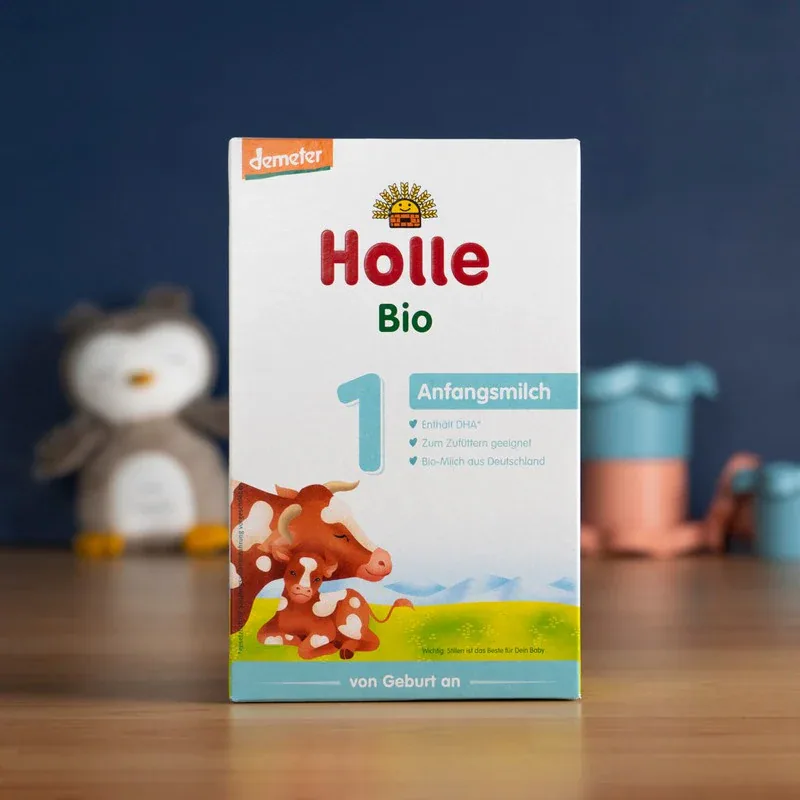
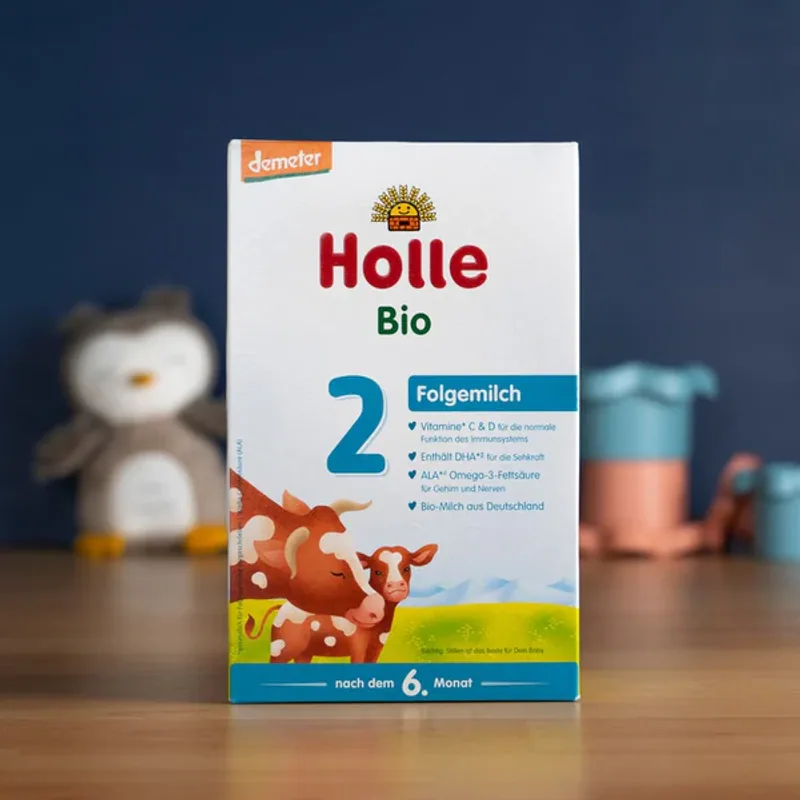
Holle Cow Stage 1 and Stage 2 are the two primary Holle Demeter biodynamic cow-milk formulas for families importing EU organic. Stage 1 for 0-6 months, Stage 2 for 6-12 months, same Demeter biodynamic milk base, same minimalist "no-GOS no-probiotic" Holle philosophy, different age-specific iron and protein fortification. The Stage 1 → Stage 2 transition around 6 months mirrors the HiPP Dutch progression but keeps Holle's distinctive pure-milk-based composition (no added prebiotics or probiotics) across both stages.
Holle Cow Stage 1 (0-6m): Demeter biodynamic and protein 1.49 g/100 ml and iron 0.54 mg and DHA 15 mg (highest EU) and energy 68 kcal, lactose-primary, and palm (organic) and no GOS/probiotic and folic acid. Holle Cow Stage 2 (6-12m): Demeter biodynamic and protein 1.4 g
- iron 1.0 mg (doubled) and DHA 14 mg and larger 600 g tin (vs Stage 1's 400 g) and lower per-oz price. Same philosophy across both stages.
Why this comparison matters
Parents on Holle Cow formula face the Stage 1 → Stage 2 question around month 5-6, same timing as HiPP families. The compositional shift is the same conceptual move (age-appropriate iron increase) but Holle's minimalist philosophy stays consistent across stages — no prebiotic, no probiotic, no HMO in either. For families who specifically chose Holle for the pure biodynamic milk-based composition without synthetic additions, the transition preserves that philosophy.
At a glance
| Dimension | Holle Cow Stage 1 | Holle Cow Stage 2 |
|---|---|---|
| Age range | 0-6 months | 6-12 months |
| EU regulation | EU 2016/127 (infant formula) | EU 2016/128 (follow-on formula) |
| Demeter biodynamic | Yes | Yes |
| EU Organic | Yes | Yes |
| FDA status | Not FDA-registered (personal import enforcement discretion) | Not FDA-registered (personal import enforcement discretion) |
| Energy | 68 kcal / 100 ml | 68 kcal / 100 ml |
| Protein | 1.49 g / 100 ml (higher than HiPP) | 1.4 g / 100 ml (slight decrease) |
| Whey:casein | 60:40 | 60:40 |
| Primary carbohydrate | Lactose | Lactose |
| Carbohydrates | 8.0 g / 100 ml | 7.7 g / 100 ml |
| Fat | 3.4 g / 100 ml | 3.6 g / 100 ml |
| Iron | 0.54 mg / 100 ml (EU standard for 0-6) | 1.0 mg / 100 ml (doubled) |
| DHA | 15 mg / 100 ml (highest among EU standards) | 14 mg / 100 ml |
| Prebiotic | None | None |
| Probiotic | None | None |
| HMO | None | None |
| Folate | Folic acid (not Metafolin) | Folic acid |
| Fat blend | Organic palm, rapeseed, sunflower, and coconut | Organic palm, rapeseed, sunflower, and coconut |
| Format | 400 g tin | 600 g tin (50% larger) |
| Typical price (US) | ||
| US availability | Personal import (Organic's Best and similar) | Personal import (Organic's Best and similar) |
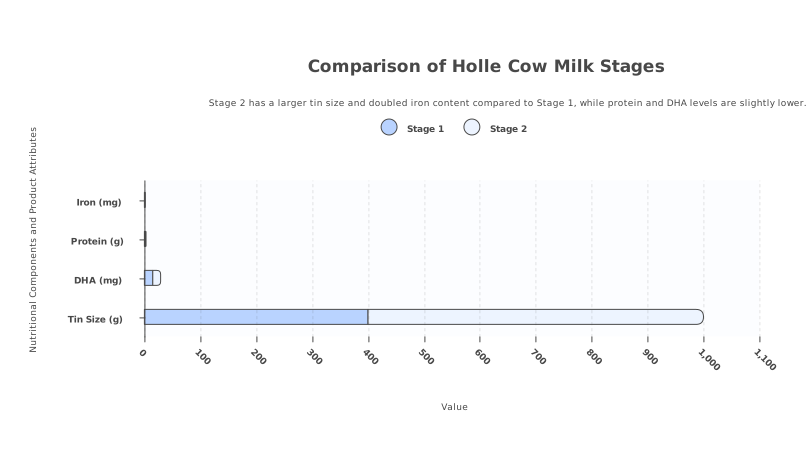
Visual generated with Napkin AI, editorial review by María López Botín. See methodology for our use policy.
What changes from Stage 1 to Stage 2
1. Iron nearly doubles
Stage 1: 0.54 mg iron / 100 ml. Stage 2: 1.0 mg iron / 100 ml (+85%).
Same rationale as HiPP and other EU stage progressions: birth-delivered iron stores deplete by 4-6 months, solids introduction begins around 6 months, and formula iron needs to increase to match physiological demand. EU 2016/128 allows higher iron in follow-on formula for 6-12 month infants.
Holle's Stage 2 iron (1.0 mg/100 ml) matches HiPP Dutch Stage 2 exactly, both sit at the EU follow-on standard.
2. Protein slightly decreases
Stage 1: 1.49 g protein / 100 ml. Stage 2: 1.4 g protein / 100 ml (-6%).
This is interesting and unlike the HiPP progression (where protein rises slightly). Holle's Stage 1 protein is at 1.49 g, relatively high for an EU Stage 1 formula (HiPP Dutch Stage 1 is at 1.28 g). The Stage 2 protein slightly reduces but remains above HiPP Dutch Stage 2's 1.3 g. This reflects Holle's use of Demeter biodynamic whole-milk protein, which provides naturally higher protein content than skim-based formulations.
3. Carbohydrates tick down
Stage 1: 8.0 g carbs / 100 ml. Stage 2: 7.7 g carbs / 100 ml (-4%).
Small reduction. Both lactose-primary.
4. DHA drops slightly
Stage 1: 15 mg / 100 ml (highest DHA in the EU Stage 1 tier). Stage 2: 14 mg / 100 ml (-7%).
Holle's Stage 1 DHA is notably high, higher than HiPP Dutch Stage 1's 13.2 mg. Stage 2 reduces marginally. Both remain in the upper range of EU fortification.
5. Fat rises slightly
Stage 1: 3.4 g fat / 100 ml. Stage 2: 3.6 g fat / 100 ml (+6%).
Minor increase. Both within EU ranges.
6. Format: 400g → 600g (50% larger tin)
Stage 1: 400 g tin. Stage 2: 600 g tin (50% larger).
This is a meaningful format change. The 600g tin provides more formula per purchase (fewer purchase cycles, less packaging per ounce) and produces a lower per-ounce price for families buying at standard retail. Going from Stage 1 → Stage 2 actually reduces your per-oz cost by ~15% due to the larger format.
7. Everything else: preserved across transition
Preserved from Stage 1 to Stage 2:
- Demeter biodynamic milk base
- EU Organic certification
- Lactose-primary carbohydrate
- 60:40 whey:casein ratio
- No GOS, no FOS, no probiotic, no HMO (Holle's minimalist philosophy)
- Folic acid (not Metafolin, consistent with Holle's traditional fortification approach)
- Organic palm, rapeseed, sunflower, and coconut fat blend
- No soy oil
- No whole milk fat (vs Kendamil's approach)
The Holle philosophy of "pure biodynamic milk and essential fortification, minimal additions" continues from Stage 1 to Stage 2.
8. Preparation
Holle's preparation instructions differ slightly between stages due to the different powder density (Stage 2 is slightly more concentrated). Always follow the scoop-to-water ratio on your specific tin, don't assume Stage 1 ratios apply to Stage 2.
When to make the transition
Holle's guidance: Stage 2 from 6 months onward. Same timing as HiPP. The decision is rarely binary — the recommendation below documents the typical pediatric-aligned threshold plus the family circumstances that justify staying on the current formula a little longer.
Practical transition timing for parents on Holle:
- Not before 6 months: Stage 2's higher iron is unnecessary for 0-6 month window.
- At 6 months, typical transition point, aligning with solids introduction.
- Not later than 8 months, delaying past this point leaves your baby on Stage 1's lower iron during a period of increased demand.
Holle users sometimes note that Stage 1's 400g tin runs out faster than HiPP's 800g tin, you may transition to Stage 2 right as a new tin purchase happens, making the switch a natural inventory decision point.
Transitioning Stage 1 → Stage 2
Compositional change is modest (iron and small protein/DHA shift). Typical approach:
- Day 1-3: Mix 25% Stage 2 and 75% Stage 1
- Day 4-6: Mix 50% Stage 2 and 50% Stage 1
- Day 7-9: Mix 75% Stage 2 and 25% Stage 1
- Day 10+: 100% Stage 2
Most infants experience no noticeable adjustment. Some may have mild stool pattern shift (related to iron increase) for 5-10 days — normal. Holle transitions are typically among the easiest because the core composition is so consistent.
Holle vs HiPP: philosophy continuity
One of the most meaningful aspects of Holle's stage transition: the minimalist no-prebiotic no-probiotic no-HMO approach continues from Stage 1 to Stage 2. Families who specifically chose Holle for this philosophy (preferring pure biodynamic milk composition without synthetic additions) don't face a composition- philosophy shift at the stage transition.
By contrast, HiPP Dutch keeps its Combiotik system (GOS and probiotics) across stages, also consistent philosophy, but a different one (actively includes synbiotic support).
Kendamil Classic keeps its whole-milk-fat, GOS, and FOS approach across stages.
All three EU brands maintain their philosophy across stages — it's a meaningful design choice that matters for families who picked a brand for specific compositional reasons.
Real-world parent experience
Following site methodology, observations come from US parent feedback on Holle use. Not clinical recommendations. Where my own feeding observations are referenced, they are clearly labeled as parent-experience notes; manufacturer claims and regulatory data are cited separately so the source weight stays explicit.
Smell and taste. Very similar between Stage 1 and Stage 2. Demeter biodynamic milk has a slightly distinctive mild smell (some parents describe as "cleaner" than conventional milk); this persists across both stages. Most infants don't notice the transition.
Stool consistency. Minor change typical at the Stage 1 → Stage 2 transition, related to iron increase. Slightly darker stool for 7-10 days is common. Not concerning unless paired with obvious discomfort.
Preparation. Holle's preparation is somewhat specific, some families find the scoop slightly different from Stage 1 to Stage 2. Always follow the exact instructions on the tin. The 600g Stage 2 tin has more formula but is the same physical size cylinder, just packed differently.
Supply management. Holle users often note that Stage 1's 400g tin runs out in ~5-6 days with typical 0-6 month feeding volumes. Stage 2's 600g tin lasts ~7-9 days at 6-12 month volumes. Factor this into ordering rhythm with your EU reseller.
No bioactive system to disrupt. Unlike HiPP Combiotik transitions (where the probiotic system continues but is a consideration), Holle has no bioactive system to preserve, the transition is purely about age-appropriate macronutrient fortification.
Verdict: which to pick when
Use Holle Cow Stage 1 if:
- Your baby is 0-6 months
- You value Demeter biodynamic and pure-milk composition without synthetic prebiotics/probiotics
- EU lower iron (0.54 mg) is appropriate for the 0-6 month window
Transition to Holle Cow Stage 2 if:
- Your baby is 6+ months (typically 6-12)
- Solids introduction has begun
- You want Holle philosophy continuity with age-appropriate iron fortification
- Larger tin (600g) and lower per-oz price are welcome practical improvements
Pick neither if:
- You want Holle and whole milk fat, switch to Kendamil Classic (whole milk fat, palm-free, Red Tractor)
- You want EU and Combiotik (GOS and probiotic synbiotic), switch to HiPP Dutch Stage 1 → Stage 2
- You want goat-milk Demeter, consider Holle Goat Stage 1 (Demeter goat, same minimalist philosophy)
What you can't infer from this comparison
Both are safe EU-compliant Demeter biodynamic formulas for their respective age ranges. Holle's minimalist philosophy (no added GOS/ FOS/HMO/probiotics) isn't "better" or "worse" than HiPP's Combiotik approach, it's a different thesis that appeals to families prioritizing composition simplicity. The Stage 1 → Stage 2 transition is modest and primarily about age-appropriate iron fortification, not major formula philosophy change.
Frequently asked questions
When should I switch from Holle Stage 1 to Stage 2?
Why does Holle protein decrease from Stage 1 to Stage 2?
Does Holle Stage 1 really have the highest DHA among EU Stage 1 formulas?
Why is Holle Stage 2's tin bigger than Stage 1's?
Does Holle have GOS prebiotic or probiotic like HiPP Combiotik?
Does Holle use Metafolin like HiPP?
Does Holle use palm oil?
Can I use Holle Stage 2 past 12 months?
Related reading
- Holle brand hub
- HiPP Dutch Stage 1 vs Stage 2, sibling EU stage transition
- Holle Cow Stage 1 vs HiPP Dutch Stage 1
- Holle Cow Stage 1 vs Kendamil Classic Stage 1
- EU infant formula regulation
- Organic certifications compared
- When to switch formula stages
- Iron in infant formula
- Holle Cow Stage 3 vs Stage 4 - Demeter Biodynamic Toddler Progression (10-18 to 12-36 Months)
- Holle Goat Stage 1 vs Stage 2 - Demeter Biodynamic Goat-Milk Progression
- Best Baby Formula for 6 Month Old (Stage 2)
Primary sources
- Holle baby food AG, manufacturer product information. holle.ch
- Demeter International, biodynamic certification standard. demeter.net
- EU Regulation 2016/127. EU compositional requirements for infant formula (0-6 months). eur-lex.europa.eu
- EU Regulation 2016/128. EU compositional requirements for follow-on formula (6-12 months). eur-lex.europa.eu
- EFSA Scientific Opinion on compositional requirements for infant formula. efsa.europa.eu
This site provides research and comparisons, not medical advice. Consult your pediatrician before changing your baby's formula.