
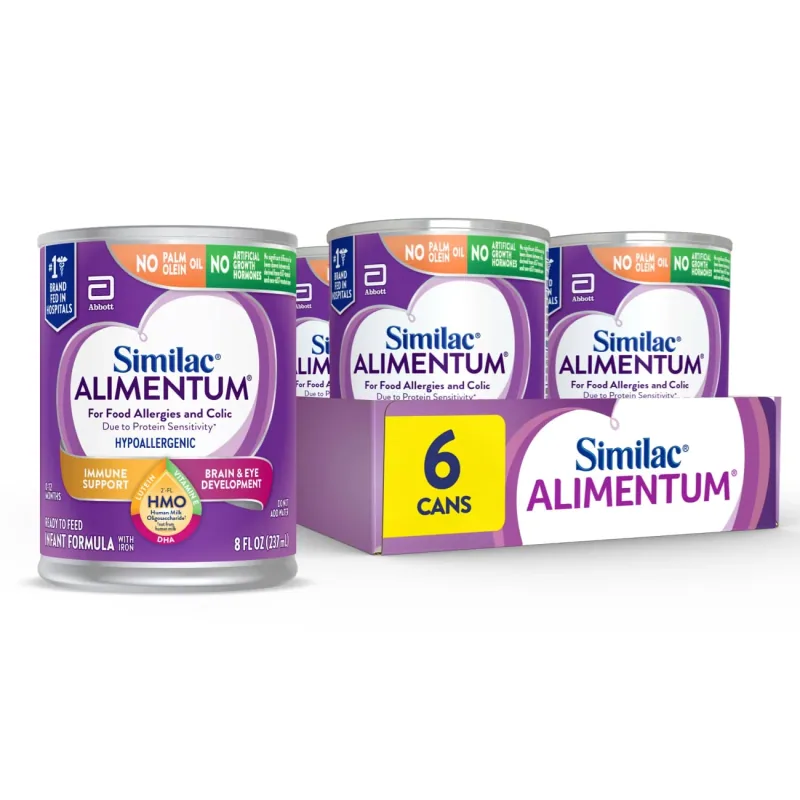
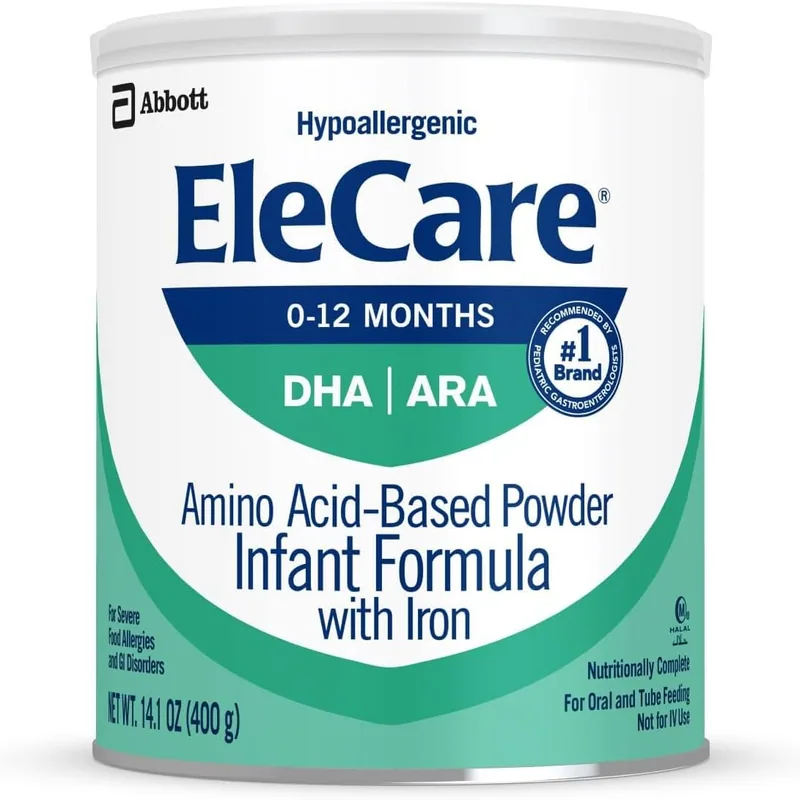
Similac Alimentum and EleCare are Abbott's two specialty hypoallergenic formulas, occupying different tiers in the CMPA management hierarchy. Alimentum is the extensively hydrolyzed casein (eHF) option, first-line for ~90% of CMPA infants. EleCare is the amino acid formula (AAF), 100% elemental free amino acids, reserved for infants who fail eHF or who have more severe indications (eosinophilic GI disease, short-gut syndrome, multiple food protein allergy). Abbott's specialty pathway parallels Reckitt's Nutramigen → Puramino ladder.
Alimentum: extensively hydrolyzed casein and 2'-FL HMO and maltodextrin primary, palm-free, MCT, and DHA 11.3 mg, ~$4.55/oz. EleCare: 100% free amino acids and corn-syrup primary and no prebiotic and palm-free, MCT, and DHA 11 mg, ~$6.50/oz. EleCare strips back the HMO to reach maximum hypoallergenicity. Step-up decision driven by eHF failure or severe indications, not preference.
Why this comparison matters
Abbott customers whose CMPA-diagnosed infant has been prescribed Alimentum sometimes face the question: "what if this isn't working?" or "when would EleCare be appropriate?" Understanding the eHF-first, AAF-if-needed clinical logic, and understanding what EleCare actually is (elemental, no HMO, no prebiotic, most hypoallergenic available), helps parents give Alimentum an adequate trial, recognize genuine eHF failure, and advocate for EleCare escalation when appropriate. This is the Abbott parallel to the Nutramigen vs Puramino decision on the Reckitt side.
The CMPA management ladder: Abbott side
| Step | Category | Abbott equivalent | When used |
|---|---|---|---|
| 1 | Standard | Pro-Advance, 360 Total Care | Healthy term infant |
| 2 | Partial hydrolysate | Pro-Total Comfort | Mild fussiness (not true CMPA) |
| 3 | Extensively hydrolyzed | Similac Alimentum | First-line CMPA (~90%) |
| 4 | Amino acid (AAF) | EleCare Infant | eHF failure / severe indications (~10%) |
At a glance
| Dimension | Similac Alimentum | EleCare Infant |
|---|---|---|
| Manufacturer | Abbott Nutrition | Abbott Nutrition |
| FDA classification | Exempt infant formula 21 CFR 107.30 | Exempt infant formula 21 CFR 107.30 |
| Protein category | Extensively hydrolyzed (eHF) | Amino acid (AAF / elemental) |
| Protein form | Hydrolyzed casein peptides <3,000 Da and free AAs | 100% free amino acids (L-form) |
| Protein % of formula | ~17% | ~28% (elevated for AAF bioavailability) |
| Allergenicity | Hypoallergenic (FDA-recognized) | Non-antigenic (most hypoallergenic available) |
| Intended use | Diagnosed CMPA first-line | Severe CMPA, eHF failure, multiple food allergies, EoE, short-gut |
| Lactose | None (lactose-free) | None (lactose-free) |
| Primary carbohydrate | Maltodextrin and sucrose | Corn syrup solids only |
| Prebiotic | None | None (EleCare has no prebiotic, different from Puramino) |
| HMO | 2'-FL HMO | None |
| Probiotic | None | None |
| Fat blend | Palm-FREE (safflower, MCT, and soybean) | Palm-FREE (safflower, MCT, and soybean) |
| MCT | Yes | Yes |
| DHA | Schizochytrium algal, ~11.3 mg/100 ml | Schizochytrium algal, ~11 mg/100 ml |
| Red flags | Maltodextrin*, synthetic β-carotene, (no palm) | Corn syrup solids*, (no palm) |
| Fat-blend notes | soy | soy |
| Format | 12.1 oz tin | 14.1 oz tin |
| Typical price | ||
| Production facility | Abbott US (post-2022 remediated) | Abbott Sturgis sole site (2022 recall, reopened July 2022 under consent decree) |
| US availability | Broad retail and pharmacy | Pharmacy and specialty supply only |
* Maltodextrin and corn syrup solids are medically appropriate (CMPA lactose-free requirement).
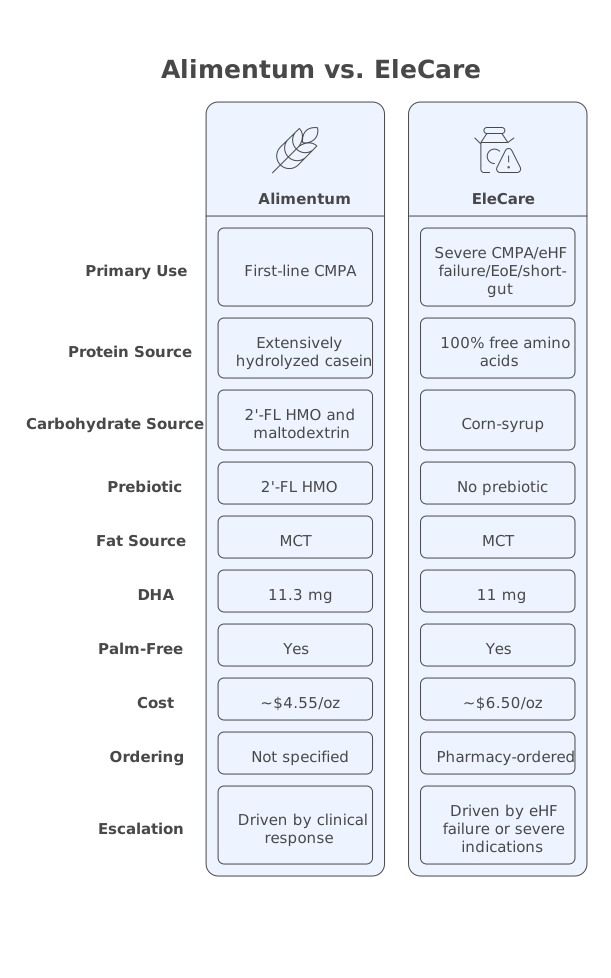
Visual generated with Napkin AI, editorial review by María López Botín. See methodology for our use policy.
Compositional differences that actually matter
1. Protein form: peptides vs free amino acids
Alimentum: extensively hydrolyzed casein (<3,000 Da) supplemented with free amino acids. Most CMPA infants tolerate this because the peptides are too small for immune recognition. ~10% of CMPA infants remain reactive to even these tiny peptides.
EleCare: 100% free amino acids, no peptides, no protein structure. Non-antigenic. This is the most hypoallergenic protein source commercially available. For infants who fail Alimentum, the amino acid shift removes the remaining antigenic potential.
2. Indication: first-line vs escalation
Alimentum: diagnosed CMPA, first-line treatment. Most infants respond within 2-4 weeks.
EleCare: indicated for:
- eHF trial failure (Alimentum or Nutramigen) at 2-4 and weeks
- Severe CMPA presentations (anaphylaxis risk, severe enteropathy)
- Multiple food protein allergy
- Eosinophilic esophagitis (EoE), eosinophilic GI disease
- Short-gut syndrome / severe malabsorption
- Failure to thrive secondary to food protein allergy
EleCare is not a "just to be safe" default; its cost and distribution constraints make it an escalation, not a starting point.
3. HMO and prebiotic: Alimentum has both strategies, EleCare has neither
Alimentum: includes 2'-FL HMO (the only eHF in US market with HMO). No added prebiotic, no probiotic. Bioactive thesis: single HMO supports gut microbiota in CMPA context.
EleCare: no HMO, no prebiotic, no probiotic. Pure amino-acid, glucose-polymer, and fat formulation. Maximum simplicity. This is a meaningful difference from some other AAFs: Puramino (Reckitt) adds GOS prebiotic, Neocate Syneo (Nutricia) adds both prebiotic AND probiotic. EleCare strips back even the prebiotic layer.
Why? EleCare's design thesis is maximum reduction of reactive material. For the severe-allergy context, any non-protein ingredient adds a theoretical (though small) reaction risk. Abbott's formulation prioritizes minimal ingredient complexity.
For the subset of AAF-requiring infants who can also tolerate prebiotic/probiotic additions, Neocate Syneo or Puramino may be more appropriate. For infants where maximum simplicity is desired, EleCare fits.
4. Fat blend: both palm-free and MCT
Both Alimentum, EleCare use palm-free, and MCT fat blends — standard for specialty hypoallergenic formulas where absorption support matters. This is a shared strength of both SKUs compared to palm-inclusive options.
Alimentum: high-oleic safflower, MCT, and soybean. EleCare: safflower, MCT, and soybean (similar).
5. Primary carbohydrate: maltodextrin (Alimentum) vs corn syrup solids (EleCare)
Alimentum powder: maltodextrin (39%) and sucrose (9%). EleCare: corn syrup solids (primary, no secondary carbohydrate).
Both are lactose-free and medically appropriate for CMPA and severe- allergy contexts. Maltodextrin has slightly lower glycemic response than corn syrup solids but the practical difference in this clinical context is minimal. Important: the Alimentum RTF liquid uses sugar and modified tapioca starch instead of maltodextrin, powder and RTF are in their ingredients different.
6. Manufacturing: EleCare sole-sourced at Sturgis
Alimentum: manufactured at multiple Abbott facilities. Sturgis was among them and was affected by the 2022 Cronobacter recall; Alimentum production resumed after Sturgis remediation.
EleCare: produced only at Abbott Sturgis, Michigan. EleCare was therefore fully affected by the 2022 recall and was one of the SKUs experiencing the longest shortage (AAF families couldn't easily switch to alternatives because AAF sourcing is more specialty). EleCare production resumed July 2022 under a consent decree with enhanced FDA oversight.
For families weighing the 2022 recall context in their decision: EleCare carries the deeper historical mark (longer shortage and consent-decree production status). The current compliance state is FDA-inspected and stable; the historical context is legitimate family consideration. See our Abbott 2022 recall aftermath for detail.
7. Price: EleCare ~43% more expensive
Alimentum ~$4.55/oz. EleCare ~$6.50/oz. ~43% price premium. AAF is consistently more expensive than eHF across manufacturers (Puramino is ~26% over Nutramigen; EleCare vs Alimentum is a wider gap because EleCare is sole-sourced Sturgis). Most US private insurance and Medicaid cover AAF with pediatrician letter of medical necessity documenting CMPA and eHF failure or severe indication.
8. Availability: EleCare pharmacy-ordered
Alimentum is available at most major US retailers. EleCare is pharmacy-ordered typically (CVS, Walgreens) or specialty distributor. Target/Walmart rarely stock it. Allow 2-7 days for pharmacy order fulfillment (longer during high-demand periods or supply constraints).
When to escalate from Alimentum to EleCare
Discuss with your pediatrician if any occur on consistent Alimentum trial (2-4+ weeks):
- Persistent CMPA symptoms (reflux, vomiting, blood in stool, severe eczema, poor weight gain)
- Growth faltering across weight-for-age percentiles
- Signs of multiple food allergy beyond cow milk
- GI enteropathy signs (chronic diarrhea, blood, mucus, distension)
- Failure to thrive despite adequate caloric intake
- Eosinophilic esophagitis or eosinophilic GI disease suspected
Pediatric GI or allergist consultation typically precedes AAF prescription, the escalation is not a retail shopping decision.
Real-world parent experience
Following site methodology, observations below come from US parent feedback. Not clinical recommendations. Where my own feeding observations are referenced, they are clearly labeled as parent-experience notes; manufacturer claims and regulatory data are cited separately so the source weight stays explicit.
Taste and smell. EleCare is more bitter than Alimentum, free amino acids taste more unpleasant than hydrolyzed peptides. Infants transitioning from Alimentum to EleCare often initially resist; 3-7 day transition window with partial volume mixing often helps. If severe aversion, pediatrician may approve small rice cereal flavoring in older infants. Alimentum's 2'-FL HMO adds marginal sweetness that slightly masks the hydrolysate bitterness.
Stool consistency. Both produce dark, loose-to-formed stools. EleCare often produces slightly firmer / less frequent stool than Alimentum (EleCare has no HMO/prebiotic contribution to soften stool via fermentation).
Weight gain. Both provide adequate calories. EleCare's elevated 28% protein is designed to compensate for lower amino-acid metabolic efficiency; infants typically gain adequately.
Transition timing. Going Alimentum → EleCare: 7-10 day gradual. Going EleCare → Alimentum or standard formula (for eventual CMPA resolution trial): 10-14 day very gradual, the more hypoallergenic tier is typically reintroduced slowly to detect re-sensitization.
Verdict: when each applies
Use Similac Alimentum (eHF) if:
- You have a new CMPA diagnosis: Alimentum is Abbott's first-line option
- Your baby responds well to an eHF trial
- 2'-FL HMO, palm-free and MCT fat blend appeals
- Retail availability and cost matter
Escalate to EleCare (AAF) if:
- Pediatrician / pediatric GI has documented:
- eHF trial failure at 2-4 and weeks
- Severe CMPA presentation
- Multiple food protein allergy
- Eosinophilic esophagitis or other eosinophilic GI disease
- Short-gut syndrome / severe malabsorption
- Failure to thrive secondary to food allergy
Pick neither if:
- You don't have a CMPA diagnosis, neither is appropriate
- You want Reckitt equivalents, consider Nutramigen (eHF, Reckitt) or Puramino (AAF, Reckitt)
- You want AAF with added synbiotic, consider Neocate Syneo (Nutricia, prebiotic and probiotic)
- You want EU-equivalent eHF: HiPP HA Combiotik (imported)
What you can't infer from this comparison
Both are safe FDA-registered specialty medical formulas. AAF isn't universally "better", it's a different clinical tier. Starting with AAF when eHF would have sufficed provides no clinical benefit and costs significantly more. The Abbott 2022 recall context affects EleCare more than Alimentum historically; current compliance is FDA- inspected and stable. Individual infant response to AAF varies; some infants do equally well on Puramino (Reckitt AAF) or Neocate Syneo (Nutricia AAF, includes synbiotic) as on EleCare.
Frequently asked questions
Should I start with EleCare instead of Alimentum?
Why does EleCare have no HMO when Alimentum does?
How does EleCare compare to Puramino (the Reckitt AAF)?
Is EleCare safe after the 2022 Sturgis recall?
Can I switch between Alimentum and EleCare?
What happens if my baby doesn't tolerate EleCare either?
Is EleCare covered by insurance?
What's the difference between EleCare Infant and EleCare Jr?
Related reading
- Similac / Alimentum brand hub
- EleCare brand hub
- Similac brand hub
- Nutramigen vs Similac Alimentum, eHF head-to-head
- Nutramigen vs Puramino: Reckitt eHF → AAF step-up
- Cow milk protein allergy explained pillar
- Abbott 2022 recall aftermath pillar
- Hydrolyzed protein explainer
- Best hypoallergenic formulas
- Neocate Syneo vs EleCare - AAF with Synbiotic vs AAF Stripped (Nutricia vs Abbott)
- Neocate Syneo vs Puramino - Two Bioactive Amino Acid Formulas Head-to-Head (Nutricia Synbiotic vs Reckitt Prebiotic)
- Nutramigen vs EleCare - Cross-Manufacturer eHF to AAF Step-Up (Reckitt eHF vs Abbott AAF)
- Similac Alimentum vs Gerber Extensive HA - Casein eHF vs Whey eHF (Both with 2'-FL HMO and MCT)
- Similac Alimentum vs Puramino - Cross-Manufacturer eHF to AAF Step-Up (Abbott eHF vs Reckitt AAF)
Primary sources
- Similac Alimentum / Abbott Nutrition, manufacturer product information. similac.com
- EleCare / Abbott Nutrition, manufacturer product information. abbottnutrition.com/elecare
- FDA 21 CFR Part 107 (incl. 107.30 exempt infant formula). ecfr.gov
- FDA Abbott recall investigation summary (2022). fda.gov
- ESPGHAN position on CMPA management: Koletzko et al., JPGN.
This site provides research and comparisons, not medical advice. Consult your pediatrician before changing your baby's formula.