
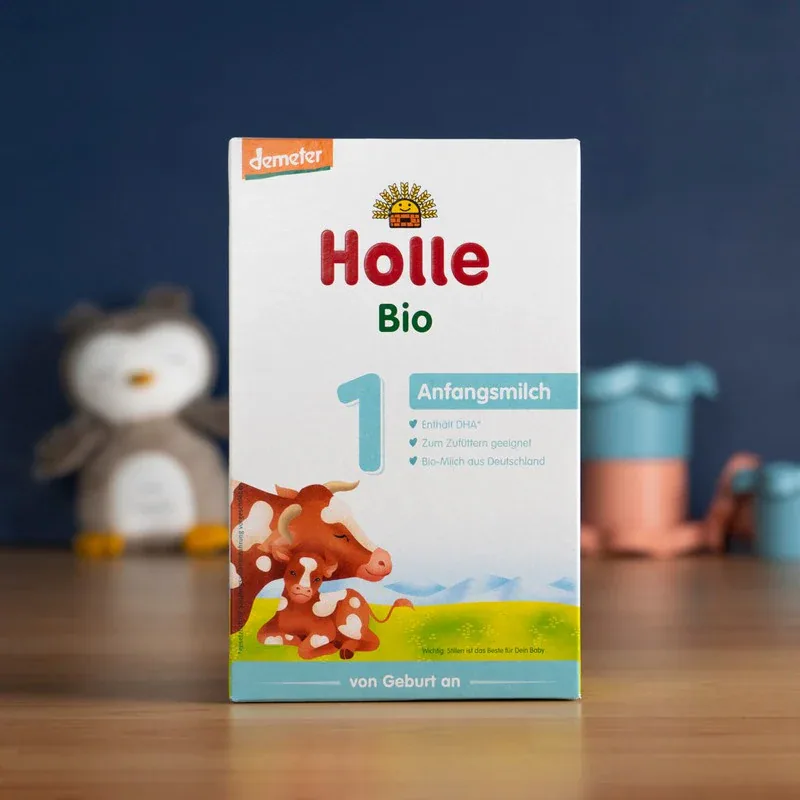
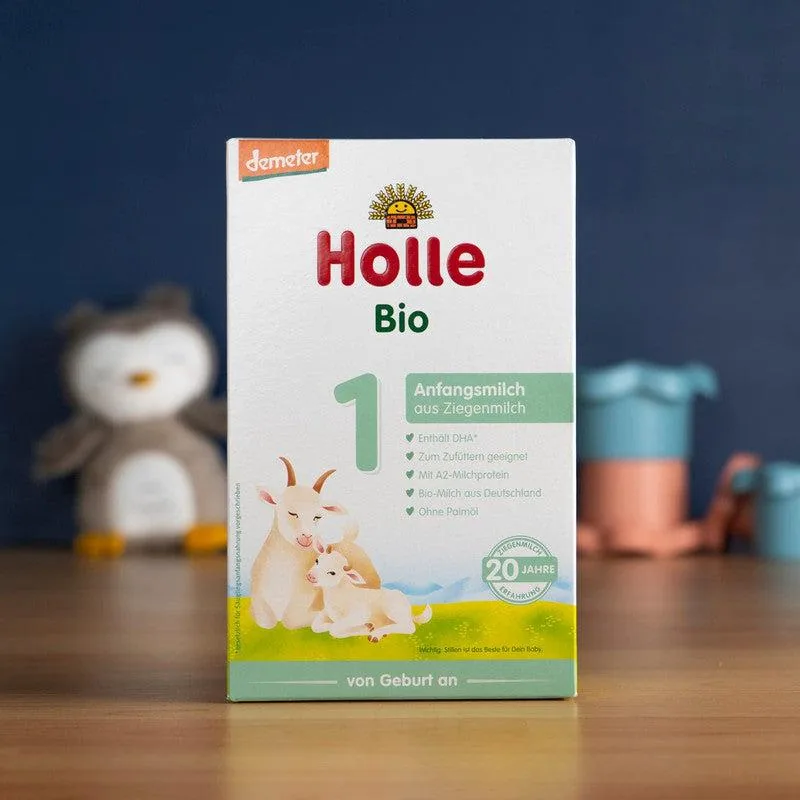
Holle Cow Stage 1 and Holle Goat Stage 1 are both Demeter biodynamic and EU Organic, both manufactured at Holle's Swiss-Dutch / German facilities with the same quality standards, both intentionally minimalist on bioactive additions. They diverge on protein species (skimmed cow milk vs whole goat milk) and on palm inclusion (Holle Cow contains RSPO palm; Holle Goat is palm-free). The choice is between cow-milk at the cheaper Holle tier and goat-milk at the cleaner fat-blend tier.
Holle Cow Stage 1 is a Demeter biodynamic and EU Organic German formula with skimmed cow milk and whey, lactose-only carbohydrate, no GOS, no HMO, no probiotic, palm oil and rapeseed and sunflower fat blend (no soy), fish-oil DHA, ~$1.95/oz delivered. Holle Goat Stage 1 is a Demeter biodynamic and EU Organic formula with whole goat milk, lactose-only carbohydrate, no GOS, no HMO, no probiotic, fat blend with no palm and no soy, fish-oil DHA, ~$2.41/oz. Same Holle minimalist philosophy, different protein species and palm inclusion.
Why this comparison matters
Within the Holle family, parents often pivot between Cow Stage 1 and Goat Stage 1 based on infant tolerance and protein-species preference. Holle Cow is the standard Demeter biodynamic cow-milk reference (the brand's flagship Stage 1). Holle Goat is the same Demeter ethos applied to goat-milk with the cleaner palm-free fat blend. Both share Holle's minimalist composition philosophy — no GOS, no HMO, no probiotic, lactose-only carb, EU 2016/127 mandatory nutrients plus DHA only.
The decision typically narrows to: cow-milk at the cheaper Holle tier (if the infant tolerates cow-milk fine and palm is acceptable) versus goat-milk at the cleaner fat blend (if cow-milk discomfort is observed or palm avoidance is decisive).
At a glance
| Dimension | Holle Cow Stage 1 | Holle Goat Stage 1 |
|---|---|---|
| Manufacturer | Holle (Swiss-Dutch / German manufacturing) | Holle (Swiss-Dutch / German manufacturing) |
| Origin | Germany | Germany |
| Age range | 0-6 months (Stage 1) | 0-6 months (Stage 1) |
| Regulation | EU 2016/127 (FDA enforcement discretion for US import) | EU 2016/127 (FDA enforcement discretion for US import) |
| Organic certification | Demeter biodynamic and EU Organic | Demeter biodynamic and EU Organic |
| Protein source | Skimmed cow milk and whey | Whole goat milk |
| Whey:casein ratio | 60:40 (cow-milk adjusted) | Goat-milk native |
| Primary carbohydrate | Lactose only added | Lactose only added |
| Prebiotic | None | None |
| Probiotic | None | None |
| HMO | None | None |
| Folate form | Folic acid | Folic acid |
| Fat blend | Palm oil (RSPO), rapeseed, sunflower (no soy) | Goat-milk fat plus rapeseed and sunflower (no palm, no soy) |
| DHA source | Fish oil, ~15 mg/100 ml | Fish oil, ~15 mg/100 ml |
| Iron | 0.54 mg/100 ml | 0.54 mg/100 ml |
| Fat-blend notes | Palm oil (RSPO-certified) | None |
| Format | 400 g box | 400 g tin |
| Typical US price | ||
| US availability | Personal import via Organic's Best Shop, 5-10 day shipping | Personal import via Organic's Best Shop, 5-10 day shipping |
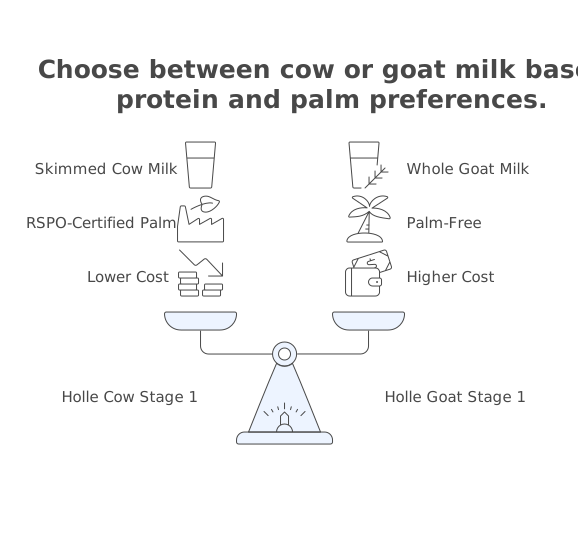
Visual generated with Napkin AI, editorial review by María López Botín. See methodology for our use policy.
Compositional differences that actually matter
Three dimensions where Holle Cow and Holle Goat diverge.
1. Protein species: skimmed cow vs whole goat
The defining difference. Holle Cow uses skimmed cow milk plus whey concentrate at a 60:40 whey:casein ratio (adjusted to match the breast-milk reference ratio). Holle Goat uses whole goat milk with the native goat-milk whey:casein ratio (closer to 20:80, the natural goat- milk biology).
Goat milk has different casein structure (less αs1-casein, more β-casein, smaller native fat globules) that some families find easier to digest in cow-milk-discomfort cases. Goat milk is not hypoallergenic; it cross-reacts with cow-milk proteins in the majority of CMPA cases. See CMPA explained.
For families where the infant tolerates cow-milk fine, Holle Cow is the cheaper option within the Holle family. For families experimenting with goat-milk for cow-milk-discomfort, Holle Goat is the Demeter goat option.
2. Fat blend: palm-inclusive vs palm-free
Holle Cow contains RSPO-certified palm oil alongside rapeseed and sunflower oils. Standard palm olein form, not sn-2 structured palm. Holle Goat is palm-free, using goat-milk fat plus rapeseed and sunflower only. Both exclude soy.
This is a meaningful gap. Among Holle-family Stage 1 formulas, only Holle Goat is palm-free. Holle Cow follows the standard EU-organic approach of using RSPO palm to mirror breast-milk fatty-acid composition. Families avoiding palm in any form pick Holle Goat (or look outside Holle to Loulouka Stage 1 or Kendamil Organic Stage 1). See palm oil explainer.
3. Cost: cow at lower price tier
Holle Cow ~$1.95/oz delivered, Holle Goat ~$2.41/oz, a ~$0.46/oz gap. At typical 100 oz/month consumption (slightly less for goat-milk families because of caloric density differences in some preparations), that's ~$46/month difference. The premium reflects goat-milk sourcing costs plus the palm-free fat-blend specification.
Both share identical Demeter certification, identical Holle manufacturing, and identical 5-10 day import shipping logistics. Cost is the principal economic differentiator within Holle Stage 1.
Regulatory framework
Both formulas comply with EU Regulation 2016/127 and Demeter biodynamic standards. Both operate under FDA enforcement discretion for personally-imported infant formula via Organic's Best Shop.
Holle is one of the principal Demeter-certified infant formula brands globally. Demeter requires whole-farm biodynamic conversion, stricter animal welfare than EU Organic baseline, and biodynamic-method use in soil management. See organic certifications compared for the tier framework.
Real-world parent experience
Following site methodology, the observations below come from my personal testing across both formulas plus a stable pool of parent-feedback notes from families. Read these as context, not prediction.
Smell and taste. Holle Cow has a clean, slightly creamier profile from the lactose-only carbohydrate plus palm-oil contribution. Holle Goat has the characteristic goat-milk profile (slightly stronger, mildly tangy) without palm to mellow it; some infants find the goat-milk tang more pronounced when switching from cow-milk Holle.
Mixability. Both dissolve cleanly at 70°C. Holle Cow with standard preparation; Holle Goat occasionally leaves trace residue from goat- milk fat character, resolves with extra swirling.
Stool consistency. Both families typically report soft to moderate stools. The minimalist composition (no GOS, no HMO, no probiotic) means neither delivers prebiotic-driven looser patterns. Holle Cow's palm-inclusive fat blend can produce slightly firmer stools in a subset of infants; Holle Goat's palm-free profile typically avoids this.
Switching between them. Use a 4-6 day gradual transition. The protein-species shift (cow to goat or reverse) plus fat-blend shift (palm-inclusive to palm-free or reverse) can produce 7-10 days of stool adjustment. Most infants tolerate the change. Many families experiment with switching from Holle Cow to Holle Goat (or reverse) to assess infant tolerance preferences while staying within the Holle family.
Verdict: when to pick each
Pick Holle Cow Stage 1 if:
- Cow-milk protein is fine for your baby
- Demeter biodynamic certification matters
- RSPO-certified palm is acceptable
- Lower per-ounce price is decisive
- Minimalist composition (no GOS, no HMO) fits your philosophy
Pick Holle Goat Stage 1 if:
- Goat-milk protein is the priority (cow-milk-discomfort experimentation without diagnosed CMPA)
- Avoiding palm in any form is decisive
- The Demeter biodynamic + palm-free + lactose-only combination is what you're after
- Higher per-ounce price is acceptable
Pick neither if:
- Whole-milk-fat preservation matters (look at Kendamil Classic or Kendamil Organic)
- Probiotic strain inclusion matters (look at HiPP Dutch Stage 1)
- Diagnosed CMPA (neither is hypoallergenic; look at HiPP HA Stage 1)
What you can't infer from this comparison
Both formulas share Holle's minimalist philosophy, manufacturing standards, and Demeter certification. The differences between them are protein species and palm inclusion, not quality-tier differences. Neither is hypoallergenic. Neither is reflux-specific or indicated for any clinical condition. For families weighting maximum bioactive stack within EU Organic Stage 1, look at HiPP Dutch (probiotic + Metafolin) or Kendamil Organic (HMO + GOS + whole-milk-fat).
Frequently asked questions
Why is Holle Goat palm-free but Holle Cow has palm oil?
Is Holle Cow or Holle Goat cheaper?
Can I switch from Holle Cow to Holle Goat or vice versa?
Are Holle Cow and Holle Goat both Demeter biodynamic?
Is Holle Goat better than Holle Cow for sensitive babies?
Does Holle Cow have GOS or HMO?
Is goat-milk formula safer than cow-milk for healthy infants?
Related reading
- Holle brand hub
- Holle Cow Stage 1, full SKU record
- Holle Goat Stage 1, full SKU record
- Holle Cow Stage 1 vs Stage 2, the cow progression
- Holle Goat Stage 1 vs Stage 2, the goat progression
- Holle Goat vs Jovie Goat, the EU Organic goat head-to-head
- Holle Goat vs Kabrita
- HiPP Dutch vs Holle Cow, the EU Organic cow-milk head-to-head
- Buying European formula in the USA
- Organic certifications compared
- Goat milk protein explainer
- Palm oil explainer
- Holle Cow Stage 1 vs Earth's Best Dairy - Demeter Biodynamic EU Organic vs USDA Organic Budget
Primary sources
- Holle, official manufacturer information. holle.ch
- Demeter International: The biodynamic certification body. demeter.net
- EU Regulation 2016/127: Infant formula compositional requirements. eur-lex.europa.eu
- FDA enforcement discretion: Personally-imported infant formula framework. fda.gov
This site provides research and comparisons, not medical advice. Consult your pediatrician before changing your baby's formula.