
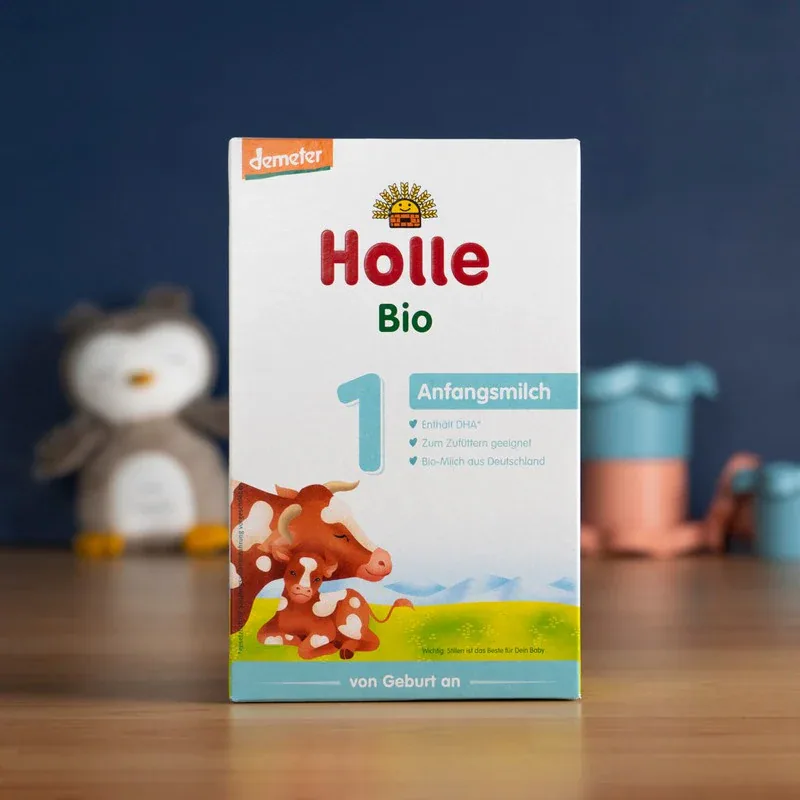
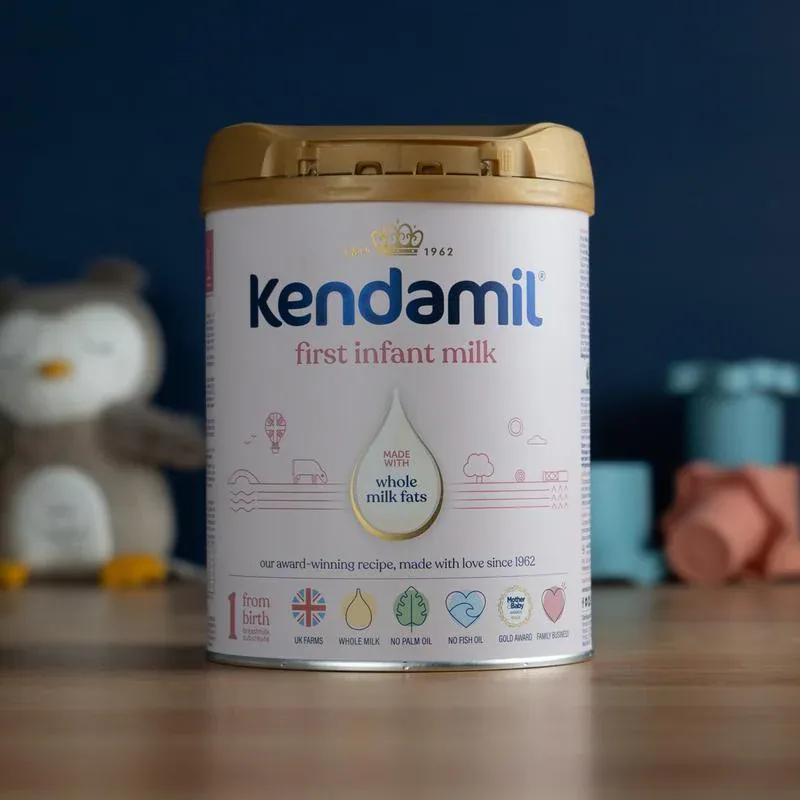
Holle Cow Stage 1 and Kendamil Classic Stage 1 are both popular choices for parents importing European infant formula, but they optimize along completely different axes. Holle is biodynamic organic (EU Organic and Demeter) with traditional minimal-additive composition. Kendamil Classic is not organic (UK Red Tractor farmer standard) with whole-milk fat, palm-free, and a GOS and FOS prebiotic blend. If organic certification is a must-have, the match is uneven: Holle clears the bar; Kendamil Classic does not. If palm-free whole-milk fat is the priority, Kendamil Classic wins, but Kendamil Organic (not Classic) is the palm-free and organic answer.
Holle Cow Stage 1 is EU Organic and Demeter biodynamic certified with traditional minimal-additive composition (no prebiotic, no probiotic), palm-inclusive, ~$1.95/oz via Organic's Best. Kendamil Classic Stage 1 is UK Red Tractor (not organic) with whole-milk fat (palm-free), GOS and FOS 9:1 prebiotic, higher DHA (~16.1 mg), at ~$1.63/oz. Not directly equivalent, organic is a hard gate between the two. For organic, palm-free, and whole-milk fat, Kendamil Organic is the actual match to Holle on the organic axis.
Why this comparison matters
Parents in US-import EU-formula communities often ask "Holle or Kendamil?" as if the two are directly equivalent. They aren't. Holle Cow Stage 1 carries Demeter biodynamic certification above EU Organic baseline. Kendamil Classic carries UK Red Tractor, a farmer-welfare and traceability standard, not an organic certification. This framing matters because many parents who "want Kendamil because it's whole- milk fat" would also answer "organic is a must" on a separate question. For those families, Kendamil Organic (not Classic) is the right comparison against Holle, the comparison we cover in Kendamil Organic vs Holle Cow.
At a glance
| Dimension | Holle Cow Stage 1 | Kendamil Classic Stage 1 |
|---|---|---|
| Manufacturer | Holle AG (Switzerland/Germany) | Kendal Nutricare (UK) |
| Age range | 0-6 months | 0-6 months |
| Regulation | EU 2016/127 and 2018/848 organic | EU 2016/127 (not organic-certified) |
| Organic certification | EU Organic and Demeter biodynamic | Not organic: UK Red Tractor farmer standard |
| Protein | Skimmed cow milk and whey | Whole cow milk and whey |
| Whey:casein | 60:40 | 60:40 |
| Primary carbohydrate | Lactose (only added) | Lactose (only added) |
| Prebiotic | None | GOS and FOS (9:1 ratio) |
| Probiotic | None | None |
| Folate form | Folic acid | Folic acid |
| DHA source | Fish oil, ~15 mg/100 ml | Fish oil, ~16.1 mg/100 ml |
| Fat blend | Palm, rapeseed, coconut, sunflower | Whole-milk fat, sunflower, coconut, and rapeseed (NO palm) |
| Fat-blend notes | Palm oil | None |
| Tin size | 400 g (cardboard box and foil pouch) | 800 g (metal tin) |
| Typical price | ||
| US availability | Organic's Best, 5-10 day shipping | Organic's Best and select US retail |
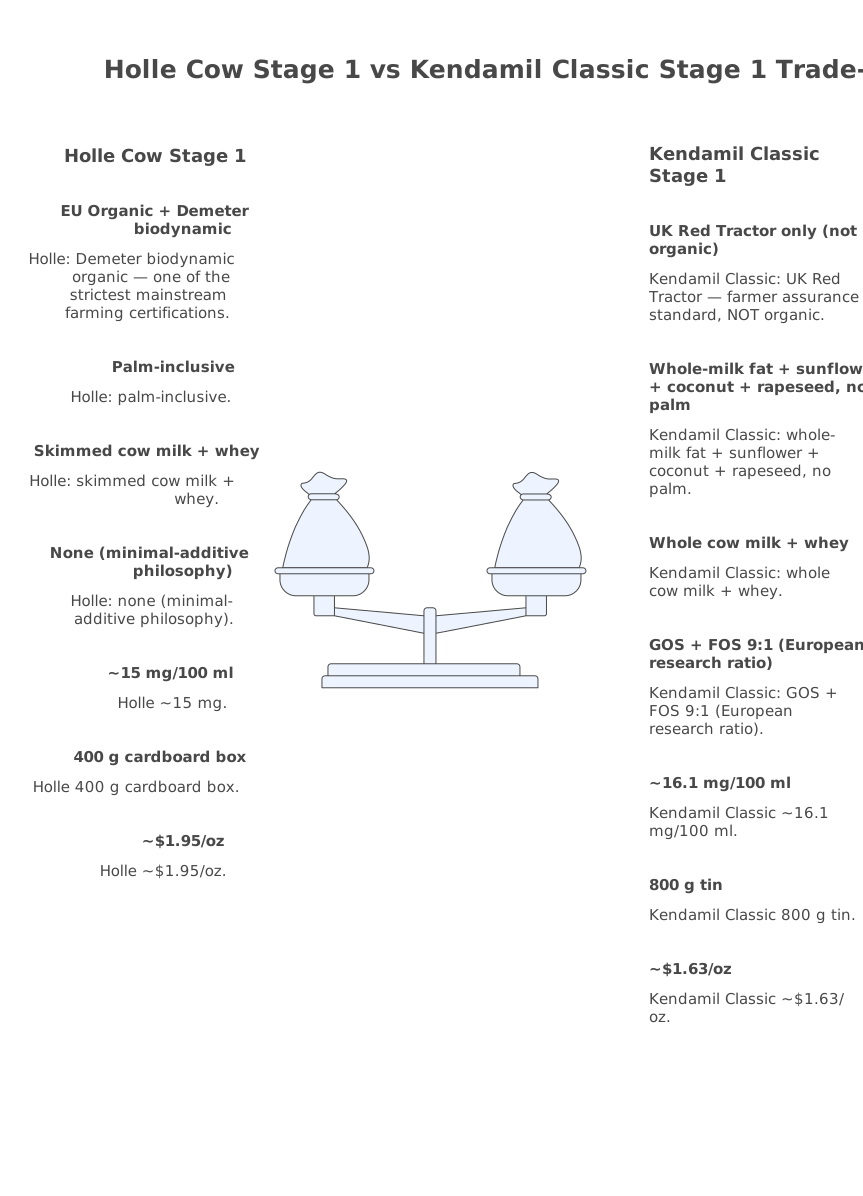
Visual generated with Napkin AI, editorial review by María López Botín. See methodology for our use policy.
Compositional differences that actually matter
1. Organic certification: Holle wins this cleanly
Holle Cow Stage 1 carries EU Organic (Regulation 2018/848) and Demeter biodynamic. Demeter is the stricter private biodynamic standard that sits above EU Organic, closed-loop farming, biodynamic preparations, cosmological planting calendars, higher animal welfare minimums. Holle is one of the few widely-available infant formulas with Demeter certification.
Kendamil Classic Stage 1 carries UK Red Tractor only, a farmer welfare and traceability assurance scheme that's legitimate in its own right (UK-origin, antibiotic restrictions, animal welfare minimums) but not an organic certification. Red Tractor permits conventional farming practices (conventional feed, conventional veterinary medicine, conventional fertilizers) that EU Organic would not.
For the "organic" question, Holle wins unambiguously. For "palm-free whole-milk fat with organic certification," Kendamil Organic (not Classic) is the correct comparison. See organic certifications compared.
2. Fat blend: palm-inclusive vs whole-milk fat palm-free
Holle Cow uses a palm-inclusive vegetable oil blend (organic palm, rapeseed, coconut, sunflower), the standard Holle-family approach.
Kendamil Classic uses whole-milk fat as the primary fat source and sunflower, coconut, and rapeseed oils. No palm oil. The whole-milk fat provides native sn-2 palmitic acid (matching breast-milk fatty acid structure) without requiring OPO/sn-2 palmitate processing.
For palm-avoidance, Kendamil Classic wins. See the palm oil explainer.
3. Prebiotic strategy: Holle adds none, Kendamil adds GOS and FOS 9:1
Holle's philosophy is traditional minimal-additive composition — Demeter-certified organic milk and mandatory EU vitamin/mineral stack, nothing else added. No prebiotic, no probiotic, no HMO, no MFGM, no lactoferrin.
Kendamil Classic adds GOS and FOS (9:1 ratio), the well-studied European research ratio used across Aptamil and some Nutrilon lines. Two prebiotic fiber classes, no probiotic strain.
For parents weighting "prebiotic fiber addition" as a positive, Kendamil Classic wins. For parents weighting "nothing added beyond what's mandatory," Holle wins. See GOS and FOS explainers.
4. DHA level
Kendamil Classic ~16.1 mg DHA / 100 ml; Holle Cow ~15 mg. Both from fish oil. Both above EU minimum. Kendamil ~7% higher, within normal breast-milk DHA variation.
5. Protein base: skimmed, whey vs whole cow milk, and whey
Kendamil Classic uses whole cow milk as protein base, preserving native milk-fat globules. Holle Cow uses the conventional skimmed-cow- milk approach with added fat separately.
6. Price per ounce: Kendamil Classic cheaper
Kendamil Classic ~$1.63/oz; Holle Cow ~$1.95/oz. ~17% difference. Two factors drive this: Kendamil Classic is non-organic (no EU Organic premium), and Kendamil's 800 g tin format is more packaging-efficient per gram than Holle's 400 g cardboard box.
7. Format and storage
Kendamil Classic: 800 g metal tin with plastic scoop, longer opened- tin shelf life, fewer repurchases.
Holle Cow: 400 g cardboard box with inner foil pouch, smaller format, more frequent repurchases, slightly shorter opened-pouch shelf life.
Regulatory framework
Both comply with EU Regulation 2016/127 (infant formula composition). Holle adds EU Regulation 2018/848 (organic) and Demeter International. Kendamil Classic carries UK Red Tractor (farmer assurance, not organic).
Neither is FDA-registered. Kendamil has some US retail distribution under FDA enforcement discretion. Holle is import-only via Organic's Best and similar resellers. See the buying European formula pillar.
Real-world parent experience
Following site methodology, the observations below come from my personal use across both kids plus a stable pool of parent-feedback notes from families on both formulas. They carry the parent-experience label rather than being claimed as regulatory or clinical facts, because individual infant variation on stool consistency, smell preference, and mixability is large enough that any specific point can reverse for a specific baby. Read these as context, not prediction.
Smell and taste. Kendamil Classic has a pronouncedly creamy, rich profile, whole-milk fat contributes noticeably. Holle has a traditional Swiss/German dairy character, cleaner, drier, more cereal-like notes. Both are "European" in profile vs US mainstream formulas.
Mixability. Kendamil can foam when shaken vigorously, gentle stirring avoids this. Holle's foil-pouch format can clump slightly at colder-than-optimal temperatures; 70°C water and prompt stirring resolves this.
Stool consistency. Kendamil Classic families commonly report moderate-to-soft stools (palm-free, whole-milk-fat contribution). Holle families report typical palm-inclusive patterns, moderate firmness. Neither is concerning.
Switching between them. Use a 4-6 day gradual transition. The palm ↔ palm-free switch is the main observable change (7-10 days of stool adjustment). GOS and FOS prebiotic add/remove also contributes.
Verdict: when to pick each
Pick Holle Cow Stage 1 if:
- Demeter biodynamic certification is a target (above EU Organic baseline)
- Traditional minimal-additive composition resonates (no prebiotic, no probiotic, nothing beyond Demeter-certified milk and mandatory vitamins/minerals)
- Swiss/German biodynamic dairy heritage (since 1933) matters
- Higher DHA level (~15 mg/100 ml) vs HiPP is a secondary benefit
Pick Kendamil Classic Stage 1 if:
- Palm-free fat blend is a must-have
- Whole-milk fat appeals (native sn-2 palmitate, creamier profile)
- GOS and FOS 9:1 prebiotic matters
- Higher DHA level (~16.1 mg/100 ml) is a target
- Lower per-ounce price matters
- You accept non-organic status (UK Red Tractor, not organic)
Pick Kendamil Organic Stage 1 if:
- You want both EU Organic certification and palm-free whole- milk fat: Kendamil Organic is the unique SKU combining both. The correct "organic match to Holle Cow with whole-milk fat" is Kendamil Organic, not Kendamil Classic.
What you can't infer from this comparison
Neither is indicated for diagnosed cow milk protein allergy, see the CMPA pillar. Neither is reflux-specific. "Demeter biodynamic" is a farming standard claim, not a direct nutritional-superiority claim. "Whole-milk fat" is a composition fact, not a clinical-outcome guarantee.
Frequently asked questions
Is Kendamil Classic organic?
Is Holle Cow Stage 1 palm-free?
What is Demeter certification?
Does Holle have a prebiotic or probiotic?
Which is cheaper: Holle Cow or Kendamil Classic?
Can I switch from Holle Cow to Kendamil Classic?
Is Kendamil Classic available at US retail?
Related reading
- Holle brand hub
- Kendamil brand hub
- Holle Cow Stage 1 vs Kendamil Organic Stage 1, the organic-vs-organic comparison (coming soon)
- HiPP Dutch Stage 1 vs Holle Cow Stage 1: Combiotik vs Demeter
- HiPP Dutch Stage 1 vs Kendamil Classic Stage 1
- Kendamil Classic vs Kendamil Organic, intra-brand (coming soon)
- Organic certifications compared
- Palm oil explainer
Primary sources
- Holle AG, manufacturer product information. holle.ch
- Kendamil / Kendal Nutricare, manufacturer product information. kendamil.com
- Demeter International, biodynamic certification registry. demeter.net
- UK Red Tractor, farmer assurance standard. redtractor.org.uk
- EU Regulation 2016/127, infant formula compositional requirements including lactose-predominance (Article 5.1). eur-lex.europa.eu
- EU Regulation 2018/848. EU organic production standards. eur-lex.europa.eu
- EFSA Scientific Opinion on compositional requirements for infant formula, regulatory context for EU fortification ranges. efsa.europa.eu
This site provides research and comparisons, not medical advice. Consult your pediatrician before changing your baby's formula.